EU Blue Card
Requirements
24/06/2026

EU Blue Card: Requirements, Salary Thresholds and How to Apply in 2026

eu blue card explanation

The EU Blue Card is a residence and work permit for highly qualified non-EU nationals who have a skilled job offer in Europe. It is available in 25 EU countries (every member state except Denmark and Ireland), and it bundles together the things skilled workers actually want: the right to live and work, fast family reunification, the option to move to another EU country later, and a shorter road to permanent residence.

It is also one of the few EU acronyms that does roughly what it says on the tin. The catch is in the detail. There is no single European office that issues it, the salary you need depends on which country your employer is in, and a job offer is not optional.

This guide covers what the EU Blue Card is, who qualifies, the 2026 salary thresholds country by country, the benefits, how family reunification works, how long the card lasts, how to apply, and what it costs. It also covers: when the Blue Card is the right route for you, and when a different visa fits better.

What is the EU Blue Card?

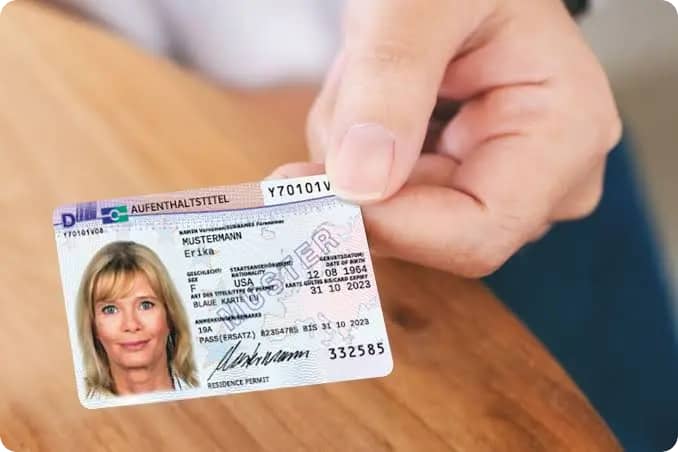
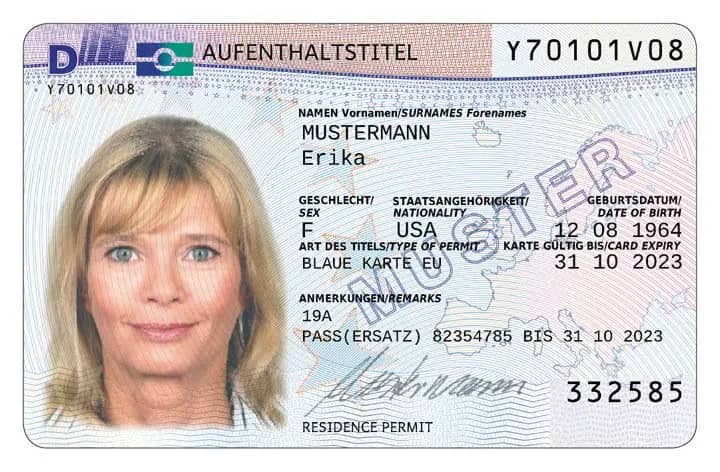
The EU Blue Card is a residence permit, marked "EU Blue Card", that lets a highly qualified non-EU worker live and work in the country that issued it. It is built for paid employment in a skilled role, and the holder is protected as an employee under that country's labour law.

The whole system runs on one piece of EU law: the Blue Card Directive, formally Directive (EU) 2021/1883. The revised Directive replaced the older 2009 version, and EU countries had until 18-11-2023 to write it into their national law. So while the rules are harmonised at EU level, the European Blue Card is applied for, and issued, by the national immigration authority of the country where you will work.

The term itself was coined to echo the US Green Card: the colour blue comes from the EU flag. The comparison is useful for the headline idea (a skilled-worker route into a bloc) and misleading for the mechanics. The Green Card is permanent and federal. The Blue Card is temporary, renewable, and issued by one country under shared rules.

It helps to be clear about what the EU Blue Card is not:

  • It is not a "work anywhere in Europe" card. It is tied to a job and a country, and moving to a second EU country needs a fresh application there.
  • It is not a job-search visa. You need the offer first.
  • It is not a freelancer or founder route. It is an employee permit. Some countries allow limited self-employment on the side, but the card itself rests on an employment contract.
  • It is not for passive income. Pensions, savings, dividends and rental income belong to other visa categories.

Why the EU Blue Card exists

The EU built the Blue Card to compete for talent. Key sectors across Europe face skill shortages that are expected to widen, and the bloc wants a clear, predictable route for the engineers, doctors, IT specialists and scientists it is short of.

The 2021 reform made the route noticeably more usable. It lowered the salary floor to a band of 1.0 to 1.6 times the national average gross salary, cut the minimum contract length, recognised professional experience instead of a degree in some sectors, widened intra-EU mobility, and fast-tracked family reunification. Each of those changes shows up in the sections below.

EU Blue Card Blog Image

Who is eligible for the EU Blue Card?

Eligibility comes down to four requirements: you are a non-EU national, you have a qualifying job offer, you meet the salary threshold, and you can prove your qualifications. Miss any one and the route usually does not work.

You must be a non-EU national

The Blue Card is for third-country nationals, meaning people who are not EU citizens.

Nationals of the EU, the EEA and Switzerland already have free movement, so they do not need one.

You need a qualifying job offer

You need a valid work contract or a binding job offer for highly qualified employment, lasting at least six months under the Directive. This is the single most important condition, and the one that rules out most people who like the idea of the card but do not have an EU employer lined up.

One nuance worth flagging: the Directive sets the minimum contract at six months, but some countries still reference twelve months in their own guidance. Portugal and the Netherlands, for example, list one year on the EU Immigration Portal. Check the rule for your destination before you assume six months is enough.

You need a university degree or equivalent professional qualifications

You prove you are highly qualified in one of two ways: a higher education qualification, or, where the country allows it, equivalent professional experience.

university degree here means a post-secondary qualification lasting at least three years. For some roles, professional experience does the same job. The clearest case is IT: the Directive specifically recognises at least three years of relevant experience gained in the last seven years for ICT managers and ICT professionals, with no formal degree required. Germany has built this into national law, which is a genuine win for the self-taught developer who never finished a degree but has shipped production code for a decade.

For regulated professions, doctors, nurses, pharmacists, teachers, architects and the like, the professional qualificationsmust be formally recognised in the destination country. The Blue Card does not override a licence. If your profession is regulated, sort the recognition first, or the card stalls behind it.

Who is usually not eligible

The Blue Card is a precise tool, and it is worth naming who it does not fit, because the disappointment is common:

  • Remote workers on a foreign payroll. A US or UK job paid from abroad does not meet the local employment requirement unless there is a compliant local contract or employer-of-record structure.
  • Freelancers and self-employed founders. The card needs an employment contract.
  • Passive-income applicants. Retirees and people living on savings or investments need a national passive-income route instead.
  • Anyone below the salary threshold. Strong qualifications do not rescue a salary that falls short of the national minimum.

If you are in one of those groups, skip ahead to EU Blue Card vs national permits vs digital nomad visas. There is almost certainly a route that fits you better.

What are the salary requirements for the EU Blue Card?

Your gross annual salary must meet the national salary threshold, and the Directive caps where that threshold can sit: between 1.0 and 1.6 times the average gross annual salary in that country. Each country picks its own figure inside that band and updates it, usually once a year.

So the same job can require very different pay depending on the country. Here is where the 2026 thresholds stand in the markets that matter most, including the three AnchorLess works in (Portugal, Spain and Italy):

Country 2026 Blue Card salary minimum How it is set Reduced threshold
Germany €50,700 gross/year ~50% of the pension contribution ceiling, set under §18g of the Residence Act €45,934.20 for shortage occupations, recent graduates and qualifying IT specialists
France €59,373 gross/year 1.5× the reference salary (€39,582), "Talent – Carte Bleue Européenne" ~€47,498 for some STEM shortage roles
Netherlands €5,942 gross/month (excl. 8% holiday allowance) indexed annually by the IND, mirrors the highly skilled migrant rate €4,754/month for graduates within 3 years of their degree
Spain €41,356.36 gross/year 1.4× the INE average gross salary (€29,540.26), Order PJC/44/2026 €33,085.09 (0.8×) for shortage roles and recent graduates
Italy roughly €33,500 to €35,500 gross/year not below the relevant national collective agreement (CCNL) or the ISTAT average governed by the CCNL where higher
Portugal about €21,030 gross/year (€1,750/month) 1.5× the national average gross salary, Law 53/2023 1.2× the average for shortage occupations (groups 1 and 2)

A few things that trip people up, everywhere:

  • Base salary is what counts. Guaranteed, fixed, gross base pay has to clear the threshold on its own. Discretionary bonuses, stock options and sign-on payments usually do not count. An offer of €48,000 base plus a "likely" €5,000 bonus is assessed at €48,000.
  • The number moves. Spain is a live example. Its 2026 threshold was €39,269.92 for most of the year, then rose to €41,356.36 on 28-05-2026 when the statistics office published a new average. A salary that qualified in April might not in July.
  • Reduced thresholds exist. Most countries cut the floor for shortage occupations and for recent graduates (usually a degree obtained within the last three years), which is how junior and hard-to-fill profiles still get in.

What are the benefits of the EU Blue Card?

The benefits are why the Blue Card is often the stronger choice for skilled workers even when a national permit is easier to get. They cover work, family, movement and the long game.

Equal treatment and social security

As a Blue Card holder you get equal treatment with nationals across a wide range: pay and working conditions, dismissal rules, health and safety, freedom of association, recognition of qualifications, education and training, social security, and access to public goods and services including housing. Some limits can apply, especially around grants, loans and housing procedures, but the baseline is parity with local workers in highly qualified employment.

Moving between EU countries

The card gives two kinds of movement. For short trips, you can travel to another participating EU country for business activities (meetings, conferences, training, exploring opportunities) for up to 90 days in any 180-day period, with no extra work authorisation for those activities.

For an actual move, after 12 months of legal residence as a Blue Card holder in your first country, you can relocate to another participating country for highly qualified employment. You apply for a new Blue Card there and meet that country's conditions. For later moves, the minimum residence period can drop to six months. This is the single biggest advantage a national permit cannot match.

A path to permanent residency

The Blue Card helps you reach permanent residency and EU long-term resident status faster, because time spent as a holder in different member states can be added together instead of needing five unbroken years in one country. To claim EU long-term resident status after using mobility, you generally need the required total period plus at least two years of legal, continuous residence as a Blue Card holder in the country where you apply. Some countries layer their own national settlement on top: Germany allows settlement in as little as 21 months with B1 German, or 27 months otherwise.

What happens if you lose your job

The card does not vanish the day a contract ends. If you become unemployed and have held the Blue Card for less than two years, you have three months to find a new qualifying job. If you have held it for more than two years, you have six. Some countries are more generous still.

How does family reunification work with the EU Blue Card?

Family reunification is one of the Blue Card's strongest features, and it is deliberately more favourable than standard immigration routes. Your spouse or partner and your children can join you, and the usual waiting periods and minimum-residence conditions do not apply.

When you lodge the family applications at the same time as your own, the family permits should be issued at the same time as your Blue Card, so the family is not left living in limbo while one person settles. Family members can also work or be self-employed without a waiting period, subject to national rules. In Germany, a spouse gets full labour-market access and is exempt from the pre-arrival German language requirement that normally applies to family visas. In France, the family route is the "Talent – Famille" permit, with no classic family-reunification waiting period.

For a relocating family, this is often the deciding argument for the Blue Card over a standard work permit.

What is the validity of the EU Blue Card?

The EU Blue Card is issued for at least 24 months where the contract allows it. If the employment contract is shorter, the card is granted for the duration of the contract plus three months. It is renewable as long as you still meet the salary, employment and qualification conditions.

The exact validity varies by country, and the renewals are where an extended permit comes from:

  • Germany and the Netherlands: the card runs for the contract length plus three months, up to a maximum of four years.
  • France: tied to the contract, up to four years.
  • Spain: three years initially, renewable for two.
  • Italy: two years for an open-ended contract, or the contract length plus three months for a fixed term.

Renewal is not automatic. Keep your contract, payslips and contribution records in order, because continuity on paper is usually what decides whether a renewal goes smoothly.

How to apply for an EU Blue Card

To apply for a residence permit under the Blue Card, you (or your employer) submit the file to the national immigration authority of the country where the job is. There is no central EU procedure. The application process runs roughly the same way everywhere, with national variations in who files and through which portal.

Who files, and where

The Directive lets each country decide whether the worker, the employer, or either one lodges the application. In several countries the employer leads it. You can usually apply from outside the country, and in some cases from inside if you are already legally resident.

The portals differ. France runs through the ANEF system, Spain through the UGE-CE (the large-companies and strategic-collectives unit), the Netherlands through the IND, and Germany through the consulate or the local immigration office. Portugal's is handled by AIMA, the agency that replaced SEF in 2023.

Step by step

  1. Secure a qualifying job offer that meets the salary threshold and matches your qualifications.
  2. Gather and prepare documents, including translations and apostilles for anything issued outside the EU. This is the slow part.
  3. Submit the application form, you or your employer, through the relevant national portal or consulate.
  4. Book an appointment to give biometrics and, where required, collect a long-stay visa to enter.
  5. Receive the decision, then collect the card and register locally.

How long it takes

The standard maximum decision period under the Directive is 90 days after a complete application.

For recognised-employer or simplified channels it can drop to 30 days, and the same 30-day window applies if you already hold a Blue Card in another EU country. If documents are missing, the clock pauses while you complete the file, which is the most common cause of delay.

What you usually need

Exact lists vary, but a standard file includes a valid passport, the work contract or binding offer, salary evidence, proof of your degree or recognised experience, licence or recognition for regulated professions, health insurance, proof of address, a criminal-record certificate, and employer documents.

Anything issued outside the EU normally needs a sworn translation and legalisation.

What is the application fee for the EU Blue Card?

The application fee is set nationally, and it is usually modest. The real cost of a Blue Card is rarely the government fee. It is the translations, apostilles, recognition of qualifications, and the price of getting it wrong.

A few concrete figures, so you can submit a realistic budget:

  • Spain: €73.26 for the initial card, €78.67 to renew, plus about €16 for the physical TIE card.
  • France: roughly €269 for the residence permit, plus a €99 long-stay visa fee and stamp duty.
  • Italy: around €600 all in, covering the work authorisation, stamp duty and visa.
  • Germany and the Netherlands: published by the national authority, and in the same modest range.

Where the budget actually grows is sworn translations and legalisation, which can run into the hundreds depending on how many documents you have. And the most expensive line item of all is a refused application: a salary stated wrong, a missing translation, or a qualification that was never formally recognised. This is the point where many applicants decide a small spend on legal or specialist support is cheaper than a second attempt and a lost start date.

EU Blue Card vs national permits vs digital nomad visas

Most EU countries run their own national permits for skilled workers alongside the Blue Card, and the Directive explicitly allows this. The national route is sometimes faster or fits a lower salary. What it does not give you is the Blue Card's EU mobility and its more generous family and long-term-residence rules.

Here is the honest decision, by who you are:

If you are... The route that usually fits Why
A skilled employee with an EU job offer, who may move countries later EU Blue Card Mobility, fast family reunification, stronger long-term residence path
A skilled employee staying in one country, or just under the threshold National highly qualified permit (e.g. Spain's HQP, Germany's national route) Often faster or simpler, sometimes a lower salary floor
A remote worker paid by a foreign employer Digital nomad visa (Portugal D8, Spain DNV, Italy DNV) The Blue Card needs a local employer; the nomad visa is built for foreign income
A founder or freelancer Self-employment / entrepreneur visa(Portugal D2, Spain autónomo, Italy lavoro autonomo) The Blue Card is an employee route
Retired or living on passive income Passive-income visa (Portugal D7, Spain NLV, Italy elective residence) No employment required, income-based

If you have an EU job offer and meet the pay, the Blue Card is usually the better long-term choice. If you do not have an EU employer, and most people moving to Portugal, Spain or Italy do not, one of the other routes is almost certainly yours.

Where the Blue Card actually gets used

This is the part the official pages leave out, and it changes how you should read everything above.

In 2024, EU countries issued 78,096 EU Blue Cards. Germany issued 56,252 of them, which is 72% of the entire bloc. The next four countries (Poland, Hungary, France and Spain) together issued fewer than 14,000. Indian citizens received the most cards by far (about 16,300), ahead of Russia, Türkiye and China. US citizens received around 1,900, UK nationals about 1,200, and Canadians under 600.

Two facts deserve a closer look. First, the 2024 total was actually 12.3% lower than 2023's record of 89,055, a dip the EU links to the disruption of countries switching over to the revised Directive. Second, and this is not a typo: Portugal issued 16 EU Blue Cards in all of 2024. Italy issued around 600.

So in two of AnchorLess's three markets, the Blue Card is a rounding error. Not because Portugal and Italy are hard to move to, they are among the most popular destinations in Europe, but because the people moving there are using different doors. They arrive on the D7 (passive income), the D8 (remote work), the D3 or highly qualified routes, and Italy's elective residence and self-employment visas. The Blue Card is overwhelmingly a Germany story, for employees of German tech and engineering firms.

The practical takeaway: if a German or Dutch employer is hiring you into a skilled role, the Blue Card is likely your route, and AnchorLess can still help with the surrounding bureaucracy (tax number, banking, fiscal representation) once you land in Portugal, Spain or Italy. If you are moving to Portugal, Spain or Italy without a local employer, which describes most readers, the Blue Card is not your route, and the visa that fits you is.

Who the EU Blue Card is for, by situation

If you are a US citizen

A US passport does not change the core rule: the Blue Card needs a local EU employer, so a US remote job paid from the States does not qualify on its own. The bigger thing to plan for is tax.

The US taxes its citizens on worldwide income wherever they live, so a Blue Card holder from the US keeps filing with the IRS and needs to think about double-taxation treaties and the foreign earned income exclusion before signing anything.

US citizens received only about 1,900 Blue Cards in 2024, which fits the pattern: most Americans moving to Europe are not arriving on an employer route.

If you are a UK national

Since Brexit, UK nationals are third-country nationals, which means they are eligible for the Blue Card on the same terms as any non-EU applicant.

For a skilled professional with an EU job offer, it is one of the cleaner routes back into EU residence and the mobility that came with it before 2020.

If you are an IT specialist without a degree

This is the standout exception to the degree rule. Under the Directive, ICT managers and professionals can qualify on at least three years of relevant experience gained in the last seven, with no university degree.

Germany applies this directly, which is why a self-taught senior developer can get a Blue Card there on experience alone, provided the salary clears the threshold.

If you are moving with family

The family rules are the reason many people choose the Blue Card over a national permit. Spouses and children join without the usual waiting periods, the family decision lands with yours, and partners can work straight away. If you are relocating a household, weigh this heavily.

Common mistakes

  • Treating the salary as a target instead of a floor. Base pay has to clear the threshold on its own, before bonuses. Build in a margin.
  • Assuming you qualify in country B because you qualified in country A. Each country sets its own threshold and documents. Germany's approval does not carry to France.
  • Forgetting regulated-profession recognition. Doctors, nurses, teachers and architects often need their qualification recognised before the card can be approved. Start that early.
  • Missing the freshness on the numbers. Thresholds change, sometimes mid-year (Spain moved on 28-05-2026). Use the figure valid on your filing date.
  • Picking the Blue Card when a national or nomad visa fits better. If you have no EU employer, the Blue Card is the wrong door. Choose the route built for your situation.
Key Takeaways

The EU Blue Card is the EU's strongest route for a highly qualified employee with a real job offer, the right salary, and a reason to want EU mobility and easy family reunification. It is harmonised by Directive (EU) 2021/1883, issued by one country, and capped by national salary thresholds that in 2026 run from about €21,030 a year in Portugal to €59,373 in France.

The most useful question is not "do I qualify for the EU Blue Card in Europe?" It is "do I qualify in the specific country where my employer is hiring me, and is the Blue Card even the right door for my situation?" If you have an EU job offer, it usually is, and the next step is confirming the threshold and documents for that country. If you are moving to Portugal, Spain or Italy without a local employer, your route is the national local visas, and that is the conversation to start instead.

AnchorLess handles the bureaucratic side of moving to Portugal, Spain and Italy, the visa file, the tax number, the bank account, whichever route turns out to be yours. If you are not sure which one that is, that is exactly the question to bring us first.

Share this article

Share this article

Join a community of 10,000+ expats
Get the weekly tips, success stories, and step-by-step guides we share with our members to make their move a success.
Trustpilotの星
Trustpilotのスター
Trustpilotのスター
Trustpilotのスター
Trustpilotのスター
I love AnchorLess! They have been fantastic for my move to Portugal with the NIF, checking account, lawyer and tax consultation. I will be happy with when this process is over, but at least the journey has been smoother with them.
LD
Lisa D
From South Africa
Trustpilotの星
Trustpilotのスター
Trustpilotのスター
Trustpilotのスター
Trustpilotのスター
Guilherme was the best! I had so many questions and moving parts and he was responsive, always professional, and went above and beyond to help me with everything! He is a PRO!!!!
DS
Debra Savage
From The United States

Our readers also viewed

ヨーロッパのビザ リトアニア エストニア ラトビア
ヨーロッパ
ビザ
21/10/2025
バルト三国(エストニア、ラトビア、リトアニア)の在留資格を探索。活気あるバルト生活へのヨーロッパビザガイド。
Brenda
Brenda
Content Manager
シェンゲン圏ビザによる旅行特典
シェンゲン
ビザ
21/04/2026
シェンゲンビザとは何か、誰に必要か、申請方法、必要書類、滞在可能期間、そしてポルトガルまたはスペインの居住権取得がより適切なタイミングについてご確認ください。
Brenda
Brenda
Content Manager
Beach Portugal

Start your new life in Europe

Turn relocation stress into success with AnchorLess.

Relocating to Europe made simple.

Start to relocate now

Arrow icon
Talk to us for free
AnchorLess support team
4.9/5 Excellent
Star
Star
Star
Star
Star
AnchorLessのロゴ
{ "translated_text": "AnchorLessは銀行、会計士、税務アドバイザー、投資アドバイザー、法律事務所でもなく、また政府機関や公式の政府ウェブサイトでもありません。私たちは中介者として活動し、認定された専門家とのつながりを提供し、ヨーロッパでの移住に関する行政手続きを効率化するお手伝いをします。", "translated_html": "AnchorLess\u001b\u001b\u001b\u001b\u001b\u001b\u001b\u001b\u001b\u001b\u001b\u001b\u001b\u001b\u001b\u001b\u001b\u001b\u001b\u001b\u001b\u001b\u001b\u001b\u001b\u001b\u001b\u001b\u001b\u001b\u001b\u001b\u001b\u001b\u001b\u001b\u001b\u001b\u001b\u001b\u
Instagram アイコン
Reddit アイコン
LinkedIn アイコン
アメリカン・エキスプレスのロゴ
ビザのロゴ
Mastercardのロゴ
およびさらに多く
4回まで無料で支払いが可能です
Klarna ロゴ

🇪🇸 スペインへ移住

矢印
イタリアへ移住
矢印
サービス

リソース

利用規約

プライバシーポリシー

免責事項

© 2022 - 2026 anchorless.io, All rights reserved.