Transfer Money
Europe Online

How to Transfer Money to Europe Online

transfer money Europe

Moving to Portugal or Spain often means learning how to manage money across borders. You may need to receive a salary or pension from the US, UK, Canada, Brazil, or another country. You may need to send money to family abroad. You may also need to move savings into a Portuguese or Spanish bank account for rent, residency, taxes, or buying property.

That is where online money transfer services become useful.

Today, immigrants have more options than traditional bank wires. You can use banks, fintech accounts, specialist currency providers, remittance companies, debit cards, credit cards, mobile wallets, or cash pickup networks. The challenge is not finding a way to transfer money. The challenge is choosing the safest, clearest, and most cost-effective way to do it.

This guide explains how to transfer money to Europe, how to send money online, how to compare transfer fees, how to check exchange rates, and how to avoid expensive mistakes when sending money internationally.

How to transfer money to Europe

To transfer money to Europe, you need three things: a sending account, a receiving method, and a provider that supports the currency route you need.

For immigrants in Portugal or Spain, the final destination is usually a euro account. That could be your Portuguese bank account, your Spanish bank account, a fintech account with a European IBAN, or another person’s account in Europe.

Start with the purpose of the transfer

The best way to send money depends on why you are sending it.

For salary, pension or freelance income

If you receive income from abroad, a fintech account can help you receive money in one currency and convert it to euros before sending it to your local bank account.

For example, someone earning in USD while living in Portugal may use a provider that gives local USD account details. The money can arrive as a local US payment, then be converted to euros and moved to a Portuguese account.

For rent, bills, and daily life

A local Portuguese or Spanish bank account is often useful for rent, utilities, direct debits, tax refunds, and administrative proof. Even if you use fintech apps, a local account can make life easier when dealing with landlords, public services, or traditional institutions.

For family support

If you need to send money to family members who do not use bank accounts, remittance providers with cash pickup or mobile wallet options may be more practical than a bank transfer.

For large transfers (more than 20K)

If you are moving savings, buying property, or transferring business funds, use a traceable provider and keep documents showing where the money came from. Larger transfers can trigger extra checks from banks or payment providers.

online money transfer Europe

Basic steps to send money to Europe

Step 1: Choose the destination

Decide whether the money should arrive in a bank account, mobile wallet, cash pickup location, or fintech balance.

Step 2: Compare the provider

Look at the transfer fee, exchange rate, delivery time, payment method, and final amount received.

Step 3: Confirm the recipient details

For Portugal or Spain, you will usually need the recipient’s full name and IBAN. For transfers outside Europe, you may need different bank details depending on the country.

Step 4: Complete identity checks

Most providers require identity verification, especially for larger international money transfers. You may need a passport, residence card, tax number, proof of address, or source-of-funds documents.

Step 5: Save the receipt

Keep the transfer confirmation, tracking number, exchange rate, fee breakdown, and provider receipt. These records can be useful for tax, banking, immigration, or property-related questions.

How to send money online

Sending money online is usually straightforward, but the details matter. The cheapest option is not always the one with the lowest visible fee.

Create your account

Open an account with a bank, fintech, money transfer app, or remittance provider. Use your legal name exactly as it appears on your ID. This helps avoid verification delays.

Add the recipient

Enter the recipient’s full name and payment details. If you are sending to your own account, make sure the account is in your name, especially for large transfers.

Choose the amount and currency

You can usually choose either the amount you want to send or the amount the recipient should receive.

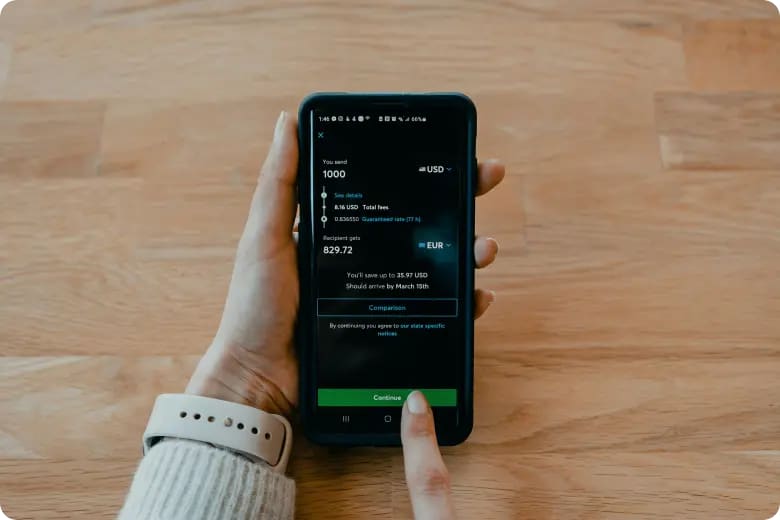
For example, you may choose to send 1,000 USD and let the provider calculate the euro amount. Or you may choose for the recipient to receive exactly 900 EUR.

Choose the payment method

The payment method can change the cost and speed of the transfer. Bank account transfers are often cheaper. Debit card payments may be faster. Credit cards can be convenient, but they often cost more.

Review the total before confirming

Before you send money online, check:

  • Transfer fee
  • Exchange rate
  • Final amount received
  • Estimated arrival time
  • Recipient details
  • Refund rules
  • Tracking options

The most important number is the final amount the recipient receives.

What are the best services to send money?

There is no single best international money transfer provider for every situation. The best service depends on the country, currency, amount, speed, and payout method.

Best ways to send money by situation

Situation Best type of provider Why it works
Receiving salary from abroad Fintech or multi-currency account Useful for holding and converting foreign income
Sending savings to Portugal or Spain Specialist currency provider or bank Better for larger, traceable transfers
Paying rent or bills locally Local Portuguese or Spanish bank Often accepted by landlords and utility companies
Sending money to family abroad Remittance provider Good for cash pickup, bank deposit, or wallet delivery
Sending euros inside Europe SEPA transfer Usually simple and low-cost
Buying property Local bank plus currency specialist Better documentation and source-of-funds trail

Fintech providers

Fintech accounts can be useful for immigrants who receive income in one currency and spend in euros. They often make currency conversion easier and may provide account details for different currencies.

Traditional banks

Banks are useful when you need a formal banking relationship, proof of funds, mortgage support, tax refund setup, or local direct debits. They can be more expensive for international transfers, especially if SWIFT or correspondent banks are involved.

Remittance providers

Remittance companies are useful when speed and access matter more than having a traditional bank account. They can be especially helpful when the recipient needs cash pickup or mobile wallet delivery.

Specialist currency providers

Specialist foreign exchange providers, like Currencies Direct, can be useful for larger transfers, such as home deposits, business payments, or moving savings. Exchange-rate differences matter more when the amount is high.

What are the fees for transferring money?

Transfer fees vary depending on the provider, country, currency, payment method, and delivery speed.

The visible fee is only part of the cost. The exchange rate can be just as important, and sometimes more important.

Types of money transfer fees

Transfer fee

This is the fee shown by the provider for sending the money. It may be fixed, percentage-based, or a mix of both.

Exchange-rate margin

This is the difference between the real market exchange rate and the rate offered by the provider. A provider can say “low fee” or “no fee” but still make money by giving you a weaker exchange rate.

Payment method fee

Paying by debit or credit card may cost more than paying by bank transfer. Credit cards can also trigger extra charges from the card issuer.

Receiving bank fee

Some international wire transfers involve intermediary banks. These banks may deduct money before the transfer arrives.

Speed fee

Faster delivery may cost more, depending on the provider and destination.

How to compare the real cost

Do not compare providers by looking only at the transfer fee.

Compare:

  • How much you send
  • How much the recipient receives
  • The exchange rate
  • The visible fee
  • The payment method fee
  • The delivery time
  • Any possible receiving bank deduction

The cleanest comparison is simple: check how many euros arrive after all fees and currency conversion.

What is the exchange rate for USD to EUR?

The USD to EUR exchange rate changes constantly. That means you should always check the live exchange rate before sending money from the United States to Europe.

How exchange rates work

If you are sending dollars to Portugal or Spain, your money will usually be converted from USD to EUR. The rate decides how many euros you get for each dollar.

For example, if the exchange rate is 1 USD = 0.85 EUR, then 1,000 USD would equal around 850 EUR before transfer fees or provider margins.

Why the provider rate may be different

The rate you see on a currency converter may not be the same rate offered by your bank or money transfer provider. Some providers add a margin to the exchange rate.

That margin is part of the cost of sending money internationally.

How to check the exchange rate before sending

Use a currency converter

Check the current USD to EUR rate before starting the transfer.

Compare provider rates

Look at the rate offered by your bank, fintech app, or money transfer provider.

Check the final euro amount

The final amount received is more important than the displayed rate alone.

Avoid rushing large transfers

For larger amounts, even a small difference in the exchange rate can cost hundreds or thousands of euros.

What payment methods can I use?

Most online money transfer providers offer several payment methods. The available options depend on the provider, country, currency, and transfer amount.

Bank account transfer

A bank account transfer is often one of the cheapest ways to send money online. It may take longer than card payments, especially for international routes outside Europe.

Debit card

A debit card can be faster than a bank transfer. It may also come with higher fees.

Credit card

Credit cards are convenient but can be expensive. Some card issuers may treat money transfers as cash advances, which can add extra costs.

Mobile wallet

Mobile wallets are available for some countries and providers. They are often useful for remittances, especially when the recipient does not want a traditional bank deposit.

Cash payment

Some providers allow you to start a transfer online and pay in cash at an agent location. This can be helpful for people who prefer not to fund a transfer from a bank account.

PayPal balance

Some services connected to PayPal allow international transfers funded from a PayPal balance, bank account, debit card, or credit card, depending on the destination.

How to avoid hidden fees when sending money

Hidden fees usually appear in three places: the exchange rate, the payment method, and the receiving bank.

Compare the final amount received

This is the easiest way to protect yourself. If you send 1,000 USD, compare how many euros each provider delivers after all fees.

Watch the exchange-rate margin

A provider may advertise a low transfer fee but offer a weaker exchange rate. That difference is a cost.

Be careful with credit cards

Credit card payments may come with provider fees and card issuer fees. For many people, a bank transfer or debit card is cheaper.

Avoid unnecessary wire transfers

Traditional wire transfers can be useful, but they may involve higher costs and intermediary bank fees.

Do not split transfers to avoid checks

If you are moving a large amount, keep it clean and documented. Splitting transfers to avoid verification can create more problems, not fewer.

Send from an account in your name

For rent deposits, property purchases, visa renewals, or proof-of-funds requests, it is better when the money comes from an account clearly linked to you.

What is the fastest way to send money?

The fastest way to transfer money depends on the route.

Inside Europe, euro transfers can be very fast when both banks or payment providers support instant SEPA transfers. For money coming from outside Europe, card-funded transfers or remittance providers may be faster, but they are not always the cheapest.

Fast options by situation

Euro account to euro account

A SEPA instant transfer can be one of the fastest options when available.

Card to cash pickup

Remittance providers can be fast when the recipient needs cash, but availability depends on the provider, destination country, agent hours, and compliance checks.

US to Portugal or Spain

An online money transfer provider may be faster and cheaper than a traditional bank wire, depending on the amount and payment method.

Large transfers

Large transfers are rarely the fastest option because the provider or bank may ask for proof of income, tax returns, bank statements, or source-of-funds documents.

Why a fast transfer can still be delayed

Transfers can be delayed by:

  • Wrong recipient details
  • Bank holidays
  • Weekend processing
  • Currency conversion checks
  • Security screening
  • Source-of-funds requests
  • Recipient bank review
  • Large transfer amounts

How to send money internationally

To send money internationally, choose the right transfer route. The most common options are SEPA, SWIFT, fintech transfers, remittance providers, and specialist currency services.

SEPA transfer

SEPA is useful for euro-to-euro transfers within Europe. Once your money is already in euros, this can be one of the simplest ways to send and receive money across participating European countries.

SWIFT or wire transfer

A wire transfer can send money across many countries and currencies. It can also be slower and more expensive because intermediary banks may be involved.

Online money transfer provider

Online providers are useful for currency conversion and international transfers. They can send money to bank accounts, cards, wallets, or cash pickup locations, depending on the provider.

Remittance provider

Remittance providers are useful when the recipient needs cash, does not have a bank account, or needs money quickly.

Specialist currency provider

Specialist providers can be useful for large transfers where the exchange rate has a major impact.

What is the best app for money transfer?

The best money transfer app depends on what you need to do.

Best for receiving international income

A multi-currency app can work well if you receive salary, freelance payments, or business income in another currency and need to convert it to euros. Here we work very well with Wise. It covers everything you need and support amounts up to 20K.

Best for sending money to someone with no bank account

A remittance app, like Western Union or Ria, may be better if your recipient needs cash pickup, bank deposit, or mobile wallet delivery.

Best for frequent transfers

If you send money regularly, choose an app with transparent fees, like Wise, good exchange rates, strong tracking, and reliable customer support.

Best for large transfers

For large amounts, an app may not be enough. You may need a provider that offers better exchange-rate support, formal documentation, and source-of-funds guidance. We always recommend **Currencies Direct.**

How to track a money transfer

Tracking a money transfer is important, especially when sending money internationally.

Use the provider’s app or website

Most providers let you track your transfer from your account dashboard.

Use the transfer number

Some providers give a tracking number, transaction ID, reference code, or control number. Keep this safe.

Check email and SMS updates

Many providers send status updates when the transfer is created, processed, delayed, paid out, or completed.

Contact support if the transfer is late

If the money does not arrive within the expected time, contact the provider with your receipt, tracking number, sender details, and recipient details.

Common transfer statuses

Pending

The provider has received the request but has not completed processing.

Processing

The money is moving through the payment network.

On hold

The provider may need more information.

Available for pickup

The recipient can collect the money.

Completed

The money has arrived or has been paid out.

online money transfer Europe

What immigrants in Portugal and Spain should know before moving larger amounts

Small transfers, up to 20K, are usually simple. Larger transfers need more care.

If you are moving savings, buying a home, sending a family gift, receiving a large sum foreign income, or transferring business funds, banks and providers may ask for proof of where the money came from.

Documents that may help

  • Payslips
  • Tax returns
  • Bank statements
  • Property sale contract
  • Inheritance documents
  • Business invoices
  • Investment sale records
  • Pension statements
  • Loan agreements

Portugal

If you are tax resident in Portugal, foreign accounts may need to be reported in your annual tax return. This can matter if you use foreign bank accounts, fintech accounts, or accounts with non-Portuguese IBANs.

For property purchases, keep the transfer traceable. If you are sending money for a deposit or final deed payment, the account name, transfer history, and source-of-funds documents should be clear.

Spain

If you are tax resident in Spain and hold foreign assets, reporting obligations may apply depending on the value and type of assets. Foreign bank accounts, investments, insurance products, and property abroad can fall into this category.

Spain also has rules around declarations for certain movements of payment means. For larger amounts, especially cash or equivalent instruments, check the rules before moving money.

Quick checklist before you transfer money online

Before sending money, check:

  • The provider supports the sending country
  • The provider supports the destination country
  • The currency route is available
  • The recipient details are correct
  • The transfer fee is clear
  • The exchange rate is acceptable
  • The final amount received is shown
  • The payment method does not add extra costs
  • The delivery time works for you
  • The transfer can be tracked
  • You have saved the receipt

For larger transfers, also check:

  • The money comes from an account in your name
  • You have proof of where the funds came from
  • The transfer does not create tax reporting issues
  • Your bank will accept the money
  • Your accountant, lawyer, or bank has confirmed the correct process if needed

The easiest way to transfer money to Europe is the one that gives you clarity before you send.

For immigrants in Portugal or Spain, a good setup often combines a local bank account with an online money transfer provider. The local bank helps with rent, taxes, residency, and official paperwork. The online provider helps with currency conversion, international payments, and faster transfers.

Before sending money, compare the full cost, not just the advertised fee. Look at the exchange rate, transfer fees, payment method, speed, and final amount received. Keep every transfer traceable, especially when moving larger amounts.

A good online money transfer should make life simpler, not create confusion later with banks, taxes, or immigration paperwork.

Moving to Portugal or Spain often means learning how to manage money across borders. You may need to receive a salary or pension from the US, UK, Canada, Brazil, or another country. You may need to send money to family abroad. You may also need to move savings into a Portuguese or Spanish bank account for rent, residency, taxes, or buying property.

That is where online money transfer services become useful.

Today, immigrants have more options than traditional bank wires. You can use banks, fintech accounts, specialist currency providers, remittance companies, debit cards, credit cards, mobile wallets, or cash pickup networks. The challenge is not finding a way to transfer money. The challenge is choosing the safest, clearest, and most cost-effective way to do it.

This guide explains how to transfer money to Europe, how to send money online, how to compare transfer fees, how to check exchange rates, and how to avoid expensive mistakes when sending money internationally.

How to transfer money to Europe

To transfer money to Europe, you need three things: a sending account, a receiving method, and a provider that supports the currency route you need.

For immigrants in Portugal or Spain, the final destination is usually a euro account. That could be your Portuguese bank account, your Spanish bank account, a fintech account with a European IBAN, or another person’s account in Europe.

Start with the purpose of the transfer

The best way to send money depends on why you are sending it.

For salary, pension or freelance income

If you receive income from abroad, a fintech account can help you receive money in one currency and convert it to euros before sending it to your local bank account.

For example, someone earning in USD while living in Portugal may use a provider that gives local USD account details. The money can arrive as a local US payment, then be converted to euros and moved to a Portuguese account.

For rent, bills, and daily life

A local Portuguese or Spanish bank account is often useful for rent, utilities, direct debits, tax refunds, and administrative proof. Even if you use fintech apps, a local account can make life easier when dealing with landlords, public services, or traditional institutions.

For family support

If you need to send money to family members who do not use bank accounts, remittance providers with cash pickup or mobile wallet options may be more practical than a bank transfer.

For large transfers (more than 20K)

If you are moving savings, buying property, or transferring business funds, use a traceable provider and keep documents showing where the money came from. Larger transfers can trigger extra checks from banks or payment providers.

online money transfer Europe

Basic steps to send money to Europe

Step 1: Choose the destination

Decide whether the money should arrive in a bank account, mobile wallet, cash pickup location, or fintech balance.

Step 2: Compare the provider

Look at the transfer fee, exchange rate, delivery time, payment method, and final amount received.

Step 3: Confirm the recipient details

For Portugal or Spain, you will usually need the recipient’s full name and IBAN. For transfers outside Europe, you may need different bank details depending on the country.

Step 4: Complete identity checks

Most providers require identity verification, especially for larger international money transfers. You may need a passport, residence card, tax number, proof of address, or source-of-funds documents.

Step 5: Save the receipt

Keep the transfer confirmation, tracking number, exchange rate, fee breakdown, and provider receipt. These records can be useful for tax, banking, immigration, or property-related questions.

How to send money online

Sending money online is usually straightforward, but the details matter. The cheapest option is not always the one with the lowest visible fee.

Create your account

Open an account with a bank, fintech, money transfer app, or remittance provider. Use your legal name exactly as it appears on your ID. This helps avoid verification delays.

Add the recipient

Enter the recipient’s full name and payment details. If you are sending to your own account, make sure the account is in your name, especially for large transfers.

Choose the amount and currency

You can usually choose either the amount you want to send or the amount the recipient should receive.

For example, you may choose to send 1,000 USD and let the provider calculate the euro amount. Or you may choose for the recipient to receive exactly 900 EUR.

Choose the payment method

The payment method can change the cost and speed of the transfer. Bank account transfers are often cheaper. Debit card payments may be faster. Credit cards can be convenient, but they often cost more.

Review the total before confirming

Before you send money online, check:

  • Transfer fee
  • Exchange rate
  • Final amount received
  • Estimated arrival time
  • Recipient details
  • Refund rules
  • Tracking options

The most important number is the final amount the recipient receives.

What are the best services to send money?

There is no single best international money transfer provider for every situation. The best service depends on the country, currency, amount, speed, and payout method.

Best ways to send money by situation

Situation Best type of provider Why it works
Receiving salary from abroad Fintech or multi-currency account Useful for holding and converting foreign income
Sending savings to Portugal or Spain Specialist currency provider or bank Better for larger, traceable transfers
Paying rent or bills locally Local Portuguese or Spanish bank Often accepted by landlords and utility companies
Sending money to family abroad Remittance provider Good for cash pickup, bank deposit, or wallet delivery
Sending euros inside Europe SEPA transfer Usually simple and low-cost
Buying property Local bank plus currency specialist Better documentation and source-of-funds trail

Fintech providers

Fintech accounts can be useful for immigrants who receive income in one currency and spend in euros. They often make currency conversion easier and may provide account details for different currencies.

Traditional banks

Banks are useful when you need a formal banking relationship, proof of funds, mortgage support, tax refund setup, or local direct debits. They can be more expensive for international transfers, especially if SWIFT or correspondent banks are involved.

Remittance providers

Remittance companies are useful when speed and access matter more than having a traditional bank account. They can be especially helpful when the recipient needs cash pickup or mobile wallet delivery.

Specialist currency providers

Specialist foreign exchange providers, like Currencies Direct, can be useful for larger transfers, such as home deposits, business payments, or moving savings. Exchange-rate differences matter more when the amount is high.

What are the fees for transferring money?

Transfer fees vary depending on the provider, country, currency, payment method, and delivery speed.

The visible fee is only part of the cost. The exchange rate can be just as important, and sometimes more important.

Types of money transfer fees

Transfer fee

This is the fee shown by the provider for sending the money. It may be fixed, percentage-based, or a mix of both.

Exchange-rate margin

This is the difference between the real market exchange rate and the rate offered by the provider. A provider can say “low fee” or “no fee” but still make money by giving you a weaker exchange rate.

Payment method fee

Paying by debit or credit card may cost more than paying by bank transfer. Credit cards can also trigger extra charges from the card issuer.

Receiving bank fee

Some international wire transfers involve intermediary banks. These banks may deduct money before the transfer arrives.

Speed fee

Faster delivery may cost more, depending on the provider and destination.

How to compare the real cost

Do not compare providers by looking only at the transfer fee.

Compare:

  • How much you send
  • How much the recipient receives
  • The exchange rate
  • The visible fee
  • The payment method fee
  • The delivery time
  • Any possible receiving bank deduction

The cleanest comparison is simple: check how many euros arrive after all fees and currency conversion.

What is the exchange rate for USD to EUR?

The USD to EUR exchange rate changes constantly. That means you should always check the live exchange rate before sending money from the United States to Europe.

How exchange rates work

If you are sending dollars to Portugal or Spain, your money will usually be converted from USD to EUR. The rate decides how many euros you get for each dollar.

For example, if the exchange rate is 1 USD = 0.85 EUR, then 1,000 USD would equal around 850 EUR before transfer fees or provider margins.

Why the provider rate may be different

The rate you see on a currency converter may not be the same rate offered by your bank or money transfer provider. Some providers add a margin to the exchange rate.

That margin is part of the cost of sending money internationally.

How to check the exchange rate before sending

Use a currency converter

Check the current USD to EUR rate before starting the transfer.

Compare provider rates

Look at the rate offered by your bank, fintech app, or money transfer provider.

Check the final euro amount

The final amount received is more important than the displayed rate alone.

Avoid rushing large transfers

For larger amounts, even a small difference in the exchange rate can cost hundreds or thousands of euros.

What payment methods can I use?

Most online money transfer providers offer several payment methods. The available options depend on the provider, country, currency, and transfer amount.

Bank account transfer

A bank account transfer is often one of the cheapest ways to send money online. It may take longer than card payments, especially for international routes outside Europe.

Debit card

A debit card can be faster than a bank transfer. It may also come with higher fees.

Credit card

Credit cards are convenient but can be expensive. Some card issuers may treat money transfers as cash advances, which can add extra costs.

Mobile wallet

Mobile wallets are available for some countries and providers. They are often useful for remittances, especially when the recipient does not want a traditional bank deposit.

Cash payment

Some providers allow you to start a transfer online and pay in cash at an agent location. This can be helpful for people who prefer not to fund a transfer from a bank account.

PayPal balance

Some services connected to PayPal allow international transfers funded from a PayPal balance, bank account, debit card, or credit card, depending on the destination.

How to avoid hidden fees when sending money

Hidden fees usually appear in three places: the exchange rate, the payment method, and the receiving bank.

Compare the final amount received

This is the easiest way to protect yourself. If you send 1,000 USD, compare how many euros each provider delivers after all fees.

Watch the exchange-rate margin

A provider may advertise a low transfer fee but offer a weaker exchange rate. That difference is a cost.

Be careful with credit cards

Credit card payments may come with provider fees and card issuer fees. For many people, a bank transfer or debit card is cheaper.

Avoid unnecessary wire transfers

Traditional wire transfers can be useful, but they may involve higher costs and intermediary bank fees.

Do not split transfers to avoid checks

If you are moving a large amount, keep it clean and documented. Splitting transfers to avoid verification can create more problems, not fewer.

Send from an account in your name

For rent deposits, property purchases, visa renewals, or proof-of-funds requests, it is better when the money comes from an account clearly linked to you.

What is the fastest way to send money?

The fastest way to transfer money depends on the route.

Inside Europe, euro transfers can be very fast when both banks or payment providers support instant SEPA transfers. For money coming from outside Europe, card-funded transfers or remittance providers may be faster, but they are not always the cheapest.

Fast options by situation

Euro account to euro account

A SEPA instant transfer can be one of the fastest options when available.

Card to cash pickup

Remittance providers can be fast when the recipient needs cash, but availability depends on the provider, destination country, agent hours, and compliance checks.

US to Portugal or Spain

An online money transfer provider may be faster and cheaper than a traditional bank wire, depending on the amount and payment method.

Large transfers

Large transfers are rarely the fastest option because the provider or bank may ask for proof of income, tax returns, bank statements, or source-of-funds documents.

Why a fast transfer can still be delayed

Transfers can be delayed by:

  • Wrong recipient details
  • Bank holidays
  • Weekend processing
  • Currency conversion checks
  • Security screening
  • Source-of-funds requests
  • Recipient bank review
  • Large transfer amounts

How to send money internationally

To send money internationally, choose the right transfer route. The most common options are SEPA, SWIFT, fintech transfers, remittance providers, and specialist currency services.

SEPA transfer

SEPA is useful for euro-to-euro transfers within Europe. Once your money is already in euros, this can be one of the simplest ways to send and receive money across participating European countries.

SWIFT or wire transfer

A wire transfer can send money across many countries and currencies. It can also be slower and more expensive because intermediary banks may be involved.

Online money transfer provider

Online providers are useful for currency conversion and international transfers. They can send money to bank accounts, cards, wallets, or cash pickup locations, depending on the provider.

Remittance provider

Remittance providers are useful when the recipient needs cash, does not have a bank account, or needs money quickly.

Specialist currency provider

Specialist providers can be useful for large transfers where the exchange rate has a major impact.

What is the best app for money transfer?

The best money transfer app depends on what you need to do.

Best for receiving international income

A multi-currency app can work well if you receive salary, freelance payments, or business income in another currency and need to convert it to euros. Here we work very well with Wise. It covers everything you need and support amounts up to 20K.

Best for sending money to someone with no bank account

A remittance app, like Western Union or Ria, may be better if your recipient needs cash pickup, bank deposit, or mobile wallet delivery.

Best for frequent transfers

If you send money regularly, choose an app with transparent fees, like Wise, good exchange rates, strong tracking, and reliable customer support.

Best for large transfers

For large amounts, an app may not be enough. You may need a provider that offers better exchange-rate support, formal documentation, and source-of-funds guidance. We always recommend **Currencies Direct.**

How to track a money transfer

Tracking a money transfer is important, especially when sending money internationally.

Use the provider’s app or website

Most providers let you track your transfer from your account dashboard.

Use the transfer number

Some providers give a tracking number, transaction ID, reference code, or control number. Keep this safe.

Check email and SMS updates

Many providers send status updates when the transfer is created, processed, delayed, paid out, or completed.

Contact support if the transfer is late

If the money does not arrive within the expected time, contact the provider with your receipt, tracking number, sender details, and recipient details.

Common transfer statuses

Pending

The provider has received the request but has not completed processing.

Processing

The money is moving through the payment network.

On hold

The provider may need more information.

Available for pickup

The recipient can collect the money.

Completed

The money has arrived or has been paid out.

online money transfer Europe

What immigrants in Portugal and Spain should know before moving larger amounts

Small transfers, up to 20K, are usually simple. Larger transfers need more care.

If you are moving savings, buying a home, sending a family gift, receiving a large sum foreign income, or transferring business funds, banks and providers may ask for proof of where the money came from.

Documents that may help

  • Payslips
  • Tax returns
  • Bank statements
  • Property sale contract
  • Inheritance documents
  • Business invoices
  • Investment sale records
  • Pension statements
  • Loan agreements

Portugal

If you are tax resident in Portugal, foreign accounts may need to be reported in your annual tax return. This can matter if you use foreign bank accounts, fintech accounts, or accounts with non-Portuguese IBANs.

For property purchases, keep the transfer traceable. If you are sending money for a deposit or final deed payment, the account name, transfer history, and source-of-funds documents should be clear.

Spain

If you are tax resident in Spain and hold foreign assets, reporting obligations may apply depending on the value and type of assets. Foreign bank accounts, investments, insurance products, and property abroad can fall into this category.

Spain also has rules around declarations for certain movements of payment means. For larger amounts, especially cash or equivalent instruments, check the rules before moving money.

Quick checklist before you transfer money online

Before sending money, check:

  • The provider supports the sending country
  • The provider supports the destination country
  • The currency route is available
  • The recipient details are correct
  • The transfer fee is clear
  • The exchange rate is acceptable
  • The final amount received is shown
  • The payment method does not add extra costs
  • The delivery time works for you
  • The transfer can be tracked
  • You have saved the receipt

For larger transfers, also check:

  • The money comes from an account in your name
  • You have proof of where the funds came from
  • The transfer does not create tax reporting issues
  • Your bank will accept the money
  • Your accountant, lawyer, or bank has confirmed the correct process if needed
Key Takeaways

The easiest way to transfer money to Europe is the one that gives you clarity before you send.

For immigrants in Portugal or Spain, a good setup often combines a local bank account with an online money transfer provider. The local bank helps with rent, taxes, residency, and official paperwork. The online provider helps with currency conversion, international payments, and faster transfers.

Before sending money, compare the full cost, not just the advertised fee. Look at the exchange rate, transfer fees, payment method, speed, and final amount received. Keep every transfer traceable, especially when moving larger amounts.

A good online money transfer should make life simpler, not create confusion later with banks, taxes, or immigration paperwork.

Share this article

Share this article

Join a community of 10,000+ expats
Get the weekly tips, success stories, and step-by-step guides we share with our members to make their move a success.
Hvězda Trustpilot
Hvězda Trustpilot
Hvězda Trustpilot
Hvězda Trustpilot
Hvězda Trustpilot
I love AnchorLess! They have been fantastic for my move to Portugal with the NIF, checking account, lawyer and tax consultation. I will be happy with when this process is over, but at least the journey has been smoother with them.
LD
Lisa D
From South Africa
Hvězda Trustpilot
Hvězda Trustpilot
Hvězda Trustpilot
Hvězda Trustpilot
Hvězda Trustpilot
Guilherme was the best! I had so many questions and moving parts and he was responsive, always professional, and went above and beyond to help me with everything! He is a PRO!!!!
DS
Debra Savage
From The United States

Our readers also viewed

Beach Portugal

Start your new life in Europe

Turn relocation stress into success with AnchorLess.

Relocating to Europe made simple.

Start to relocate now

Arrow icon
Talk to us for free
AnchorLess support team
4.9/5 Excellent
Star
Star
Star
Star
Star
Logo AnchorLess

AnchorLess není banka, účetní, daňový poradce, investiční poradce nebo advokátní kancelář, ani jsme vládní nebo oficiální vládní webová stránka. Působíme jako zprostředkovatel, který vám pomáhá navázat kontakt s akreditovanými odborníky a zjednodušuje administrativní procesy při vašem stěhování do Evropy.

Ikona Instagramu
Ikona Facebooku
Ikona Redditu
Ikona LinkedIn
Logo Amex
Logo víza
Logo Mastercard
& více
Platba 4X bez poplatků
Logo Klarna

🇪🇸 PŘESTĚHUJTE DO ŠPANĚLSKA

Šipka

Zdroje

Podmínky a podmínky

Zásady ochrany osobních údajů

Závěrečná ustanovení

© 2022 - 2026 anchorless.io, všechna práva vyhrazena.