Portuguese Citizenship Through a Parent: Who Qualifies and How to Apply

In short
Being recognized as Portuguese is one thing. Actually landing in Portugal, with your NIF sorted, a bank account open, and your taxes in order, is another. That second part is what we handle at AnchorLess, so once the citizenship side is moving, talk to us about the move itself.
If one of your parents has a Portuguese citizenship, you can most likely claim Portuguese citizenship by descent, and here is the reassuring part before any of the paperwork: you are very likely Portuguese already, from the day you were born, in whatever country that happened.
Citizenship through a parent is the cleanest route in the whole Portuguese nationality system. There are no residency requirements, no language exam, and no test of your ties to Portugal. The real work is not the law. It is getting your documents to line up with what Portugal already holds on record for your Portuguese parent, and that is where most applications actually stall.
This guide covers what it is and how to apply for Portuguese citizenship through a parent, who qualifies for citizenship by descent, the one fact that decides the whole claim, the documents and requirements, the smart move when your Portuguese relative is a grandparent, the traps around adoption and paternity recognized after 18, where to apply, the benefits, and how long the process takes.
Table of contents15
- What is jus sanguinis in Portuguese citizenship?
- Can I get Portuguese citizenship through my father or mother?
- Did the 2026 nationality law change the parent route?
- Who qualifies for Portuguese citizenship by descent?
- What if my Portuguese ancestor is a grandparent or great-grandparent?
- Do my documents have to match the Portuguese records?
- What if my Portuguese parent recognized me after I turned 18?
- Can I get Portuguese citizenship if I was adopted by a Portuguese parent?
- My Portuguese parent registered me. Do I need to transcribe their marriage?
- How do I apply for Portuguese citizenship through a parent?
- Where do I apply: consulate, conservatória, or a nationality desk?
- What are the benefits of Portuguese citizenship?
- How long does it take to get Portuguese citizenship by descent?
- The questions people ask most before applying
- What claiming Portuguese citizenship through a parent really comes down to
What is jus sanguinis in Portuguese citizenship?
Jus sanguinis is the right of blood: Portuguese nationality passes from a Portuguese parent to their child, wherever the child is born, though sometimes not automatic.
Portugal runs mostly on 'jus sanguinis' (blood). On top of that sits a narrow, conditional 'jus soli' (soil, the right of birthplace), which only applies to children born in Portugal to foreign parents under specific conditions.
For a child of a Portuguese parent, blood decides it. Your birthplace does not change the answer, and a child born abroad to a Portuguese parent has the same nationality of origin as one born in Lisbon, as long as the parent register the child when it's born or presents the proper evidence later.
Is a child of a Portuguese citizen automatically Portuguese?
In law, yes, from birth. In practice, you still have to register it.
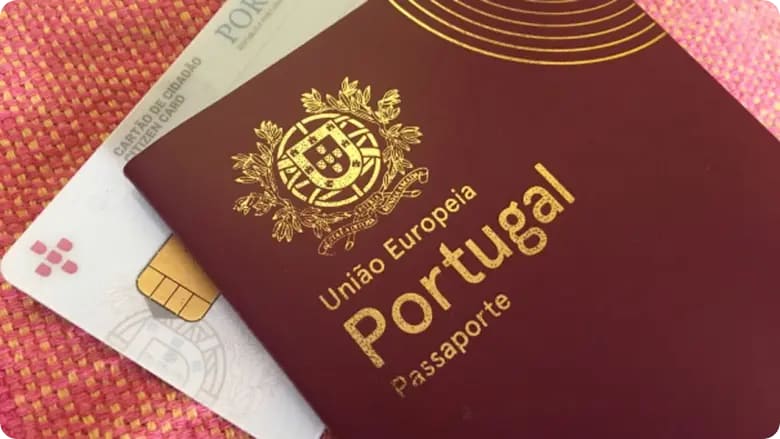
Nationality of origin is retroactive to birth, so legally you have been Portuguese since the day you were born. What you cannot do until your birth is registered in Portugal is hold a Portuguese passport or a 'cartão de cidadão'. So you are Portuguese by right from birth, and the registration is what lets you prove it and use it.
Since the 2026 nationality law, that registration carries even more weight, because the full legal effects depend on the record being completed.
Can I get Portuguese citizenship through my father or mother?
Yes, on exactly the same terms. A Portuguese father passes nationality to a child the same way a Portuguese mother does.
The law grants nationality to the children of a Portuguese mother or a Portuguese father, with no hierarchy between them. If your father was Portuguese when you were born, they passed nationality to you. If your mother was, the same holds.
Were you born in Portugal or abroad to a Portuguese parent?
The route splits by where you were born, though the nationality of origin is the same.
Born in Portugal to a Portuguese parent
You are Portuguese by origin, the most direct case in the entire system.
Born abroad to a Portuguese parent
You are Portuguese by origin, but you have to make it real on paper. You register (transcribe) your birth in the Portuguese civil registry, or you declare that you want to be Portuguese. This registration is the act that turns a birthright into a usable status, and it is the route most of the Portuguese diaspora takes.
Born abroad while your parent served the Portuguese State
You are Portuguese by origin if your Portuguese parent was abroad in the service of the Portuguese State when you were born.
Did the 2026 nationality law change the parent route?
No. The child-of-a-Portuguese-parent route was not changed by the 2026 law. If your claim runs through a parent, the ground under you is the same as before.
What the 2026 law changed sits at the edges of this topic, not at its center:
- The grandchild route now demands proof of effective ties to the Portuguese community, language, and clean criminal conditions. That affects people claiming through a grandparent, covered briefly below.
- Filiation established after 18 was tightened, which matters for anyone recognized late by a Portuguese parent. Covered in detail further down.
- The naturalization periods moved to seven and ten years, which matters for people with no Portuguese ancestry, not for children of Portuguese parents.
If a guide tells you the parent route got harder in 2026, it is confusing the child route with the grandchild route. They are different.
Who qualifies for Portuguese citizenship by descent?
A child of a Portuguese parent is eligible and qualifies by origin, with no residence, no language exam, and no test of ties to Portugal. This is the lightest ancestry route Portugal has for descendants.
What are the requirements to qualify through a parent?
Three things, and only three:
- A parent who was Portuguese when you were born.
- Filiation established, meaning the parent is legally recognized as your parent and appears on your birth record.
- Your documents consistent with the Portuguese records. This is the part that trips most people, and it has its own section below.
What don't you need to qualify for Portuguese citizenship through a parent?
No residence, no language, no proof of ties.
- You do not need to live in Portugal.
- You do not need a language certificate.
- You do not need to prove effective ties to the Portuguese community. That requirement lands on grandchildren, not on children.
That last point is the whole reason claiming as a child is so much lighter than claiming as a grandchild.
Do adults qualify, or only children?
Adults qualify too, with no age limit. An adult child of a Portuguese parent qualifies on the same basis as a newborn. For a minor, a parent or legal representative files on their behalf.
The one fact that decides it: was your parent Portuguese when you were born?
The whole claim turns on this. Your parent had to be Portuguese, in law, at the moment you were born. Settle this before you spend anything on translations.
A parent who is Portuguese by origin
Always counts. Origin is retroactive to their own birth, so they were legally Portuguese from the day they were born, which includes the day you were born. Even if they only got recognized and registered decades later, the law treats them as having been Portuguese the whole time.
A parent who became Portuguese by acquisition
Counts only if it happened before you were born. Acquired nationality, through naturalization or marriage, takes effect from its registration, without reaching backwards.
Two consequences follow:
- If your parent naturalized after you were born and you were still a minor then, you have a separate route. A minor child of someone who acquires Portuguese nationality can also acquire it by declaration. That sits in our guide to Portuguese citizenship by naturalization.
- If you were already an adult when your parent naturalized, their new nationality does not reach back to you.
Does the origin route open for you?
Use this to settle it in one look.
| Your Portuguese parent's status | When they became Portuguese | Does the origin route open? |
|---|---|---|
| Portuguese by origin | From their own birth (retroactive) | Yes, always |
| Naturalized or acquired by marriage | Before you were born | Yes |
| Naturalized or acquired | After you were born, while you were a minor | No to origin, but a separate minor route by declaration is open |
| Naturalized or acquired | After you were born, when you were already an adult | No, it does not reach back to you |
What if my Portuguese ancestor is a grandparent or great-grandparent?
This guide is about parents. If your Portuguese relative is a grandparent or further back, one move can turn a hard claim into an easy one. This is the only place grandparents and great-grandparents appear here, and the reason is this strategy, not the routes themselves.
How does the generational ladder work?
Because origin is retroactive, a recognized parent becomes a Portuguese parent from the day they were born. The moment a living parent is recognized as Portuguese, they were Portuguese when you were born, which makes you a child of a Portuguese parent.
So instead of claiming as a grandchild, you have the person in between claim first, and then you claim as a child.
What if my grandparent is Portuguese and my parent is alive?
Your parent claims first, as a child of the grandparent. Once they are recognized and registered, they are Portuguese, and then you claim as their child. The result is easier documents, a shorter wait, any conservatória with a nationality desk, and no effective-ties test.
What if the Portuguese relative is a great-grandparent?
You cascade generation by generation. The grandparent claims as a child of the great-grandparent. Once recognized, the grandparent is a Portuguese parent, so the parent claims as the grandparent's child. Once the parent is recognized, you claim as the parent's child. Every step is a child-of-a-Portuguese-parent claim, the light route, repeated down the line.
What if someone in the chain has died or won't apply?
The cascade breaks at the missing link. The next living generation after the Portuguese ancestor then has to claim as a grandchild, which is the harder route, with effective ties, language, and criminal conditions. If that is your situation, the grandparent route is the one to study.
Is it better to claim Portuguese citizenship through a parent or a grandparent?
Through a parent, whenever you have the choice. Lighter, faster, and you can file it in more places.
- Lighter documents.
- Shorter processing.
- It can be filed at any conservatória with a nationality desk, and at your consulate. The grandchild route is handled only by the central registry in Lisbon.
- No test of effective ties to the community.
The differences side by side:
| What differs | Through a parent (child) | Through a grandparent (grandchild) |
|---|---|---|
| Legal condition | A right, granted on filiation alone | Conditional, subject to assessment and approval |
| Effective ties to the Portuguese community | Not required | Required, and you have to prove them |
| Portuguese language | Not required | Required |
| Criminal-record conditions | Not a qualifying bar | Clean criminal conditions required |
| Where you can file | Any conservatória with a nationality desk, plus your consulate | Central registry in Lisbon only |
| Typical speed | The fastest ancestry route | Slower |
Before you build a plan, go read the room. Portuguese Facebook groups and forums are where people post real, current experiences: which conservatórias are moving right now, how long a child case is actually taking, which document quirk got someone rejected. Use them for the lived reality. Then verify every legal point against official sources, because forum advice ages fast and the 2026 law shifted things. The grandparent and great-grandparent routes themselves live in our guide to Portuguese citizenship by descent.
Do my documents have to match the Portuguese records?
Yes, exactly, or the application is rejected. Before you gather a single document, confirm your papers match what Portugal already holds for your Portuguese parent. This step decides whether your process is smooth or a two-year headache.
Why does Portugal check against its own record?
Your parent's Portuguese record is the anchor. They have a Portuguese birth record, an 'assento de nascimento', held in a conservatória. Your claim attaches to that record, and everything you submit is checked against it.
The rule is blunt. The correct names and dates are the ones in the Portuguese certificates, not the ones on your foreign documents. If your papers disagree with the Portuguese record, the application is refused, and you are expected to fix the discrepancy before you file.
What if the name is spelled differently on my documents?
A different spelling of your parent's name is the single most common reason a child case stalls. How serious it is depends on whether the difference is only in the spelling or in the actual name.
If it is phonetically the same
Usually resolvable. Examples: an accent that appears in one document and not the other, an "i" where the Portuguese record has a "y", a single consonant against a double one, a Portuguese name recorded abroad with a local twist.
The registry generally treats these as the same name once you show they point to the same person. The path is lighter, often an administrative clarification backed by supporting documents.
If it is phonetically different
A bigger problem. Examples: a genuinely different first or last name, a surname changed on marriage or migration, a nickname recorded as if it were the legal name.
This is a substantive difference, and the registry will not assume the two names belong to one person. You need stronger proof, and sometimes a court to declare that both names identify the same individual.
What if the birth date does not match?
Treated as seriously as a name difference. A day, a month, or a year out of place has to be reconciled, and the Portuguese record is the reference. Depending on where the error actually sits, you either correct the foreign document or prove that both records describe the same person.
!: Facebook groups and citizenship forums constantly recommend you search for the original Portuguese documentation first and then check with your own foreign document to see if it matches. If it doesn't, the recommended path is alter your documents accoridng to the original Portuguese ones, before applying.
How do I correct a mismatch?
You correct your own foreign documents in the country that issued them, so they line up with the Portuguese record. The Portuguese 'assento' is the reference, so you never touch it. You bring your birth certificate, ID, and the rest into agreement with it, at the registry or court back home that issued them.
One practical point up front: changing anything on the Portuguese record itself, from abroad, is slow and impractical, and it is almost never what you actually need. The fix you need is on your side, in your country.
Fixing a clerical error or a phonetic spelling
Usually an administrative correction at the registry that issued the document. A missing letter, an accent, an "i" for a "y", a single consonant against a double one: in most countries the issuing registry can correct this administratively, with the Portuguese certificate as the proof of the correct form. In many phonetic-equivalent cases (a classic one is 'Souza' against 'Sousa'), no correction is even needed, because the registry reads them as the same name.
Fixing a genuinely different name or date
This is where a court back home usually comes in. When the difference is substantive, a first or last name that is actually different, a dropped surname, a date that no document reconciles on its own, the issuing country's registry will not simply assume the two records are the same person. You go through a judicial rectification in that country, where a judge declares that both records identify the same individual and orders the correction.
Documents that bridge the two versions
Gather these early, because they are what a registry or a court will want to see. Older certificates, baptism records, marriage records, prior passports, anything official that connects the two versions and shows one continuous identity.
Do my documents need to be valid on a certain date?
Issue them within six months of filing, and the clock is read when the file enters the system. A long wait for analysis afterwards does not invalidate documents that were fresh on entry. Six months is the safe target that clears every office. Some are more generous, up to a year, and marriage certificates are often held to a tighter 180 days, so when you are unsure, six months keeps you safe everywhere.
A few specifics worth knowing:
- The receiving office sets the window. Some consulates ask for a birth certificate issued in the last six months, others accept up to a year. Check the exact rule of the office you file with.
- The apostille itself never expires. What can go stale is the document, and the apostille rides along with it, so an old apostille on a fresh certificate is fine, and a fresh apostille does not rescue an old certificate.
- Different documents, different clocks. Criminal records run out fast, around 90 days, and have to arrive inside that window. Identity documents have to be issued within the last ten years.
- Watch the age bracket. If the applicant is days from turning 18, that flips the process: who signs, whether a fee applies, and whether civil status has to be declared. Confirm before you send anything.

What if my Portuguese parent recognized me after I turned 18?
You can still get nationality, but only if the recognition went through a court, and only if you apply within three years of the judgment. This is the point that saves or sinks a claim, and most people have never heard it.
If you were recognized while still a minor
The ordinary child route is open. Filiation established during your minority produces nationality effects normally.
If you were recognized after 18
Only a judicial recognition counts, inside a three-year window.
The rule since the 2026 law
Filiation established after 18 produces nationality effects only when three things are all true: it concerns nationality of origin, it was established or recognized through a judicial process, and the request is made within three years of the judgment becoming final.
The trap that costs people the right
A simple administrative acknowledgment after 18, with no court involved, does not produce nationality effects. This is where people lose the right without realizing it. If your recognition was administrative and you are already past 18, the biological-parent route may be closed, and the three-year clock only exists for the judicial path.
Can I get Portuguese citizenship if I was adopted by a Portuguese parent?
Yes, but as acquisition, not origin, so it does not reach back to your birth. An adoptee of a Portuguese national acquires Portuguese nationality by declaration.
How does adoption give nationality?
By declaration, effective from the adoption judgment. Because it is acquisition, the effects run from the registration of that acquisition, the way all acquired nationality does, rather than from your birth.
What if I was adopted after 18?
Portugal does not adopt adults, so this situation does not arise domestically.
Portuguese adoption is only for minors
Since the 2023 reform, the person being adopted has to be under 18 at the date of the adoption petition. There is no such thing as being adopted at 18 or older inside the Portuguese system.
Adopted as a minor, declaring later as an adult
If the adoption was decreed while you were a minor, you can still make the declaration later, even as an adult, because the adoption was established during your minority. Turning 18 does not erase it.
An adult adoption granted abroad
An adult adoption granted in another country does not open Portuguese nationality. Adoption is acquisition, and the rule that lets adulthood-established filiation count for nationality applies only to nationality of origin through a court, which adoption is not.
Do not confuse adoption with late paternity recognition
Two different mechanisms. Late biological recognition has a three-year judicial window. Adoption is a minors-only route whose declaration survives your turning 18. Mixing them up is exactly how people misjudge their own case.
My Portuguese parent registered me. Do I need to transcribe their marriage?
What the claim needs is filiation, and the marriage only matters when it is what proves that filiation. If your Portuguese parent appears on your birth record as your parent, because they declared or acknowledged you directly, the parent-child link is already established, and that link is what carries the nationality.
Where the link instead rests on the parents being married (the marital presumption of parenthood), the marriage has to be transcribed into the Portuguese registry first, because a marriage celebrated abroad is not on the Portuguese record until it is registered there.
When is transcription actually needed?
It comes down to who is the Portuguese parent and who declared your birth.
| Your situation | Transcribe the marriage? |
|---|---|
| Portuguese father, who was not the birth declarant (your mother registered you), so paternity leans on the marriage | Yes. The marriage is what puts the father-child link on the Portuguese record |
| Portuguese father, who was the declarant and acknowledged you as a minor | Usually not. That act of registering you is the strongest proof of parenthood, so the marriage is not the trigger |
| Portuguese mother, named on your birth certificate, declarant or not | Usually not. Maternity is established by the birth itself. The marriage may be asked for only to explain a change of name |
| Both parents Portuguese, married abroad | Yes, in practice. Transcribing their marriage is a legal duty, and cases routinely stall without it |
Two rules of thumb the community repeats: a birth after 01-04-1978 tends to clear without transcription, while a birth before that date with married parents almost always needs it. And when a Portuguese parent registered you before your first birthday, that strengthens the case for skipping transcription. When you are unsure, transcribing as a precaution (a fee of roughly €120) is cheaper than the delay of being asked for it mid-process.
What if I am the child of a second marriage?
For your own claim, you transcribe the marriage that established your filiation, which is the one your parents were in when you were born. You do not have to transcribe the first marriage, the divorce, and the second in chronological order just to file your case.
The full chain matters in one situation: if a child of the first marriage, your half-sibling, or their own children as grandchildren, will also claim. Then the first marriage and its dissolution become part of proving their line, and the family should sort it together.
Your Portuguese parent does carry a separate legal duty to transcribe the first marriage and to homologate the divorce in Portugal (a 'revisão de sentença estrangeira', which needs a lawyer and a Portuguese court). That duty is real, but it sits on the parent, it does not block your claim, and it can be done later. If nobody from the first marriage will ever claim, and it was never registered in Portugal, you do not need it for your process at all.
How do I apply for Portuguese citizenship through a parent?
The core act is registering (transcribing) your birth in the Portuguese civil registry. That registration is what makes your Portuguese nationality real on paper.
What is the process for children of Portuguese citizens?
Birth registration is the process. As a child of a Portuguese citizen, you are entitled to nationality of origin, and registering (transcribing) your birth in the Portuguese civil registry is what formalizes it. The proof you attach is what links you to your Portuguese parent's record.
Step 1: confirm the records match
Check first, fix first. Before anything else, check your documents against the Portuguese record for your parent, and fix any discrepancy. Everything below assumes this is done, because skipping it is the most common way an application fails.
Step 2: gather your documents and requirements
A short core list, properly legalized.
The core documents and how each must be legalized
Each item carries its own legalization rules. This is the table to check before you spend anything on apostilles or translations.
| Document | Apostille | Certified PT translation | Signature recognition | Registered in Portugal first | Recency |
|---|---|---|---|---|---|
| Your birth certificate (long-form, names your Portuguese parent) | Yes | Only if not in Portuguese | No | No | Within 6 months |
| Your Portuguese parent's Portuguese birth certificate (the 'assento') | No, it is already Portuguese | No | No | It is the Portuguese record | Recent copy, civil status updated |
| A copy of your identification (passport or ID) | Yes, on the certified copy | Only if not in Portuguese, English, or Spanish | No | No | Issued within the last 10 years |
| The application form (Modelo 1C, or the under-18 version) | Only if signed outside a consulate | No, it is already in Portuguese | Yes, by authenticity | No | Current version |
| Criminal record (only where age and route call for it) | Yes | Yes, if not in Portuguese | No | No | Around 90 days |
| Your parents' marriage certificate (only when filiation rests on the marriage) | Yes | Yes, if not in Portuguese | No | Yes, this is the transcription | Up to 180 days |
The pattern to notice: the only document you have to register in Portugal before filing is the marriage certificate, and only when your filiation depends on it. Your parent's 'assento' is not something you legalize, it is the Portuguese record everything else is checked against.
Step 3: choose where to file
Consulate, nationality desk, post, or a lawyer online. The next section breaks down what each option means for your timeline.
Step 4: submit and pay
Around €175 for an adult on the attribution route, and minors under 18 are exempt. Multiple 2026 sources report no state fee for a minor's attribution, so confirm the current amount and the exemption scope with the IRN or your consulate before you pay. Since the 2026 law, nationality applications also involve collection of biometric data.
Step 5: track it online
You get a process number and an access code, and you can check the status online without going to a registry office. Keep every receipt and confirmation you receive.
Where do I apply: consulate, conservatória, or a nationality desk?
Three doors, and the door changes how fast it moves. Your consulate abroad, a conservatória with a Balcão da Nacionalidade in Portugal, or the central registry in Lisbon by post or through a lawyer online.
| Where you file | Who it is for | Processes or forwards | Speed |
|---|---|---|---|
| Your consulate abroad | Child of a Portuguese parent | Processes, as an extension of the central registry | Varies by consulate |
| Balcão da Nacionalidade (Porto and some conservatórias) | Any route with a nationality desk | Processes the case itself | Faster |
| Conservatória without a nationality desk | Anyone, but it does not decide | Forwards to Lisbon or Porto | Slower |
| Post to the central registry in Lisbon | Any route | Processes the case | Standard |
| Online | Lawyers and solicitadores only | Processes the case | Depends on the lawyer |
Applying at your consulate (abroad)
A real option for a child of a Portuguese parent, because the consulate acts as an extension of the central registry, so you can transcribe your birth there.
Note the limit: grandchildren, marriage cases after 03-10-1981, and some other routes are handled only by the central registry in Lisbon, not by consulates. The child route is one a consulate can take, which is one more reason claiming as a child runs smoother.
Applying at a Balcão da Nacionalidade in Portugal
Nationality desks receive and process the request. They sit at the Arquivo Central do Porto and at some Conservatórias do Registo Civil, and a current list is kept on the official justice portal.
Applying at a Loja de Cidadão or a conservatória without a nationality desk
You can hand it in, but be clear about what happens next. A conservatória without a nationality desk does not process the case itself. It forwards the file to Lisbon or Porto, which adds time. Smaller desks have also closed and transferred their cases to Lisbon, which adds more. If speed matters, file where a nationality desk actually processes the case, or with your consulate.
Applying by post to the central registry in Lisbon
Post it to the Conservatória dos Registos Centrais, at Rua Rodrigo da Fonseca 202, Lisbon. Send the payment together with it, or the file is returned.
Applying online through a lawyer
The online nationality service is for lawyers and solicitadores. As an individual, you file in person or by post.
What are the benefits of Portuguese citizenship?
Full Portuguese and European Union citizenship, from birth. This is the main reason the route is worth the paperwork. An EU citizenshio gives you rights and opportunities, besides residency, across the European Union.
A Portuguese passport and visa-free travel
One of the strongest passports in the world for visa-free travel, with consular protection when you are abroad.
The right to live, work, and study across the EU
Free movement across Europe. As an EU citizen, you can live, work, study, and retire in any of the 27 EU countries, plus the wider European Economic Area and Switzerland, with no visa.
A cartão de cidadão and access as a national
You are treated as a national, not a foreigner. You can hold the Portuguese citizen card and use healthcare, education, and public services on the same footing as any citizen.
Dual nationality
Portugal allows it. On Portugal's side, claiming Portuguese citizenship does not require giving up your current one. Check separately what your other country permits.
Passing citizenship to your own children
You can pass it down. Because this is nationality of origin, your own children can claim it the same way it reached you, wherever they are born.
How long does it take to get Portuguese citizenship by descent?
Often 12 to 18 months, and frequently longer right now. The child route is the fastest ancestry route, though "fast" is relative given the current backlog.
How long does Portuguese citizenship through a parent really take right now?
Past a year for many cases, sometimes two or more. The central registry is working through a heavy volume of applications, and the justice services have added desks and extended opening hours to cope. A clean file at the right location moves faster than a messy one filed at a place that has to forward it.
How much does Portuguese citizenship through a parent cost?
Around €175 for an adult, nothing for a minor, plus apostilles and certified translations. The attribution route is nationality of origin, and cheaper than the acquisition routes. Confirm the current figures with the IRN or your consulate before you pay, since the schedule changes.
| Item | Fee |
|---|---|
| Attribution through a parent, adult | Around €175 |
| Attribution through a parent, minor under 18 | Exempt |
| Attribution through a grandparent, adult | Around €175, but with heavier conditions |
| Marriage transcription (when needed) | Around €120 |
| Death transcription (when needed) | Free |
| Changing a name on the Portuguese 'assento' | Around €200 |
Those are the state fees only. Apostilles, certified translations, and certified copies are extra, and they add up faster than the government fee itself.
What speeds up or slows down the Portuguese citizenship by descent process?
Clean documents speed it up. Mismatches and the wrong filing spot slow it down.
- Speeds it up: documents that match the Portuguese record, apostilles and translations done properly, and filing where a nationality desk processes the case.
- Slows it down: a name or date mismatch, missing translations, filing at a conservatória that only forwards the file, and claiming as a grandchild when a living parent could have claimed first.
The questions people ask most before applying
A few doubts come up again and again once the plan gets real.
Do I need to live in Portugal to claim through a parent?
No. There is no residence requirement, no language exam, and no effective-ties test for a child of a Portuguese parent.
Can I still apply if my Portuguese parent has passed away?
Yes. Your claim rests on the filiation and on your parent's Portuguese record, both of which survive them. Your parent does not need to be alive for you to claim as their child. A living parent only matters for the cascade strategy, where they claim first to simplify your case.
Will claiming Portuguese citizenship make me lose my current one?
Not on Portugal's side. Portugal allows dual nationality. Whether your other country does is a separate question to check.
My birth certificate and the Portuguese record come from different countries. Is that a problem?
Only if the details disagree. Records issued in different countries are normal. What matters is that names and dates line up, and that foreign documents carry the apostille and a certified Portuguese translation.
Do names really have to match?
Yes, and this is the detail that sinks the most cases. The Portuguese record is the reference, and any discrepancy has to be corrected before you file.
What claiming Portuguese citizenship through a parent really comes down to
If a parent was Portuguese when you were born, you are Portuguese by origin already. The task is proving it, not earning it.
Pin down whether that parent was Portuguese by origin or by acquisition, and when, because that decides whether the origin route is open.
Check your documents against the Portuguese record first. A name or date mismatch is the single most common reason a case fails, and it is fixable before you file.
If your Portuguese relative is a grandparent or further back, and the person in between is alive, have them claim as a child first. It turns a grandchild claim into a child claim, which is lighter, faster, and can be filed anywhere with a nationality desk.
Watch the two adulthood rules. Biological recognition after 18 only counts through a court and within three years. Adoption is a minors-only route, and its declaration survives your turning 18.
File where a nationality desk actually processes the case, or with your consulate. A plain conservatória forwards the file and adds months.
Being recognized as Portuguese is one thing. Actually landing in Portugal, with your NIF sorted, a bank account open, and your taxes in order, is another. That second part is what we handle at AnchorLess, so once the citizenship side is moving, talk to us about the move itself.
Share this article