




The D2 in 6 numbers (2026)
- 3 routesfreelancer, entrepreneur or startup
- €0minimum investment set by law
- €11,040of means for one person, for a year
- €110consular fee per applicant
- 60 daysfor the consulate to decide
- 10 yearsto Portuguese citizenship
The entrepreneur and freelancer visa, in 7 steps: who qualifies, how much you need, what it costs, and how we can help at each step.
Get the free D2 checklist


The Portugal D2 visa, often called the entrepreneur visa, lets citizens of countries outside the EU, the EEA and Switzerland move to Portugal to work for themselves: as a freelancer with a service contract, with a company or an investment, or with a startup in a certified incubator.
The law sets no minimum investment, but you need means of subsistence: €11,040 for one person in 2026. This guide takes you through the requirements, the documents and the 7 steps, up to your residence card.


The D2 in 6 numbers (2026)
Yes to all five? The D2 is your visa.
Working remotely for clients or an employer abroad? Look at the D8 instead. A doubt on one point? Ask us in a free call.
Create my free account →Your personal D2 checklist, free. No card required.
The D2 is the Portuguese residence visa for independent professionals and immigrant entrepreneurs. It is for citizens of countries outside the EU, the EEA and Switzerland who want to work for themselves in Portugal.
You apply at the Portuguese consulate (or its VFS Global center) for the country where you live. The consulate issues a 4-month residence visa; in Portugal, AIMA then gives you a residence permit, renewed for as long as your activity and your means continue.

The D2 has three routes, set by article 60 of the foreigners’ law. You need one of them, plus the conditions of every residence visa.
You have a service contract, or a written proposal of one, in a liberal profession, and you are qualified to practice it. If your profession is regulated in Portugal, add a declaration from the body that regulates it.
The activity must be on the tax authority’s list of professions. Some consulates want the contract to be with a Portuguese client: London does. Our freelancing guide explains how the work runs once you are there.
You have made an investment in Portugal, or you have money available in Portugal (a loan from a Portuguese bank counts) and show that you will invest it. You describe the investment in a declaration: its nature, its value and its duration.
A company registered in Portugal is the proof London’s consulate lists, with its registry certificate and a business plan. Our guide to starting a business in Portugal covers the company side.
Your innovative project is accepted by IAPMEI, the State agency for competitiveness and innovation, and you sign an incubation contract with a certified incubator. IAPMEI’s declaration is then your proof.
| Route | For | Key proof |
|---|---|---|
| Independent professional | Freelancers in a liberal profession | Service contract |
| Entrepreneur | Founders and investors | Investment |
| Startup Visa | Innovative startups | IAPMEI letter |
The Startup Visa is the D2’s third route, not another visa: the same residence visa, the same permit. What differs is the gate. You apply to IAPMEI first, on its online platform, and it judges the innovation, the scalability and the jobs your project can create.
The program asks for the potential to reach €325,000 of yearly turnover or assets five years after incubation. At each renewal, you show that the incubation contract goes on. The law also lets incubated founders apply for the permit in Portugal without a residence visa. Our Startup Visa guide goes into detail.
Both suit people who work for themselves, but not the same clients. If you work remotely for clients or an employer outside Portugal, the D8 digital nomad visa is the one to apply for.
| Visa | D2 | D8 |
|---|---|---|
| Work | Your business, or services under contract | Remote, clients abroad |
| Money in 2026 | €11,040 of means for a year | €3,680 a month |
No. The law sets no amount, for a company or for any other investment. The consulate looks at the purpose of your stay, so the investment must be real and described: its nature, value and duration, in your declaration.
Consulates measure your means on the Portuguese minimum wage, €920 a month in 2026. For an investment, the rule is 12 months of it: €11,040 for one person, available in Portugal. Income from your service contract or your company counts.
For each family member who comes with you, add 50% for a spouse or another adult and 30% for each child, adult children who depend on you included:
| Household | Means for a year |
|---|---|
| Main applicant alone | €11,040 |
| + spouse (+50%) | €16,560 |
| + spouse + 1 child (+30%) | €19,872 |
| + spouse + 2 children (+30% each) | €23,184 |
What each consulate wants to see varies: London asks for three months of bank statements with at least €920 available, New Delhi for proof covering 12 months. When the minimum wage rises (usually in January), these amounts rise with it.
The law doesn’t list one, but some consulates do: London names a business plan among the papers of a company. Even where it isn’t asked, it is the clearest way to show the nature, value and duration of your investment, and how the business will support you.
Free D2 checklist
Your D2 visa, step by step, in a free account
Free
Create my free account4.8/51,500+ reviews
No card required
Yes. Your family can apply for their residence visas at the same time as you, to come with you. For each of them, you show more means: 50% more for an adult, 30% more for a child. You can include:
Family members who move with you get their own residence permit and their own path to permanent residence and citizenship, counted from their own first permit.
Tip: apply together. Since October 2025, bringing family later through family reunification takes two years of residence first (15 months for a spouse you lived with for 18 months before, no wait for your minor children), and AIMA then has nine months to decide.
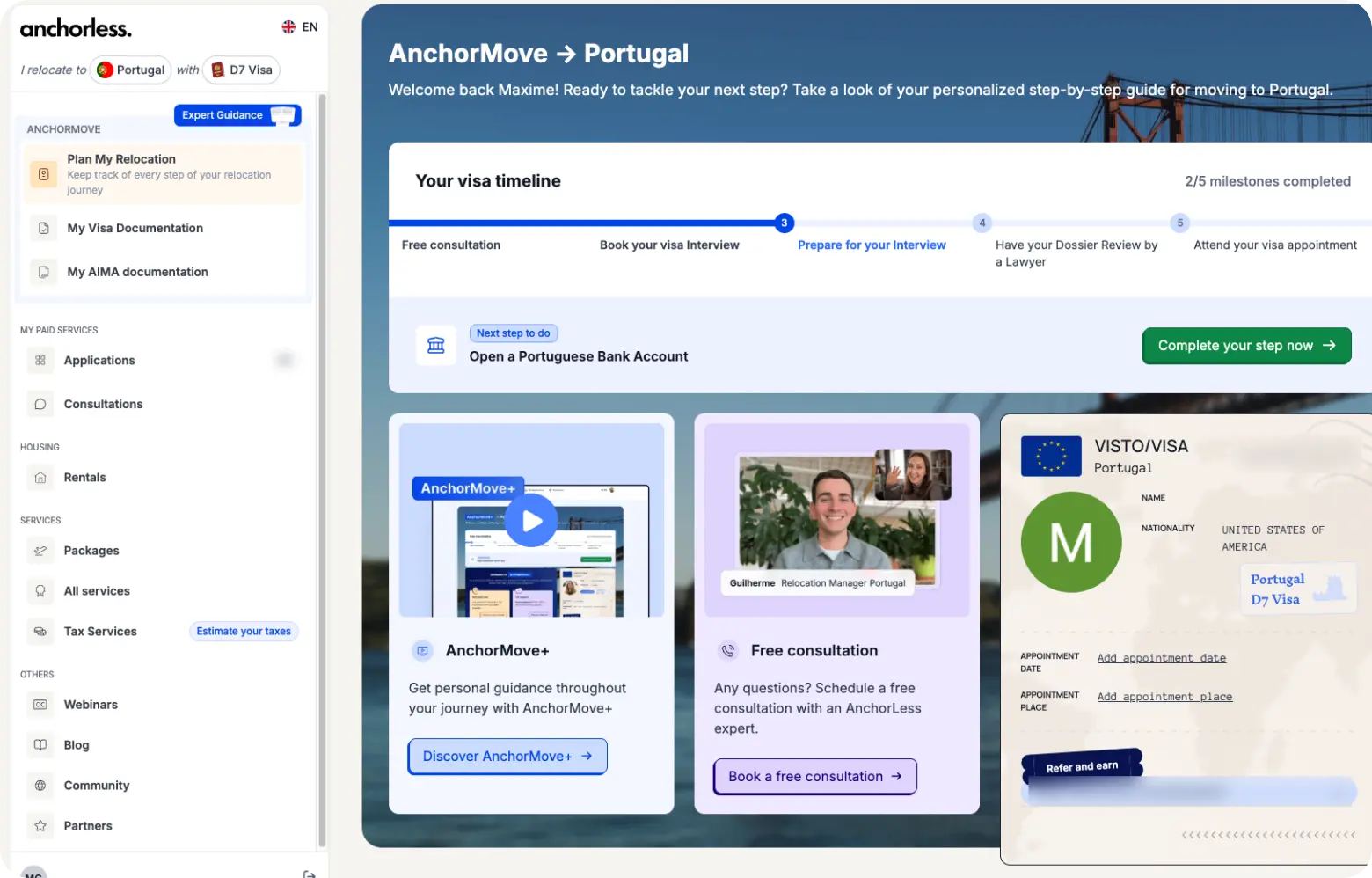
From your sofa to your Portuguese residence card. Each step says what to do and what it costs. In a free AnchorLess account, you tick them off one by one and get expert help where you need it.
Freelancer with a service contract, entrepreneur with a company or an investment, or startup in a certified incubator. Then check your means: €11,040 for one person.
Take the 30-second checkYour Portuguese tax number: banks and landlords ask for it, and so does the registration of your company or your self-employed activity. You can get it from abroad.
Get my NIFYour means must be available in Portugal, and consulates usually ask for a Portuguese statement: €11,040 for one person, more with family.
Open my accountFreelancers get a service contract or a written proposal. Entrepreneurs register a company or make the investment, and describe it. Startups get IAPMEI’s approval and sign with an incubator.
Get my company quoteA lease (consulates usually ask for at least 12 months), a deed, or a term of responsibility from someone who hosts you.
Review my leaseOr find your home with usProof of means, your route’s documents, criminal record, travel insurance: the full checklist is below. Book the consulate or VFS Global center for where you live and pay the €110 fee.
Review my visa fileFind your consulateWithin the visa’s 4 months, register your activity with the tax office and Social Security, then go to AIMA. AIMA has 90 days to decide (up to 120); your first card lasts 2 years.
Have your AIMA file checked (€259)| Fee | When | Amount |
|---|---|---|
| Consular visa fee (children under 6 don’t pay) | When you apply | €110 |
| Service fee of VFS Global or another provider | Where one handles applications | Varies |
| First residence permit, at AIMA | In Portugal | €185.60 |
The AIMA fee is €247.30 where the reduced rate does not apply: see the AIMA Portugal fee table in our guide. Add your company’s own costs, the apostilles of your documents, any translation your consulate asks for, and your insurance.
By law, the consulate has 60 days to decide on a residence visa, and London and New Delhi both give 60 days as their standard time; a consulate can take longer when it needs an interview or more documents. In Portugal, AIMA then has 90 days to decide on your residence permit, which it can extend by 30.
A Portuguese visa refusal usually comes down to one of these:
A doubt about your application? AnchorLess offers a free consultation to clear it up.
Your application rests on a complete file. Some documents are Portuguese and take time, like your NIF (tax number), a Portuguese bank account and your company papers: start them first (steps 2 to 4 above).
From your country of nationality, or from the country where you have lived for over a year, apostilled or legalized (not needed under 16). It must be recent: the US and London consulates want it issued less than 90 days before you apply.
The rules ask for travel insurance that covers medical expenses, urgent care and repatriation, and set no amount. Consulates add their own: London wants it to cover the visa’s full 120 days, New Delhi at least €30,000. Citizens of countries with a health agreement with Portugal, like Brazil (PB4) or the UK (S1), may not need it. Insurte, our partner, offers cover made for visa applications.
Partner · Insurte
Schengen travel insurance for your visa
Partner offer
Your D2 visa is valid for 4 months and two entries: the time to move, start your activity and get your residence permit. It comes with a pre-authorization of residence and provisional tax, Social Security and health service numbers.

Read the paperwork the consulate gives you first: the pre-authorization of residence holds the information on getting your permit, and many residence visas come with the AIMA appointment already scheduled. If no date was assigned, request one from AIMA; London’s consulate, for one, says it does not book AIMA appointments. Our guide to the AIMA appointment explains which option to pick. Go within the visa’s 4 months.
AIMA’s list for D2 visa holders has no foreign criminal record. AIMA has 90 days to decide, which it can extend by 30. The fee for a first permit is €185.60 in AIMA’s 2026 table (€247.30 where the reduced rate does not apply).
Ask AIMA to renew at least 30 days before your card expires. You show that your means and your home continue, that your activity goes on, and that your taxes and Social Security contributions are in order; startups show that their incubation contract goes on.
AIMA decides a renewal within 60 days, and the receipt of your request counts as your card for 60 days, renewable.
While your card is valid, don’t stay away from Portugal for more than 6 months in a row or 8 months in all without a good reason, or AIMA can cancel it. A D2 detail: the law does not cancel the permit when you prove you worked or ran your business abroad during the absence.
| Card | Longest absence allowed | Valid |
|---|---|---|
| First residence permit | 6 months in a row, or 8 in all | 2 years |
| Renewed permit | 6 months in a row, or 8 in all | 3 years |
| Permanent residence (after 5 years) | 24 months in a row, or 30 in 3 years | No limit |
After five years with a residence permit, you can apply for permanent residence: you need basic Portuguese (an A2 certificate, for example), your means of subsistence and accommodation, and no prison sentence over one year in the last five years. It has no time limit, and its card is renewed every five years.
Ten years after your first residence permit is issued (seven for nationals of Portuguese-speaking countries and EU citizens), you can apply for Portuguese citizenship: an EU passport, to live and work anywhere in the EU, the EEA and Switzerland.
Ten years of legal residence, counted from your first residence permit (seven for nationals of Portuguese-speaking countries and EU citizens). You must also prove, by a test or a certificate, that you know Portuguese (level A2 under the current regulation) and, since the 2026 law, Portuguese culture, history and national symbols, citizens’ rights and duties and how the State is organized.
You also declare your adherence to the rule of law, show you can support yourself, and must have no conviction that bars it. The new test is still to be set by regulation.
From the United States, the US checklist adds a few documents, and the total is higher than the consular fee alone:
If you want to work for yourself in Portugal, with clients under contract, a company or a startup, the D2 is the visa built for it, with no minimum investment. If your clients or employer are abroad, the D8 fits better. Prepare your business documents early and apply together with your family: the move will be all the smoother.
The rules, amounts and fees in this guide were checked on 22 October 2026 against the law and the official portals:
Written by Brenda L., relocation expert at AnchorLess.
Be a citizen of a country outside the EU, the EEA and Switzerland and fit one of three routes: a service contract or proposal in a liberal profession, an investment or a company in Portugal, or an incubation contract under the Startup Visa. Add means of subsistence (€11,040 for one person in 2026, available in Portugal), a valid passport, travel insurance, a home in Portugal, and no conviction for a crime punishable by more than a year in prison.
No. The law sets no amount. Your declaration states the investment’s nature, value and duration, and you need means of subsistence on top: €11,040 for one person in 2026.
For an investment, 12 months of the Portuguese minimum wage: €11,040 for one person in 2026, €16,560 with a spouse, and €3,312 more for each child. Income from your contract or your company counts, and the money should be available in Portugal.
Not by law: a freelancer shows a service contract or a written proposal in a liberal profession, and the professional body’s declaration if the profession is regulated. Some consulates ask for a business plan from applicants with a company: London does.
For entrepreneurs, the law names no sector: what counts is a real investment in Portugal. For freelancers, the activity must be a liberal profession on the tax authority’s list of professions, with the qualifications Portugal requires for it.
The Startup Visa is one of the D2’s three routes. Instead of a contract or an investment, you show IAPMEI’s declaration that you signed an incubation contract with a certified incubator, after IAPMEI accepted your innovative project.
The D2 if your work is a liberal profession under a service contract, or your own business in Portugal. The D8 if you work remotely for clients or an employer outside Portugal and earn at least €3,680 a month (2026).
By law, the consulate has 60 days to decide. The visa is then valid 4 months, to travel to Portugal and go to AIMA, which has 90 days (up to 120) to decide on your residence permit.
Yes.
Your spouse or partner, your children and dependent parents can apply at the same time as you. For each, you show more means: 50% more for an adult, 30% more for a child.
Yes.
You can take a job by replacing your card at AIMA. Since September 2026, you can also change the nature of your self-employed activity by telling AIMA, without a new card.

Can't find the answer you're looking for? Contact our team of experts.
Start your new life in Portugal
Turn relocation stress into success with AnchorLess.
Relocating to Portugal made simple.


AnchorLess is not a bank, accountant, tax advisor, investment advisor, or law firm, nor are we a government or official government website. We act as an intermediary, helping connect you with accredited professionals and streamlining administrative processes for your relocation in Europe.


 MOVE TO PORTUGAL
Services
Guides
 MOVE TO SPAIN
Services
Guides
 MOVE TO ITALY
Services
 MOVING IN EUROPE
Guides
Free tools
© 2022 - 2026 anchorless.io, all rights reserved.

