What is the Portugal D6 visa (family reunification visa)?
Family reunification is the right of a foreign resident of Portugal to bring their family to live with them. The D6 visa is the residence visa the family gets for it: you ask AIMA, Portugal’s immigration agency, and once AIMA says yes, your family collects the visa at a Portuguese consulate and flies over.
There are two ways to bring your family, depending on when they move:
| Route | When | Who files |
|---|
| Family reunification (D6) | You already live in Portugal | You, at AIMA |
| Accompanying visas | You all move together | Each, at the consulate |
What your family gets
- A residence permit of the same duration as yours, and later one of their own.
- The right to work, employed or self-employed, to study and to use the health service, with no special authorization.
- Visits to the other Schengen countries for up to 90 days in any 180 (to travel, not to live or work there).
- Permanent residence after five years, and Portuguese citizenship after ten (seven for nationals of Portuguese-speaking countries and EU citizens).
D6 visa requirements: who counts as family?
You, the resident, are the one who applies. The law lets you bring:
- Your spouse, or a partner in a de facto union (AIMA asks for proof of more than 2 years together).
- Your or your spouse’s minor children, and incapacitated children, in your care.
- Minors adopted by you or your spouse, if Portugal recognizes the adoption.
- Adult children who depend on you, are single and study in Portugal (anywhere, for golden visa holders).
- Your or your spouse’s parents, if they depend on you.
- Minor brothers and sisters under your guardianship, by a decision Portugal recognizes.
They must live with you or depend on you, whether the family ties came before your move or after. Since October 2025, a marriage or union must be valid and recognized under Portuguese law, and both of you must be at least 18 on the day of the request. For a child of only one of you, the other parent must agree in writing, or a decision must have given you custody.
Married to a Portuguese or EU citizen? The D6 is not your route: the families of Portuguese, EU, EEA and Swiss citizens have their own visa at the consulates.
The two-year rule: when can you bring your family?
Since 23 October 2025, you can ask for most family members once you have held a valid residence permit for two years. Some can come sooner:
| Family member | Wait |
|---|
| Spouse or partner | 2 years |
| Spouse or partner you lived with for 18 months right before moving | 15 months |
| Minor or incapacitated children in your care | None |
| Spouse or partner who is the other parent of such a child | None |
| Family of a highly qualified (D3), EU Blue Card or golden visa holder | None |
| Parents and adult children | 2 years |
In exceptional cases, the minister in charge of migration can shorten or waive the wait, given the strength of your family ties and your integration in Portugal.
Can your family apply from inside Portugal?
Only the family members with no wait, if they are in Portugal on the day you apply; AIMA asks for proof that they entered legally. A 180-day window that let the others apply from Portugal too closed in April 2026. Everyone else applies from abroad: you file the request at AIMA, they get the D6 visa at their consulate.
Family reunification income and housing requirements in 2026
You must have enough income for the whole family, without social benefits. AIMA counts on the minimum wage, €920 a month in 2026: 100% for you, 50% for each other adult and 30% for each child (or dependent adult child), secured for 12 months.
| Household | A month | A year |
|---|
| You + spouse | €1,380 | €16,560 |
| You + spouse + 1 child | €1,656 | €19,872 |
| You + spouse + 2 children | €1,932 | €23,184 |
| You + 1 child | €1,196 | €14,352 |
| You + spouse + 1 parent | €1,840 | €22,080 |
When the minimum wage rises (usually in January), these amounts rise with it.
How do you prove your income?
With what fits your situation: your work contract and last 3 months of payslips, a service contract with 6 months of receipts, a pension certificate, statements of investment income, or funds available in Portugal. If someone else vouches for your means, AIMA’s term of responsibility (Modelo 4) needs a signature certified by a notary, a lawyer or a solicitor.
What counts as accommodation?
A home you own or rent, normal for a family of that size in your region, and meeting the usual safety and health standards. At AIMA you sign a sworn declaration of your address, with the land registry certificate if you own the home, or your landlord’s declaration if you rent.
How to apply for the Portugal D6 visa in 7 steps
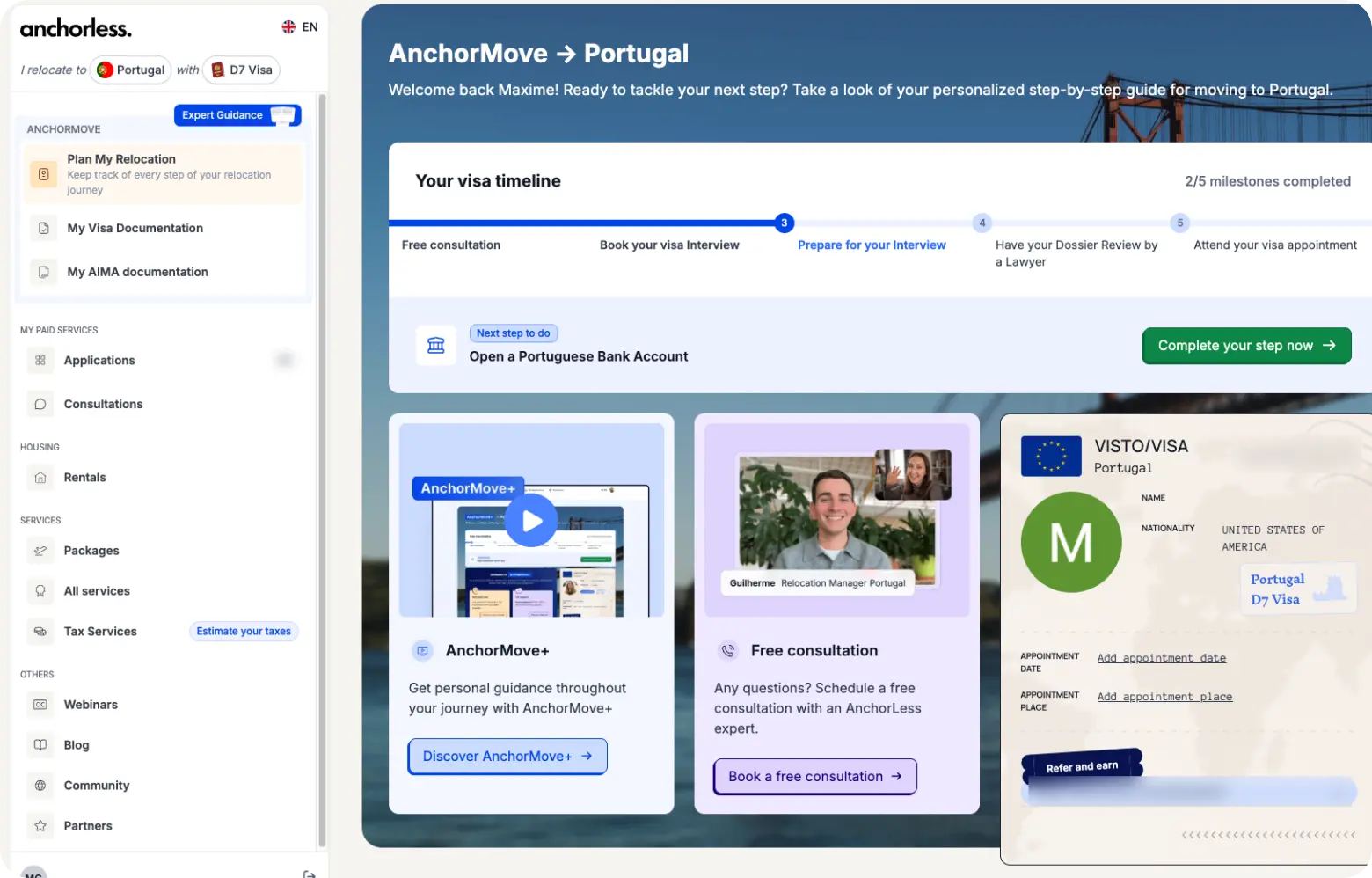
From your request at AIMA to your family’s residence cards. Each step says what to do and what it costs. In a free AnchorLess account, you tick them off one by one and get expert help where you need it.
1
Check that your family can join you
A residence permit held for two years (less, or none, in the cases above), family members the law covers, enough income for everyone, and a home that fits.
Take the 30-second check2
Gather the proof of family ties
Marriage or birth certificates, adoption or custody decisions, proof that your parents depend on you: each one authenticated, with a certified copy of every passport.
Notarization with us: €79By a Bar-registered lawyer
Notarize my document3
Translate what is not in Portuguese
AIMA asks for a Portuguese translation of every document written in another language: certificates, criminal records, proof of income.
Official translation: €79In less than a week
Translate my document4
Show a home and income for the whole family
A home that fits your family, owned or rented, and income for 12 months: €16,560 a year for you and a spouse in 2026, more with children.
Lease checked by a lawyer: €99In 48 hours
Review my leaseOr find your home with us5
Send your request to AIMA
You file it yourself, with AIMA’s form, by appointment at an AIMA office. AIMA has nine months to decide, and tells you within 8 days when it says yes.
Lawyer check of your file: €259Feedback in 3 business days
Have your AIMA file checked6
Your family applies for the D6 visa
Within 90 days of the approval, at the consulate where they live. It doesn’t ask again for what AIMA has, and issues the visa within 10 days.
€110 for a spouse or parentFree for children
Find their consulate7
They fly to Portugal and get their residence cards
Within the visa’s 4 months, they go to AIMA. Each gets a permit of the same duration as yours, and then follows Portuguese and civic training.
AIMA fee: €185.60 eachSame duration as yours
Read our AIMA guide
How much does the D6 visa cost?
| Fee | Who pays | Amount |
|---|
| Visa fee at the consulate | Spouse, partner or parent | €110 |
| Visa fee at the consulate | Children | Free |
| Residence permit at AIMA | Each family member | €185.60 |
| Visa center fee (VFS Global or other) | Where there is one | Varies |
The AIMA fee is €247.30 where the reduced rate does not apply: see the AIMA Portugal fee table in our guide. Add the apostilles, certified copies and translations of the documents.
Why are family reunification requests refused?
AIMA can refuse a request when:
- the conditions are not met: time of residence, income or housing;
- the family member is banned from entering Portugal or flagged in the Schengen Information System;
- their presence would threaten public order, public security or public health.
Before refusing, AIMA must weigh the family ties, your time in Portugal and the ties with the home country, and a refusal can be challenged in the administrative courts. A marriage or adoption made only to obtain residence leads to the permit’s cancellation. A doubt about your file? AnchorLess offers a free consultation to clear it up.
Portugal family reunification visa processing time
By law, AIMA has nine months to decide on your request. When it says yes, it tells you within 8 days, and your family has 90 days to apply for the visa at their consulate, or the approval lapses. The consulate then issues the visa within 10 days.
At the legal maximum, that is about a year from your request to their visa, after the two years of residence most family members wait for. In practice, AIMA’s times vary: our AIMA guide follows how its family reunification queue moves.
- Year 0your first residence permit
- 2 yearsyou can request most family
- 9 monthsat most for AIMA to decide
- 90 daysfor your family to apply for the visa
- 4 monthsto enter Portugal and go to AIMA
- 5 yearstheir permanent residence
- 10 yearstheir citizenship
Family reunification documents checklist
Two files: yours, for AIMA, then your family’s, for the consulate.
For your request at AIMA
- AIMA’s request form (Modelo 1), signed by you;
- Your residence permit;
- A certified copy of each family member’s passport;
- Proof of the family ties, authenticated: marriage certificate, birth certificates, adoption or guardianship decision, or proof of more than 2 years of de facto union;
- For a child of only one of you: the other parent’s written consent, authenticated by a Portuguese consulate, or the custody decision;
- For dependent parents: proof that they depend on you, such as the money you send them. For adult children: proof of dependency and of enrollment in a school in Portugal;
- A sworn declaration of your address, with the land registry certificate (owner) or your landlord’s declaration (tenant);
- Proof of your income (see above);
- Each family member’s criminal record from their country of nationality, or from where they lived more than a year before Portugal, authenticated (not for children under 16).
For the D6 visa at the consulate
- AIMA’s notification of the approval;
- Each family member’s passport, valid at least 3 months beyond the planned stay, and proof of identity;
- The national visa form, signed (by a parent or guardian for a minor), and 2 recent passport photos;
- Travel insurance covering medical expenses, urgent care and repatriation;
- For a minor not traveling with both parents: the parents’ travel authorization, or a court order.
The consulate doesn’t ask again for documents AIMA already has: it checks who your family members are.
Apostille, legalization and translation
AIMA wants the certificates duly authenticated: with the Hague apostille where it applies, legalized by a consulate elsewhere. A document in another language needs a translation into Portuguese by one of the bodies of the notarial code, such as a Portuguese notary, the Portuguese consulate in the country that issued it, or that country’s consulate in Portugal.
Moving together: family visas with your own
Not living in Portugal yet? Then there is no two-year wait: your family can apply for residence visas to accompany you, at the same time as your own D7, D8 or other residence visa.
- Who: the same family members, from your spouse or partner to your dependent parents.
- What they show: proof of the family ties, and income for you and them for the stay or 12 months, whichever is shorter.
- Fee: €110 each (children under 6 don’t pay).
It is a different visa from the D6: the consulates keep it for families moving with a visa applicant, not for the families of people already living in Portugal, who go through AIMA first.
After the D6 visa: arrival and residence permits at AIMA
The D6 is a residence visa: valid for 4 months and two entries, the time to travel and ask AIMA for the residence permit. By law, it comes with your family’s tax (NIF), social security (NISS) and health service (SNS) numbers, assigned automatically.
How do they get their AIMA appointment?
Normally, the visa carries a link with the AIMA appointment. If it has none, they ask AIMA for one through its contact form, choosing “Residence Permit” and “Residence Permit with Consular Visa (Non-CPLP)” (“CPLP” for nationals of Portuguese-speaking countries), with their own email address. Our guide to the AIMA appointment explains the form.
What happens at AIMA?
- Biometric data (photo, signature and fingerprints) and a check of the documents.
- Each family member gets a permit of the same duration as yours (2 years if you are a permanent resident), and the card arrives at your address.
- The fee is €185.60 per permit in AIMA’s 2026 table (€247.30 where the reduced rate does not apply).
Portuguese and civic training
Since Lei 61/2025, family members who get a reunification permit must follow Portuguese language training and training on Portugal’s constitutional principles and values, and children must attend compulsory school. Renewing their permit depends on it, and on their knowledge of the language and of these principles, unless a delay is not their fault.
How the training works is still to be set by regulation: none had been published when we checked. Exemptions are possible on humanitarian grounds.
How long are your family’s permits valid, and how are they renewed?
| Permit | Valid for |
|---|
| First permit, family of a temporary resident | Same as yours |
| First permit, family of a permanent resident | 2 years |
| Renewal, family of a permanent resident | 3 years |
| Their own permit, after 2 years | Same as yours |
After two years, if the family ties still hold, each family member can get an autonomous permit, no longer tied to yours; at once if you have minor children living in Portugal. A spouse married to you, or in a union, for more than five years gets one from the start, and divorce, widowhood or domestic violence can open one sooner.
To renew, they go back to AIMA before the card expires, with updated documents and proof of the integration training. While a card is valid, they shouldn’t stay away from Portugal for more than 6 months in a row or 8 months in all without a good reason, or AIMA can cancel it.
Permanent residence and citizenship for your family
After five years with a residence permit, each family member can apply for permanent residence: they need basic Portuguese (an A2 certificate, for example), means of subsistence and accommodation, and no prison sentence over one year in the last five years. It has no time limit, and its card is renewed every five years.
Ten years after their first residence permit is issued (seven for nationals of Portuguese-speaking countries and EU citizens), they can apply for Portuguese citizenship: an EU passport, to live and work anywhere in the EU, the EEA and Switzerland. Their time counts from their own first permit, not from yours.
They must also prove, by a test or a certificate, that they know Portuguese (level A2 under the current regulation) and, since the 2026 law, Portuguese culture, history and national symbols, citizens’ rights and duties and how the State is organized. They declare their adherence to the rule of law, show they can support themselves, and must have no conviction that bars it. The new test is still to be set by regulation.
Is the D6 the right route for your family?
If you already live in Portugal on a residence permit, the D6 is the way to bring your family: plan for two years of residence first (no wait for your minor children), enough income for everyone and a home that fits. If you haven’t moved yet, apply together: there is no two-year wait.








 MOVING IN EUROPE