Table of contents15
- The D7 in 6 numbers
- Can you get a D7?
- What is the D7 visa?
- Who it is for: D7 or D8
- Income and savings in 2026
- Bringing your family
- How to apply in 7 steps
- Documents checklist
- After approval: AIMA
- Validity and renewal
- Permanent residence and citizenship
- Cost of living
- Applying from the US
- Is the D7 right for you?
- Frequently asked questions
The D7 in 6 numbers (2026)
- €920a month of your own income, at least
- €11,040in savings, for one person
- €110consular fee per applicant
- 60 daysfor the consulate to decide
- 4 monthsto enter Portugal and go to AIMA
- 10 yearsto Portuguese citizenship
Can you get a D7? The 30-second check
- You are not an EU, EEA or Swiss citizen. Those citizens live in Portugal without a visa.
- Your own income reaches €920 a month (€1,380 for a couple), from a pension, rents, dividends, interest or royalties.
- You can show €11,040 in savings (€16,560 for a couple), available in Portugal.
- Your criminal record is clean.
- You will really live in Portugal: a home there, and never more than 6 months away in a row.
Yes to all five? The D7 is your visa.
Earning from remote work? Look at the D8 instead. A doubt on one point? Ask us in a free call.
Create my free account →Your personal D7 checklist, free. No card required.
What changed in 2025 and 2026
- Minimum wage of €920 in 2026: €11,040 a year of income, and as much in savings, for one applicant.
- Visa fee of €110 since March 2025 (it was €90).
- Family later takes two years: since October 2025, family reunification needs two years of residence first, so apply together.
- Citizenship after ten years of legal residence since May 2026 (seven for nationals of Portuguese-speaking countries and EU citizens), counted from your first residence permit.
What is the Portugal D7 visa (retirement visa)?
The D7 gives legal residence in Portugal to citizens of countries outside the EU, the EEA and Switzerland who live on a regular income of their own, at least the Portuguese minimum wage, that doesn’t depend on a job in Portugal.
You apply at a Portuguese consulate (or its VFS Global center) in the country where you live. The consulate issues a 4-month residence visa; in Portugal, AIMA then gives you a residence permit, renewed for as long as you meet the conditions.
Benefits of the Portugal D7 visa
- Live in Portugal, with your spouse and children.
- Visit the other Schengen countries for up to 90 days in any 180 without another visa (to travel, not to live or work there).
- Use the national health service (Portuguese healthcare) and state schools (education) as a resident.
- Work in Portugal if you want to, employed or self-employed.
- Permanent residence after five years, and Portuguese citizenship after ten (seven for nationals of Portuguese-speaking countries and EU citizens).
D7 visa requirements: who is eligible?
The D7 is open to citizens of countries outside the EU, the EEA and Switzerland whose own income reaches the Portuguese minimum wage. Typical applicants:
- Retirees with a regular pension.
- Property owners with rental income.
- Investors living off dividends and interest, royalties or fund distributions.
- Families: your spouse and children can apply with you (see below).
You also need a clean criminal record, a valid passport, a place to live in Portugal, and proof of your income and savings. The consulate is strict on documents but open on the type of income: what matters is that it is regular and traceable.
D7 or D8?
Both let you live in Portugal on income from abroad, but not the same income. If you work remotely, the D8 digital nomad visa is the one to apply for.
| Visa | D7 | D8 |
|---|---|---|
| Income | Pension, rents, dividends, interest, royalties | Remote work |
| Minimum in 2026 | €920 a month | €3,680 a month |
D7 visa income and savings requirements in 2026
Portuguese consulates need proof of a stable income of at least the Portuguese minimum wage, €920 a month (€11,040 a year) in 2026, and of savings of one year of it, €11,040, for the main applicant. You need both: the income shows you can support yourself month after month, the savings that you have a buffer.
For each family member who comes with you, add 50% for a spouse or another adult and 30% for each child:
| Household | Yearly income | Savings |
|---|---|---|
| Main applicant alone | €11,040 | €11,040 |
| + spouse (+50%) | €16,560 | €16,560 |
| + spouse + 1 child (+30%) | €19,872 | €19,872 |
| + spouse + 2 children (+30% each) | €23,184 | €23,184 |
What counts as income?
- Pensions: regular pension payments.
- Rentals: income from properties you let.
- Investments: dividends, interest and other investment income.
- Royalties: copyrights, patents or licenses that pay regularly.
Bring statements that show the payments, and your latest tax return.
Where should the savings be?
You must show that the money is available in Portugal: in practice, consulates ask for a statement of your Portuguese bank account before your visa appointment. When the minimum wage rises (usually in January), these amounts rise with it.
Free D7 checklist
Your D7 visa, step by step, in a free account
- Your personal D7 checklist
- Every step tracked in your dashboard
- Expert help when you need it
Free
Create my free account4.8/51,500+ reviews
No card required
Can your family join you on a D7 visa?
Yes. Your family can apply for their residence visas at the same time as you, to come with you. For each of them, you show more income and savings: 50% more for an adult, 30% more for a child. You can include:
- Your spouse, or a partner you have lived with for more than two years.
- Your minor children, and adult children who depend on you, are single and study in Portugal (there is no age limit).
- Your or your spouse’s parents, if they depend on you: the proof is usually the money you send them.
- Minors adopted by you or your spouse, and minor brothers and sisters under your guardianship.
Family members who move with you get their own residence permit, the same access to healthcare and schools, and their own path to permanent residence and citizenship, counted from their own first permit.
Tip: apply together. Since October 2025, bringing family later through family reunification takes two years of residence first (15 months for a spouse you lived with for 18 months before, no wait for your minor children), and AIMA then has nine months to decide.
How to apply for the Portugal D7 visa in 7 steps
From your sofa to your Portuguese residence card. Each step says what to do and what it costs. In a free AnchorLess account, you tick them off one by one and get expert help where you need it.
- 1
Check that you qualify
A regular income of your own of at least €920 a month, €11,040 in savings, a clean criminal record, and a home in Portugal.
Take the 30-second check - 2
Get your NIF
Your Portuguese tax number: the bank, the landlord and the visa form all ask for it. You can get it from abroad.
Get my NIF - 3
Open a Portuguese bank account and move your savings
Consulates ask for a statement of a Portuguese account showing your savings: €11,040 for one person, more with family.
Open my account - 4
Secure your home
A lease (consulates usually ask for at least 12 months), a deed, or a term of responsibility from someone who hosts you.
Review my leaseOr find your home with us - 5
Build your visa file
Proof of income, criminal record with its apostille, travel insurance, declaration of intent, photos: the full checklist is below.
Review my visa file - 6
Apply at the consulate
Fill in the form, book your appointment at the consulate or VFS Global center for where you live, and pay the €110 fee. The consulate has 60 days to decide.
Find your consulate - 7
Fly to Portugal and get your residence permit
Within the visa’s 4 months, go to your AIMA appointment. AIMA has 90 days to decide (up to 120); your first residence card lasts 2 years.
Have your AIMA file checked (€259)
How much does the D7 visa cost?
| Fee | When | Amount |
|---|---|---|
| Consular visa fee (children under 6 don’t pay) | When you apply | €110 |
| Service fee of VFS Global or another provider | Where one handles applications | Varies |
| First residence permit, at AIMA | In Portugal | €185.60 |
The AIMA fee is €247.30 where the reduced rate does not apply: see the AIMA Portugal fee table in our guide. Add the apostilles of your documents, any translation your consulate asks for, and your insurance.
How long does the D7 visa take?
By law, the consulate has 60 days to decide on a residence visa; in practice, times vary from one consulate to another. In Portugal, AIMA then has 90 days to decide on your residence permit, which it can extend by 30. Use the wait to prepare your move and your AIMA documents.
- Day 0You apply at the consulate
- 60 daysat most for the decision
- 4 monthsto enter Portugal and go to AIMA
- 90 daysfor AIMA to decide (up to 120)
- 2 yearsyour first residence card
- +3 yearseach renewal
- 5 yearspermanent residence
- 10 yearscitizenship
Why are D7 applications refused?
A Portuguese visa refusal usually comes down to one of these:
- Insufficient funds;
- An income that does not fit the D7 (income from remote work is a D8 case);
- A criminal record with convictions;
- Incomplete documents.
A doubt about your application? AnchorLess offers a free consultation to clear it up.
D7 visa documents checklist
Your application rests on a complete set of documents. Some are Portuguese and must be ready before you apply, like your NIF (tax number) and a Portuguese bank account. The steps to prepare them, in order:
1 Check your passport expiration date
Your passport must be valid at least 3 months beyond the end of the stay you apply for; some consulates ask for 6 months from your appointment. It must also have 2 blank pages for the visa. Check it before anything else.
2 Get your NIF Portugal to your D7 Visa application Essential
To begin your new life in Portugal, you must obtain an NIF, also known as a "Número de Identificação Fiscal" or Tax Identification Number.
A NIF will be required for your Visa application, to secure a place and to open a Portuguese bank account.
What precisely is a NIF?
The NIF represents your Portuguese tax identification number. It's a simple and straightforward approach to identify yourself for tax purposes in Portugal.
3 Set up a Portuguese bank account for your D7 Visa application Prestige bank
There are very few banks that will open accounts for foreign citizens not based in Portugal. Digital banks such as Revolut typically do not receive acceptance for this purpose.
We recommend that you look into our service forBank Account in Portugalas a solution.
As long as you can provide ID, status in Portugal, proof of address and income, you can easily open a bank account at any agency once you have fully established yourself in Portugal.
It is advisable to hold the minimum annual threshold established by your visa. Also, avoid revolut and similar digital banks, AIMA commonly requests accounts in Portuguese banks.
4 Transfer the D7 visa required savings to your Portuguese bank account
For lower amounts (under $20,000)
We prefer Wise (previously TransferWise) because of its low conversion rates and simple approach. Their app or website enables speedy transactions, which makes it a popular choice among immigrants.
For bigger amounts
We recommend Currencies Direct for larger transactions ranging from US dollars to euros. They also provide lower conversion rates and a straightforward in-app transaction for transferring funds. You will also have access to support that will meet all of your needs.
The documents to bring to your D7 appointment
Ensure you have all necessary documents:
- Portuguese NIF;
- Portuguese bank account;
- A passport valid at least 3 months beyond the end of the stay you apply for (some consulates ask for 6 months from your appointment);
- Proof of accommodation in Portugal: a deed, a lease (consulates usually ask for at least 12 months, so a short holiday rental is not enough) or a term of responsibility from someone who hosts you;
- Proof of your income (pension statements, rental contracts, dividend or interest statements, your latest tax return), at least the Portuguese minimum wage, more with dependents;
- Proof that your savings are available in Portugal: usually a statement of your Portuguese bank account;
- 2 recent passport photos (3x4);
- Travel insurance covering medical expenses, urgent care and repatriation;
- A criminal record certificate from your country of nationality and from any country where you lived more than a year, apostilled or legalized (not needed under 16);
- A declaration of intent to move to Portugal, live there and become a tax resident;
- The visa fee (below).
What counts as proof of accommodation?
A property deed if you buy, a lease if you rent (consulates usually ask for at least 12 months, so a booking of a few weeks won’t do), or a term of responsibility signed by a Portuguese citizen or legal resident who hosts you. In Portugal, AIMA asks for your address again: a sworn declaration, with the land registry certificate if you own the home or your landlord’s declaration if you rent.
Criminal record
From your country of nationality and from any country where you lived more than a year, apostilled or legalized (not needed under 16). It must be recent: check your consulate’s limit (in the US, under 90 days), and ask whether it needs a translation.
Travel insurance
Consulates ask for travel insurance that covers medical expenses, urgent care and repatriation, and many want it valid at least 6 months (some count from your appointment). The €30,000 often quoted is the minimum for Schengen short-stay visas: the D7 rules set no amount. A monthly subscription, great for short trips, is often not what a consulate wants to see. Insurte offers this D7 cover, and through our partnership, we have a special price with them.
Partner · Insurte
Schengen travel insurance for your visa
- Embassy and visa compliant
- Certificate sent instantly
- Refund if your visa is refused
Partner offer
After the D7 visa: moving to Portugal and your AIMA appointment
Your D7 visa is valid for 4 months and two entries: the time to move and get your residence permit. Before you leave:
- Final preparations: finalize your travel, inform those concerned (the tax authorities of your home country, for example), and get your papers in order for AIMA.
- Check what you can take with you. Some items may be prohibited because of what they are made of (like hoverboards), or may need a Baggage Certificate from your local Portuguese consulate (like kitchen appliances).
- Cover your bases at home: leave a power of attorney with someone you trust, and bring copies of your main documents (birth and marriage certificates, property titles, vaccination cards).
Once in Portugal, move into your home, sort out your health cover and your bank, and change the address of your NIF to your Portuguese home, at the tax office (Finanças).

How do I get my AIMA appointment?
Many D7 visas are issued with the AIMA appointment already scheduled: the date and office are in the paperwork the consulate gives you, so read it before you request anything. If no date was assigned, request one through AIMA’s official contact form; appointments are always free. Our guide to getting an AIMA appointment explains which option to pick. Go within the visa’s 4 months.
What happens at the AIMA appointment?
- Biometric data (photo, signature and fingerprints) and a check of your documents.
- Documents: your passport and residence visa, proof of your means of subsistence (recent statements), proof of your address, your tax and social security registration if you have them, and health insurance or proof that you are covered by the national health service (SNS).
You don’t need a foreign criminal record for AIMA: its list for residence visa holders has none, and it checks the Portuguese record itself.
AIMA has 90 days to decide, which it can extend by 30; then your residence card arrives at your address. The fee for a first permit is €185.60 in AIMA’s 2026 table (€247.30 where the reduced rate does not apply), paid on your own payment slip (DUC).
How long is the D7 visa valid, and how do you renew it?
- Residence visa: 4 months, two entries, to enter Portugal and go to AIMA.
- First residence permit: 2 years.
- Renewals: 3 years at a time, as long as you live in Portugal and still meet the D7 conditions (income, accommodation).
- Permanent residence after 5 years with a permit; citizenship after 10.
Renew at AIMA before your card expires, the same way as your first card, with updated documents. While your card is valid, don’t stay away from Portugal for more than 6 months in a row or 8 months in all without a good reason, or AIMA can cancel it. Permanent residence allows up to 24 months away in a row, or 30 months in three years.
| Card | Longest absence allowed | Valid for |
|---|---|---|
| First residence permit | 6 months in a row, or 8 in all | 2 years |
| Renewed permit | 6 months in a row, or 8 in all | 3 years |
| Permanent residence (after 5 years) | 24 months in a row, or 30 in 3 years | No limit |
Permanent residence and citizenship with a D7 visa
After five years with a residence permit, you can apply for permanent residence: you need basic Portuguese (an A2 certificate, for example), your means of subsistence and accommodation, and no prison sentence over one year in the last five years. It has no time limit, and its card is renewed every five years.
Ten years after your first residence permit is issued (seven for nationals of Portuguese-speaking countries and EU citizens), you can apply for Portuguese citizenship: an EU passport, to live and work anywhere in the EU, the EEA and Switzerland.
What are the requirements for citizenship through a D7 visa?
Ten years of legal residence, counted from your first residence permit (seven for nationals of Portuguese-speaking countries and EU citizens). You must also prove, by a test or a certificate, that you know Portuguese (level A2 under the current regulation) and, since the 2026 law, Portuguese culture, history and national symbols, citizens’ rights and duties and how the State is organized. You also declare your adherence to the rule of law, show you can support yourself, and must have no conviction that bars it. The new test is still to be set by regulation.
Cost of living in Portugal on a D7 visa
The cost of living is one of the main reasons people choose the D7 over other European retirement visas: Portugal is more affordable than the US, the UK, Canada or most of Western Europe, with a high quality of life.
A typical monthly budget for a couple outside Lisbon (Porto, the Algarve, Coimbra, Braga), as a rough guide:
- Rent (1-bedroom outside Lisbon): €700–€1,000 / month.
- Groceries (couple, mid-range): €300–€450 / month.
- Utilities (electricity, water, gas, internet): €120–€180 / month.
- Eating out (mid-range, ~6 meals): €150–€250 / month.
- Transport (public + occasional taxi): €60–€120 / month.
- Private health insurance (couple): €80–€150 / month.
- Gym, leisure, subscriptions: €80–€150 / month.
- Total (couple): about €1,500–€2,300 / month.
In Lisbon, budgets run roughly 30–40% higher (mainly rent); smaller cities and inland regions can be 20–25% lower. Our Portugal vs USA comparison and our guides to Lisbon and Porto go into detail.
Keep in mind that the D7’s €920 a month is the legal minimum, not a comfortable budget: with rent alone at €700–€1,000 outside Lisbon, plan for more.
Portugal D7 visa for US citizens: what it costs
From the United States, the total is higher than the consular fee alone, because of a few add-ons:
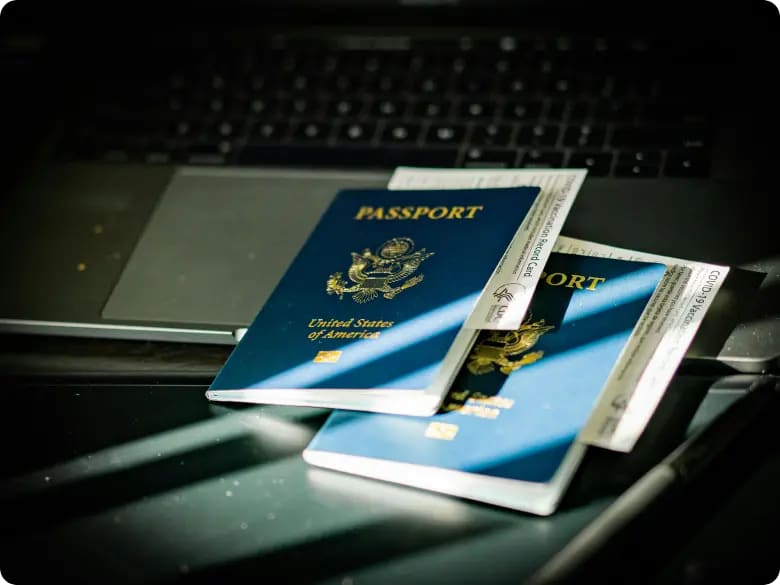
- Consular visa fee: €110 per applicant, 127.11 USD at the US centers in 2026.
- VFS Global service fee: 43.91 USD per application, in New York, Washington DC, San Francisco, Houston and Miami. In New England, Rhode Island, New Jersey, Pennsylvania and Delaware, you apply at the Portuguese consulates in Boston, New Bedford, Providence or Newark instead.
- FBI criminal record (Identity History Summary): 18 USD to the FBI, plus the cost of having your fingerprints taken (police, a private service or a participating Post Office, about 50 USD). It must be issued less than 90 days before you apply.
- Apostille on the FBI record, by the US Department of State: 20 USD per document.
- No translation: US consulates take the FBI record in English, with its apostille.
- Travel insurance for the D7: the price depends on your age and the provider.
In all, plan for about 260 USD per person in fees before insurance, flights and accommodation. Once you arrive, the AIMA residence permit fee is €185.60 (€247.30 at the standard rate).
Is Portugal still welcoming American expats and retirees in 2026?
Yes: Portugal remains a popular destination for American retirees, and the D7 is the usual route for US retirees, pensioners and investors. Two things changed in 2025 and 2026: citizenship now takes ten years of legal residence, and bringing family later takes two years of residence first, so plan the whole household from the start.
What keeps Americans coming on the D7:
- US retirement income counts: Social Security, US pensions, IRA or 401(k) distributions and US rental income, as long as the income is regular and documented.
- Affordable living: outside Lisbon and Porto, everyday costs are lower than in most US metro areas.
- Established expat communities: Lisbon, Porto, Cascais, the Algarve and Madeira have large, active networks of American expats and retirees.
- English goes a long way in daily life in the cities; Portuguese matters for permanent residence (a basic level) and for citizenship.
- Path to EU citizenship: ten years of legal residence on the D7 open Portuguese citizenship and full EU mobility.
- Healthcare: D7 holders can use the SNS (the public system) once registered as residents, and private hospitals with English-speaking doctors.
In short: the D7 application process is well documented, and regular US income is a solid basis for it. The road to citizenship is longer since 2026, so plan for ten years.
Is the D7 a good fit for retirees and investors from outside the US?
The D7 is genuinely global — it works for retirees, investors and pensioners from many backgrounds. Common applicant profiles AnchorLess supports include:
- British retirees post-Brexit, looking to keep EU mobility through Portuguese residency.
- Canadian pensioners moving for affordable living and milder winters.
- South African investors seeking long-term stability and EU access.
- Brazilian applicants combining language affinity with the Portugal Passive Income Visa (and seven years to citizenship instead of ten).
- Australian and New Zealand retirees using the D7 as a base for European travel.
Across these cohorts, the same D7 fundamentals apply: valid passport, proof of accommodation, bank statements, clean criminal record, health insurance, and financial proof of stable income at the Portuguese minimum wage threshold (€920 a month, €11,040 a year) plus matching savings.
For the steps from your own country, see our guides to moving to Portugal from the US, the UK, Canada and Brazil.
Is the D7 visa right for you?
If your own regular income reaches €920 a month and you can show one year of it in savings, the D7 is one of the simplest ways to live in Portugal, alone or with your family, in a beautiful and welcoming country. Prepare your documents carefully and apply together with your family: the move will be all the smoother.
How we checked this guide
The rules, amounts and fees in this guide were checked on 22 October 2026 against the law and the official portals:
- Lei 23/2007, the foreigners’ law (residence visas, permits, family, absences), up to date with Lei 62/2026;
- the consulates’ visa portal (vistos.mne.gov.pt) and AIMA, for documents and fees;
- Portaria 91/2025/1 (the €110 fee) and Lei Orgânica 1/2026 (citizenship);
- the 2026 minimum wage, €920 a month.
Written by Brenda L., relocation expert at AnchorLess. The cost-of-living figures are a rough guide, not official data.
Frequently asked questions
What are the requirements for the Portugal D7 visa?
Be a citizen of a country outside the EU, the EEA and Switzerland, with a regular income of your own of at least €920 a month (€11,040 a year in 2026), savings of the same amount available in Portugal, a clean criminal record, a valid passport and a home in Portugal. Add 50% for a spouse and 30% for each child.
What is the minimum passive income required for the D7 Visa?
The Portuguese minimum wage: €920 a month, or €11,040 a year in 2026, for the main applicant. Add 50% for a spouse or another adult (€5,520) and 30% for each child (€3,312). You also need savings of the same yearly amount.
Can I get a D7 visa without passive income?
The D7 is granted on a regular income of your own that does not come from a job in Portugal: pensions, rents, dividends, interest or royalties. If you earn your living from remote work, the D8 digital nomad visa is the route (€3,680 a month in 2026).
How long does the D7 visa take?
By law, the consulate has 60 days to decide. The visa is then valid 4 months, to travel to Portugal and go to AIMA, which has 90 days (up to 120) to decide on your residence permit.
Can family members be included in the D7 Visa application?
Yes!
Your spouse or partner, your children and dependent parents can apply at the same time as you. For each, you show more income and savings: 50% more for an adult, 30% more for a child.
What counts as proof of accommodation for the D7?
A property deed, a lease (consulates usually ask for at least 12 months), or a term of responsibility signed by a Portuguese citizen or legal resident who hosts you.
Is it necessary to know Portuguese to get the D7 Visa?
No, not for the visa!
Portuguese counts later: basic Portuguese (an A2 certificate, for example) for permanent residence after five years, and Portuguese and knowledge of the country for citizenship.
Can I work in Portugal with a D7 Visa?
Yes!
Your residence permit lets you work in Portugal, employed or self-employed. But the D7 is granted on your own regular income, not on a job: if remote work is your main income, the D8 digital nomad visa fits better.
How long can I stay outside Portugal with a D7?
While your residence permit is valid, no more than 6 months in a row or 8 months in all without a good reason, or AIMA can cancel it. With permanent residence, 24 months in a row or 30 in three years.
Can I travel in Europe with a D7 visa?
Yes: with your D7 visa, then your residence permit, you can visit the other Schengen countries for up to 90 days in any 180. Living or working there needs their own permit.
Reviewed by Raquel Velez · Lawyer (advogada) ·
Share this article