What should I do after receiving my CRUE?
Change your NIF address to Portugal and become a Portuguese resident for fiscal matters.
How long is the CRUE valid?
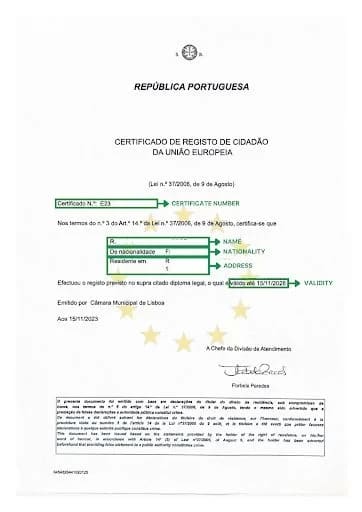
The CRUE is valid for 5 years.
After that, if you want to remain living in Portugal you'll need to convert your certificate into a permanent residency permit with AIMA (the process is very simple).
How to get a CRUE for children?
With your minor child(ren) present, you must do the same process, along with their birth certificate or any documentation that proves your relationship and guardianship.
The legal guardian and the child, must go to the local junta with:
- Child's birth certificate (or family booklet);
- Child's ID;
- Legal Guardian's ID;
- Declaration signed by the minor's guardian in Portugal (if the minor does not have a parent residing in the country).
How welcomed are expats in Portugal?
Portuguese citizens tend to be very accepting and welcoming toward expats.
Though there are some reports of unwelcoming citizens, the large majority is friendly. Several immigrants consider the residents open, helpful, and amiable.
Are there Spanish speakers among the Portuguese people?
A significant number of Portuguese nationals possess the ability to understand or speak Spanish. Remember, Portugal is surrounded by Spain.
The number grows as you get close to the Spanish border or venture into highly touristic areas, like the Algarve.
Are there French speakers among the Portuguese nationals?
Yes, there are!
Especially among Gen X or Boomers. In the past, French was a mandatory class in middle and high school, which has enabled many Portuguese people to converse in French.
There are also international schools for Francophones in Portugal.
Are there German speakers among the Portuguese people?
To be fair, the concentration depends on the area that you are residing in. For example, you'll find a higher concentration of German speakers in the western Algarve compared to the eastern region, likely due to the presence of more DACH immigrants and infrastructure near the Atlantic.
There are German international schools located in Porto, Lisbon, and Algarve, indicating a presence of German speakers in these regions.
Are there Italian speakers among the Portuguese nationals?
Despite the presence of Italian expats in Portugal, it is uncommon to see Portuguese nationals conversing in the language.
You'll find your language spoken quite often in Italian-owned businesses, and in some areas in the Algarve, like Olhão or Quateira.
What are the benefits of CRUE?
- Clear confirmation of residency rights under EU/Portuguese law: Portugal’s EU residence framework guarantees equal treatment with Portuguese nationals (within the limits of EU rules) and confirms your residence status across Portuguese territory.
- Work and self-employment rights: As an EU resident under this regime, you’re entitled to be employed or self-employed in Portugal without needing a work permit.
- Easier access to day-to-day essentials and public services: In practice, the CRUE is commonly used to unlock and smooth admin steps such as healthcare registration (SNS), education-related processes, and other public services, because it proves you’re legally resident rather than “just visiting.”
- Stronger position for housing, banking, and “paperwork life”: Many landlords, banks, and service providers ask for residency proof; the CRUE certificate is the standard document EU citizens can show to demonstrate legal residence in Portugal.
- Enables residence for non-EU family members: If you have non-EU relatives moving with you, your CRUE is typically a core document for their AIMA residence card as family members of an EU citizen (the EU-family route).
- Pathway to longer-term status after 5 years: The CRUE is the starting point that supports eligibility for permanent residence after five years of legal residence (and, depending on the rules in force, can support citizenship planning as well).