





AIMA Portugal: Appointments, Residence Permits & Documents

In short
AIMA in 2026 is a different agency from the one that made headlines for its backlog. On its own numbers most of that historical queue is cleared, a pending file no longer puts you in an irregular situation, and new tools let you track your card, even if the friction has only moved, not vanished. What has not changed is where it lives: getting an appointment, reaching a human, and receiving the physical card.
Summarise this article with the AI of your choice:
AIMA Portugal, officially the Agência para a Integração, Migrações e Asilo, is the immigration agency that decides residence permits, renewals, and family reunification for EU and non-EU citizens. AIMA replaced SEF Portugal in 2023 and now runs the administrative side of Portuguese immigration, from your first AIMA appointment to each residence permit renewal.
If you are moving from outside the EU, EEA, or Switzerland, getting to know AIMA Portugal early saves real trouble later. The paperwork is rarely the problem; the real waits are getting an AIMA appointment and then receiving the residence permit card.
The picture has improved. The historical backlog that defined AIMA has been largely worked through, the residence permit renewal process now runs online through the AIMA portal, and there are free official channels to contact AIMA, if you know which one to use.
Below we cover what AIMA Portugal is and the AIMA services it runs, how to get an AIMA appointment when your visa does not include one, how the online residence permit renewal works, where permanent residence and citizenship fit in, when a lawyer is worth the money, and the latest AIMA news for 2026.
A quick note for EU, EEA, and Swiss nationals: you usually do not need AIMA at the start, since your initial registration goes through the CRUE process. You meet AIMA later, when your CRUE reaches the five-year mark and you move to permanent residency.
Table of contents8
- What is AIMA Portugal?
- How to get an AIMA appointment?
- How to renew your AIMA residence permit
- How much does an AIMA residence permit cost in 2026?
- How do I check my AIMA appointment and application status?
- What if something goes wrong with your AIMA process?
- When is it worth hiring a lawyer for AIMA?
- What are the AIMA updates in 2026?
Get your AIMA application dossier reviewed
Have your AIMA dossier reviewed by a Portuguese lawyer recognised by the Portuguese Bar Association
Review my AIMA application


Review by a Portuguese Immigration Lawyer
100% remote with feedbacks in 3 business days

What is AIMA Portugal?
AIMA is the government agency for integration, migration and asylum, created in 2023 to take over the administrative side of immigration from SEF.
It decides who can live in Portugal legally, issues the residence permits and cards that prove it, and handles asylum and integration alongside.
We'll walk through what that means in practice, starting with its role and its services.
What is AIMA's role in immigration?
AIMA is the Portuguese government body responsible for the legal residency of non-EU, EEA, and Swiss nationals, and for EU citizens once they pass five years of legal residence.
If you fall into that group, AIMA is the immigration agency that controls whether, and how, you can stay in Portugal long-term.
The AIMA role in immigration is administrative, not police work. The AIMA responsibilities are issuing residence permits, deciding renewals, and processing family reunification so a legal resident can bring a spouse, children, or dependent parents.
The throughline: if you are not an EU, EEA, or Swiss citizen and intend to live in Portugal, you need a visa to enter, then a residence permit once you arrive, and your path runs through AIMA.
What services does AIMA provide?
The services AIMA provides fall into three areas: immigration administration, asylum and international protection, and migrant integration. The first two are the administrative work SEF used to do; the third came from the old High Commission for Migration.
Most people only ever touch the first area, but knowing the full range of AIMA services tells you which door is even the right one.
Immigration administration
On the immigration side, AIMA services cover residence permits and the renewal of residence titles.
It also issues residence cards, extensions of stay, permanent residence certificates for EU citizens, residence cards for non-EU family members of EU citizens, and permits for UK nationals covered by the Brexit arrangements.
Two words are worth pinning down first: the visa and the residence permit.
Which are the Portuguese visas?
The visa is what lets you enter Portugal to settle.
For non-EU nationals moving here it is usually a residence (D) visa issued by a consulate, such as the D7 (passive income or pensioners), D8 (remote workers and digital nomads), the work and HQA visas, the student visa, or the family route.
The visa is a temporary entry document; on its own it does not make you a resident. It is the ticket in, and AIMA is what you deal with once you land.
The consulate issues the visa, but AIMA has a binding say in the decision. Under article 53 of the Foreigners Law, a residence visa needs a mandatory prior opinion from AIMA ('parecer prévio'), which runs the migration-risk analysis on your application.
If AIMA does not object within its window the visa can proceed, but a negative AIMA opinion is binding, and the consulate cannot grant the visa over it.
So your file already passes through AIMA before you ever set foot in Portugal.
What is a Portugal residence permit?
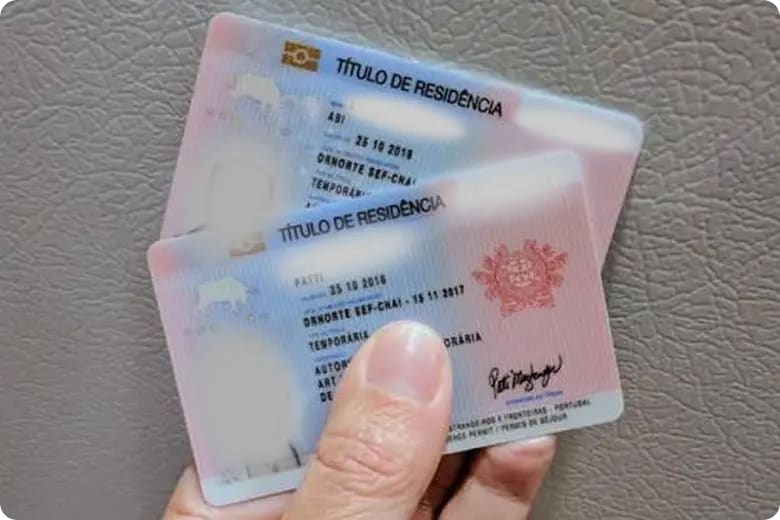
The residence permit ('autorização de residência') is what makes you a legal resident, issued by AIMA after you arrive on your visa.
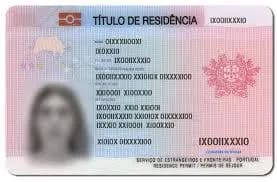
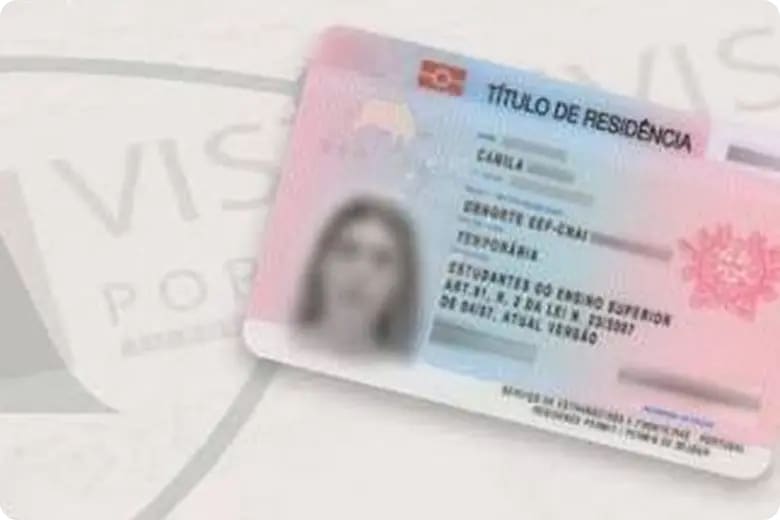
It comes as a physical residence card, usually valid two years and renewable, and is the document that carries your rights to live, work, and access services.
The whole point of the appointment and renewal steps below is getting and keeping this permit, and the application documents you prepare are the same ones AIMA checks at the appointment.
Asylum and international protection
AIMA is the competent body for asylum applications and international protection.
If you are in Portugal as an asylum seeker or a refugee, your file is decided here, under a separate legal track from the residence permits this guide focuses on.
Migrant integration
On the integration side, AIMA runs reception and inclusion programs, anti-discrimination work, and public services such as Portuguese-language resources and migrant support centers.
These integration services are separate from the permit services, but the same agency provides them.
Two supports are worth knowing, because hardly anyone uses them, and both now sit under AIMA.
What are the CNAIM and CLAIM offices?
- CNAIM ('Centros Nacionais de Apoio à Integração de Migrantes') are the large national one-stop centers that bring several public services under one roof: immigration, social security, health, and legal orientation, with phone translation in dozens of languages.
- CLAIM ('Centros Locais de Apoio à Integração de Migrantes') are the local version, smaller offices spread across municipalities that offer the same kind of orientation closer to where you live.
There is also the Migrant Support Line, on 808 257 257 or +351 21 810 61 91 (weekdays, roughly 9:00 to 19:00), which gives information in multiple languages at the cost of a local call.
All three help with orientation: which channel to use, how to fill a form, basic legal guidance. They do not decide your residence case, so use them to find the right door, not to unlock it.
What was SEF, and when was AIMA created?
AIMA was created by Decree-Law 41/2023 and began operating on 29 October 2023, replacing SEF ('Serviço de Estrangeiros e Fronteiras'), which had combined border enforcement with immigration administration.
You will still see AIMA services described in old SEF terms, so treat the two as the same lineage: same files, same offices in many cities, new name and a narrower job.
What does AIMA no longer do?
When SEF was dismantled its work was split up, so you do not turn up at the wrong place.
Safety matters now runs with the Portuguese police force. Border control went to the GNR and PSP (land and sea to the GNR, airports to the PSP), immigration crime and trafficking to the Polícia Judiciária, and passport issuance to the IRN.
AIMA kept the administrative and asylum work; the policing moved to those forces.
What's AIMA's current status?
AIMA today is in far better shape than a year ago: the historic backlog is mostly cleared and renewals now run online.
The friction has shifted to the two steps that are still slow, getting an appointment and receiving the physical card, both of which the 2026 updates below cover in detail.
You'll still see a lot of AIMA related service or information still using SEF Portugal terms.
Get expert immigration answers you can trust
In just 60 minutes, our licensed immigration expert clarifies your best strategy and answers all your questions
Book my immigration consultation
Help identifying the best strategy and visa category for your move
Guidance from our immigration lawyer tailored to your status, goals, and specific questions


How to get an AIMA appointment?
Securing an appointment is the single biggest hurdle of a first residence permit.
Once you are at the counter with a complete file, handing in your residence permit application is usually straightforward; getting the date is what is unpredictable.
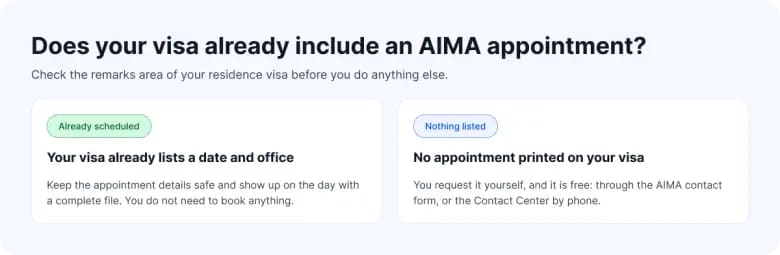
First, check whether you already have one. Many residence visas, including common D7, D8, and D4 cases, are issued with the AIMA appointment already scheduled, and the details travel with your visa paperwork rather than as an obvious booking, so read what the consulate gave you before you request anything.
If none was assigned, you request it through the AIMA Contact Form (contactenos.aima.gov.pt), choosing the option that matches your exact case, because the wrong option leaves the request sitting in the wrong queue.
If no option fits, AIMA also lets you request appointments via email as a written fallback.
Appointments are free: AIMA never charges to schedule one, and it has warned repeatedly about fake booking sites and phishing emails that do. A real payment request appears only later, inside the official portal.
How do I contact AIMA, and which option do I pick?
If your visa did not come with a date, you request the appointment through the AIMA Contact Form (contactenos.aima.gov.pt).
The option matters:
- a non-CPLP consular-visa holder picks 'Autorização de Residência com Visto Consular (Não CPLP)',
- while a CPLP national who entered on a CPLP consular visa picks 'Autorização de Residência CPLP'.
Enter your passport and visa numbers, upload both, and keep the confirmation.
You can also call AIMA on the AIMA Contact Center, +351 217 115 000, weekdays 8:00 to 20:00, or email AIMA at geral@aima.gov.pt.
The phone line is partly outsourced, so whoever answers may not be an AIMA officer, and replies are uneven, so keep every confirmation.
Our dedicated guide to getting an AIMA appointment goes deeper into wait times, asking for an earlier date, a second or missed appointment, and what to do when no date comes.
What documents are needed for a residence permit?
The exact list depends on your route, aka visa, and each one carries its full set of specifications.
In every case, the required documents for residence permit applications must be valid documents on the day you submit:
- usually a valid passport,
- proof of income for your category,
- proof of accommodation,
- health insurance,
- and a criminal record where it applies.
Bring a complete file, and over-prepare. Treat AIMA as the authority it is: if an officer asks for a document, provide it, even when it is not on the published checklist, even when forums swear 'nobody ever asks for that', and even when the request seems unreasonable.
When in doubt, over-prepare, because 'they didn't ask me' is not a reason to leave a document at home.
AIMA can require any document it considers necessary to issue your permit, so try to supply whatever it asks; only if something is genuinely impossible to obtain is it worth a lawyer to push back, and even then, do not assume the request itself is a mistake.
If you entered without a visa (CPLP tourist / waiver)
If you entered without a consular visa, as a tourist or on a visa waiver, be realistic: there is no general way to regularise from inside Portugal.
The 'manifestação de interesse' that used to allow it ended in June 2024, and law changes through 2026 have kept closing doors, including the higher-education student route that many relied on and was being called 'manifestação de interesse 2.0'.
For ordinary work, the rule now is to leave and obtain the correct visa from a consulate, and a refusal comes with a deadline to leave.
A few narrow exceptions still exist in law, not as a general path: certain family cases, being the non-EU family member of an EU citizen who lives here, or a specific situation such as being the parent of a Portuguese child.
Use the CNAIM for return support or a lawyer to check whether one of these actually fits you, rather than expecting a contact channel to regularize you (because chances are it won't).
What if I get a refusal ('indeferimento')?
A refusal usually comes with a deadline to leave, set at 20 to 30 days under the 2026 law, and it can be recorded in the Schengen system for about a year. So do not ignore the letter or let the clock run out.
It is not always the end, though. You can challenge it, through an administrative appeal ('recurso') or in court, and applicants report many refusals overturned.
If a deadline is already running, this is exactly when a lawyer earns the cost.
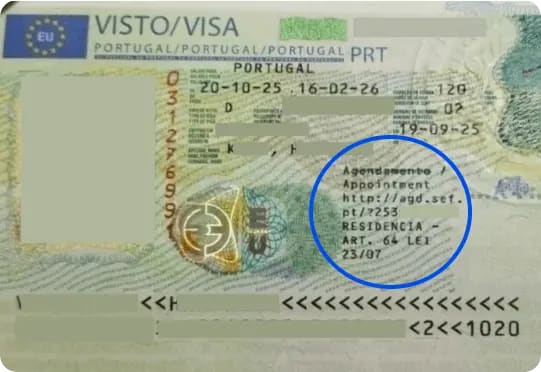
It's not uncommon for the appointment to be placed in an office far from where you are residing. Be mindful of that; check the location early and plan accordingly.
Get your AIMA application dossier reviewed
Have your AIMA dossier reviewed by a Portuguese lawyer recognised by the Portuguese Bar Association
Review my AIMA application
Review by a Portuguese Immigration Lawyer
100% remote with feedbacks in 3 business days
How to renew your AIMA residence permit
Renewing is simpler than the first application, and the renewal process is now online from start to finish.
You renew residence permits through the Renewals Portal (portal-renovacoes.aima.gov.pt): pick the CPLP or non-CPLP route, let AIMA run its automatic checks against the tax authority and Social Security, pay one DUC, and upload documents only if asked.
Most people never visit an office; AIMA calls you in case it needs biometrics or a document check.
The documents for residence permits are lighter for a renewal than for a first application, but they must all be valid documents on the day you submit. Have ready:
- your valid passport,
- proof of accommodation,
- proof of income for your permit category,
- health cover (SNS or private),
- and a criminal record certificate where it applies;
keep your NIF active and your NISS registered, since a mismatch is the usual reason a renewal stalls.
When you submit, the portal checks your standing automatically against the tax authority (AT) and Social Security. A renewal needs those obligations met (article 78), so a real debt can block it.
If the portal returns an 'Em Revisão' (under review) message instead of clearing, that is usually a sync delay rather than a debt, and what to do about it sits with the other common snags further down.
After payment you get a proof-of-renewal receipt, and your right of residence generally continues for a period (usually 6 months) after the card expires while the residence permit renewal is processed, so carry both the expired card and the submission proof until the new one arrives.
The full step-by-step, documents, the payment troubleshooting, and what to do if the portal rejects your permit are in our dedicated AIMA renewal guide.
What about the permanent residence permit?
After a few renewals in the span of 5 years of legal residence, the goal shifts from renewing a temporary permit to permanent residence.
We keep this to an overview, since it has its own guide, but here is where AIMA fits.
How to apply for the permanent residence permit
Five years of legal temporary residence open the door to a permanent residence permit, applied for through AIMA.
Alongside the residence time, the law asks for means of subsistence, accommodation, a clean record, and basic knowledge of Portuguese.
The application follows the same online logic as a renewal: you submit through AIMA's portal with your documents, pay the fee, and attend only if AIMA asks.
What it means and what to expect
Permanent means the permit itself no longer expires.
What you have to renew is the card, every five years, and you must update your data (address, passport, civil status) whenever it changes, since the card carries it.
You keep the obligations of any resident, including tax and Social Security, and long absences can still cost you the status: a permanent permit can be cancelled after 24 consecutive months away, or 30 months spread over a three-year period, unless the absence is justified (article 85 of the Foreigners Law).
EU permanent residency
Two different things carry this name.
- For non-EU nationals, the EU long-term resident status is the alternative to the Portuguese permanent permit after the same five years, and it makes moving to another EU country easier.
- For EU, EEA, and Swiss citizens, whose first five years run through the CRUE registration, the step is a permanent residence certificate requested from AIMA. Since July 2026 that request goes through the Renewals Portal rather than the old contact-form route.
The switch was bumpy: in mid-2026 eligible applicants reported portal errors and emails unanswered for weeks, so leave extra time.
Can I become a Portuguese citizen as a resident?
Yes. Portuguese citizenship by naturalization is based on years of legal residence in Portugal, plus language and clean-record conditions, and it is decided by the IRN, not AIMA.
AIMA matters because the residence time it certifies is what the application rests on, so keep every permit and renewal receipt.
The residence-time requirement was under revision through 2025 and 2026, and the eligibility time increased from five years to the now valid 7 years for CPLP and EU nationals, and 10 years for the remaining applicants.
You can read more in our guide to Portuguese citizenship by naturalization before planning around it.
Get your AIMA application dossier reviewed
Have your AIMA dossier reviewed by a Portuguese lawyer recognised by the Portuguese Bar Association
Review my AIMA application
Review by a Portuguese Immigration Lawyer
100% remote with feedbacks in 3 business days
How much does an AIMA residence permit cost in 2026?
What you are actually paying for
A residence permit fee has two parts: reception and analysis, which pays for AIMA opening and reviewing your file, and grant or renewal, which pays for issuing the permit itself.
Every total in this section already adds the two together. You do not pay them separately.
Since the 2024 rule change AIMA charges both at once, in a single DUC (Documento Único de Cobrança) at the moment you submit, not the analysis now and the grant later.
You then have 10 business days to pay it, and paying only one part first is not how the current system works.
For most applicants the physical card is included in the grant or renewal fee, so you do not pay for the card on top. A separate card cost appears only for people who are exempt from the grant fee, which is explained further down.
How the 25% reduction works
The reduced column in the table below is a 25% reduction set by Portaria 307/2023.
It applies when the act goes through AIMA's digital channel, and also to an in-person application when that procedure is not available digitally yet, so a first permit that AIMA still handles in person does not lose it.
An assisted in-person service, where an online option does exist, gets a smaller 10% reduction.
Two charges never get this reduction: in-pe rson collection and urgent issuance.
What each situation costs
These are the amounts in AIMA's official 2026 table, each total already combining reception-and-analysis with the grant or renewal.
| Situation | Standard | Digital (25% off) |
|---|---|---|
| Temporary permit, grant or renewal | €247.30 | €185.60 |
| Permanent permit, grant (article 80) | €484.10 | €363.20 |
| Permanent permit, title renewal (every 5 years) | €194.90 | €146.10 |
| EU Blue Card, grant or renewal | €329.70 | €247.30 |
| Golden Visa (ARI), grant | €9,261.70 | €6,946.30 |
| Golden Visa (ARI), renewal | €5,053.10 | €3,789.90 |
| Long-term resident (ERLD) | €329.70 | €247.30 |
| Visa-exemption analysis (no consular visa) | €307.20 | €230.40 |
In practice, a first temporary permit or an online renewal is the €185.60 reduced total. Always pay the amount your own DUC generates, not a figure copied from someone else.
Permanent residence is two payments, years apart.
When you move from a temporary permit to permanent after five years, you pay the grant once (€484.10, or €363.20 digital).
The permanent status itself never expires, but the card is renewed every five years, and that renewal is the cheaper €194.90 (or €146.10 digital), not the grant fee again.
Two EU-related documents follow a different, much cheaper regime (Portaria 13/2024), not the table above:
- the residence card for the family member of an EU citizen,
- and the permanent residence certificate an EU, EEA, or Swiss citizen gets after five years through CRUE.
Both are on the same scale, and their online figure is that regime's own rate, not the 25% reduction: €18 in person or €15 online for someone 25 or over, €15 or €12.50 under 25, and free for a child up to age one.
That amount already covers producing the document, so the separate €79.10 card charge from the non-EU regime does not apply to either.
If you collect the card at AIMA, or need it urgently
Two charges sit outside the 25% rule and are the same whichever channel you used.
- Collecting the card in person at AIMA costs an extra €29.90.
- Urgent issuance, by the second business day after approval, adds €47.80.
There is no separate postal-delivery fee in the official table.
When the amounts change
The prices updates automatically every 1 March, by the previous year's inflation index (Article 3, Portaria 307/2023), and it has been in force since 1 March 2026.
So a figure you read, depending on the period, may already have risen; confirm your own amount in the DUC.
What a replacement card (segunda via) costs
A lost, stolen, or damaged card is reissued as a segunda via, and it is not a fresh permit. Under Portaria 307/2023 a second copy costs 50% of the issue fee for that same title (a third copy or later, the full issue fee).
For a common temporary permit that is about €57.15, or €42.90 through the digital channel; a permanent title is half of its own higher issue fee, so more.
That half-fee is the whole charge, not something stacked on top: a reissue does not repeat the reception-and-analysis fee or the grant, and the card itself is already covered, so you are not paying for the permit twice.
The only thing that can be added is how you receive it, the same €29.90 in-person collection noted above, or postage.
These amounts are the official percentage applied to the official issue fees, not a line AIMA prints, so your DUC is what counts, and this is separate from the €79.10 card cost that only exempt applicants pay.
Who is exempt, and what they actually pay
Being exempt from the grant or renewal fee is not the same as paying nothing.
- CPLP nationals (Angola, Brazil, Cape Verde, Guinea-Bissau, Mozambique, São Tomé and Príncipe, every CPLP country except Timor-Leste) are exempt from the grant or renewal fee, so for a temporary permit the €114.30 (or €85.80 reduced) is removed.
They still pay the reception-and-analysis fee and the physical card, so the permit works out to €133 + €79.10 = €212.10, or €99.80 + €59.40 = €159.20 through the digital channel.
CPLP does not mean a free permit.
- Victims of human trafficking or of an illegal-immigration operation are fully exempt from the fee for that specific residence permit.
- International-protection beneficiaries applying for EU long-term-resident status in Portugal are exempt from the reception, issue and renewal of that title.
- Minors get a 50% reduction, but only on certain renewal fees, and only in the specific situations set out in articles 122 and 124 of the Foreigners Law.
It is not half-price for every minor's permit.
Get your AIMA application dossier reviewed
Have your AIMA dossier reviewed by a Portuguese lawyer recognised by the Portuguese Bar Association
Review my AIMA application
Review by a Portuguese Immigration Lawyer
100% remote with feedbacks in 3 business days
How do I check my AIMA appointment and application status?
Once your file is in, the question is always the same: where is it?
AIMA spreads status across a few surfaces that do not always agree, so the first thing to know is which one answers which question.
Checking an appointment
There is no public "look up my appointment" page.
- If your visa came with an appointment, the date and office are on your visa paperwork.
- If you requested one through the contact form, your confirmation email and any later AIMA emails are the record.
Check your spam folder around the date, because AIMA sends and reschedules by email at odd hours, sometimes with little notice.
Checking your application, and what "waiting for a decision" means
To follow a submitted file, use the AIMA contact form at contactenos.aima.gov.pt, choose 'Consulta e acompanhamento do processo', then 'Qual o estado do meu processo?'.
The status wording tells you where you stand:
- 'Pedido em Avaliação' means it is still being decided,
- 'Deferido' means approved,
- and 'Indeferido' means refused.
A refusal is not the end: it can be appealed through a 'recurso', and applicants report many refusals overturned that way.
If you are past AIMA's legal deadline with no decision at all, the lawyer section below is your lever.
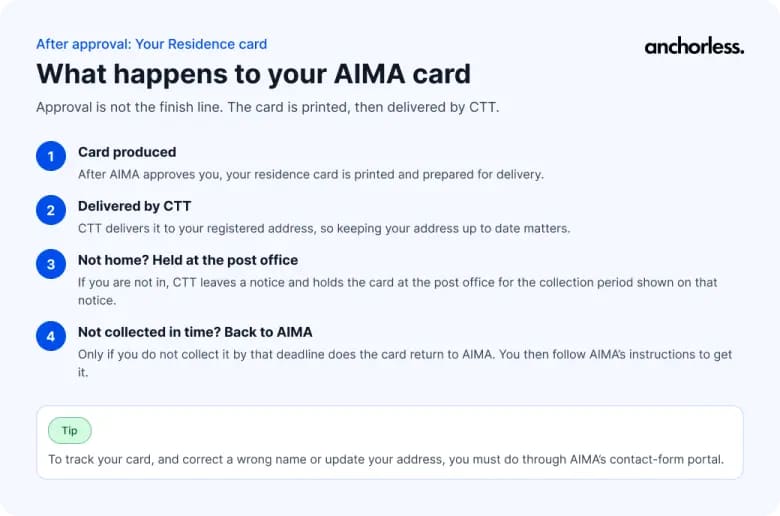
Tracking your card: a decision is not a delivered card
Approval and delivery are two separate stages, and this is where people get stuck.
Using the tracking tool, and how to read it
AIMA's tracking tool, reached through the contact form portal and still in testing, follows your process from decision to card production, dispatch, and delivery, with a tracking code for the card.
It is real progress, though the surfaces do not always agree.
Applicants have watched the Renewals Portal read 'Deferido' for months while the contact form still said 'Cartão em produção', and others had the card in hand while a status still read under review.
Read the tracker as one signal, not the whole story.
Delivery, collection, and your address
Delivery then has two stages of its own.
- If CTT cannot deliver, it leaves a notice and holds the card at the post office for the collection window shown;
- only if you miss that window does the card go back to AIMA, which then publishes a collection notice.
That return-and-collect wait is unpredictable, from days to months, so keep your address current in AIMA's records through the contact form.
While a renewal is pending, carry both the expired title and the submission receipt (the six-month continuation rule is in the renewal section above).
What if something goes wrong with your AIMA process?
Most AIMA trouble follows a handful of patterns, and each has a free first move long before it becomes a legal fight.
This is the practical layer between knowing where your file is and paying a lawyer: what the problem usually is, which channel resolves it, and the point at which a delay stops being normal.
No appointment comes, or you cannot book one
You can try and resubmit through the AIMA Contact Form and confirm you picked the option that matches your exact case, because the wrong one parks the request in a queue no one reads.
A first silence is not yet a problem; many applicants got a date only after long waiting times and, sometimes, requesting it again.
It becomes a real problem once your visa has expired with no date in sight or aknowledgement from AIMA regarding your request for appointment, or a decision deadline has passed with nothing back, which is the point where the missed deadline turns into leverage rather than a wait.
You were approved, but the card has not arrived
A 'Deferido' decision and a card in hand run on separate clocks, and the gap between them is where most people get stuck.
Keep your address current so CTT can deliver, follow the card through the tracking tool, and measure this wait in months after approval, not weeks, before treating it as stuck.
When it has genuinely stalled, the escalation is the deadline route set out below.
A renewal that stalls on 'Em Revisão'
An 'Em Revisão' renewal is almost always the automatic tax-authority and Social Security check flagging a mismatch, not a rejection.
Confirm you are clean on the Portal das Finanças and Segurança Social Direta, keep your NIF active and your NISS registered, and hold onto your certificates, since most of these clear once the systems sync.
A confirmed debt is the one thing that genuinely blocks a renewal, so settle that first, and treat the message as a real problem only if it stays frozen for weeks after you have shown you are clean.
You lost your card, or it was stolen
A lost or stolen card is neither a renewal nor a new permit; it is a segunda via, a reissue of the same title, and it runs on its own track.
Request it through the AIMA Contact Form, choosing 'Autorização de Residência' and then '2.ª via do Cartão/Título de Residência', with a copy of your passport and of your existing title, plus a police report ('participação policial') for a loss or theft.
One catch matters before anything goes wrong: without a saved copy of the title you cannot even start the reissue through the form, so photograph both sides of your card now.
The fee is not a full new permit, only a share of the issue fee for your title, set out with the other costs above. And a segunda via is meant for a card that is not already near renewal; once you are inside the renewal window, you renew rather than reissue.
A missed or rescheduled appointment
AIMA sends and moves dates by email, sometimes at odd hours and with little notice, so a missed appointment is often a missed email.
Check your spam folder around the expected date, and if the slot is genuinely gone, request a new one through the same contact-form option you used before rather than starting fresh somewhere else.
Keep every confirmation, since that email trail is your only record of where you stand.
Wrong data on your card, or a change of address
If the card shows an error, or your address, passport, or civil status changes, you fix it through the AIMA Contact Form, and a change of address can now be done online.
One thing worth knowing: if the mistake is AIMA's own, and you complain within 30 days of collecting the card, the corrected card is reissued free (article 72 of Decree-Regulation 84/2007), unlike a lost-card reissue, which you pay for.
This is not housekeeping: an out-of-date address is a common reason a finished card is delivered to the wrong place and then held or returned.
A permanent-residence card in particular has to be updated whenever the data printed on it changes.
Get expert immigration answers you can trust
In just 60 minutes, our licensed immigration expert clarifies your best strategy and answers all your questions
Book my immigration consultation
Help identifying the best strategy and visa category for your move
Guidance from our immigration lawyer tailored to your status, goals, and specific questions
When is it worth hiring a lawyer for AIMA?
Most of the AIMA process you can do yourself, through channels that are free.
A lawyer earns the cost in the two situations that come up constantly in expat groups:
- when you cannot get an appointment at all,
- and when you were already approved but the card has not come for months.
Everything below is about deciding whether you are in one of those cases.
When does a lawyer actually help?
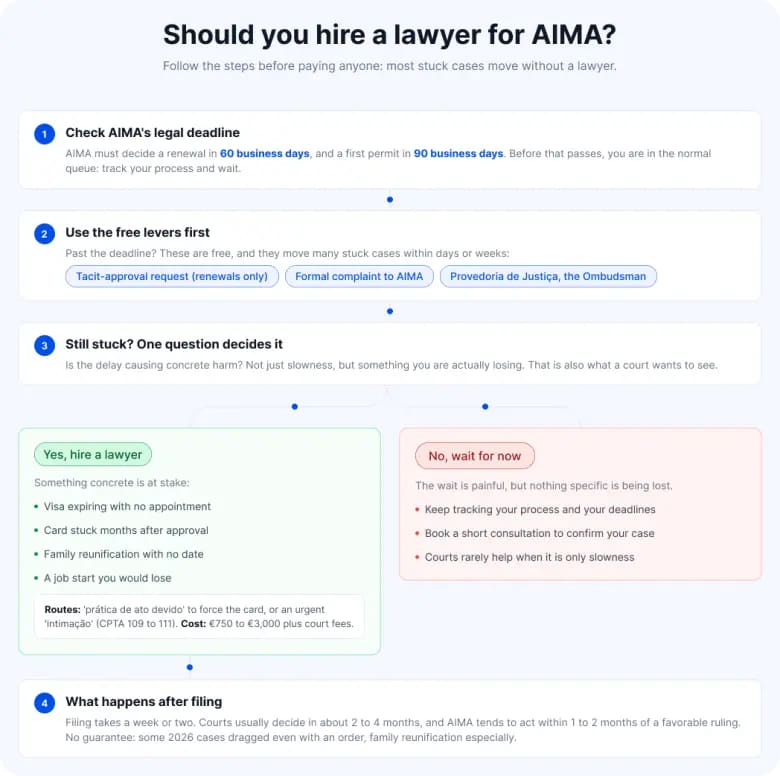
A lawyer helps when there is a legal deadline AIMA has missed and something concrete at stake.
Those are the two conditions a court looks for, and they are also what separates a case a lawyer can move from a case where you would pay to wait in the same queue.
Getting an AIMA appointment through a lawyer is really getting a court to order AIMA to schedule; speeding up a card is getting a court to order AIMA to issue what it already owes you.
What deadline works in my favor?
It depends on whether you are renewing or applying for the first time, and people mix the two up.
Renewals: the 60 business-day decision deadline
Under the Foreigners Law, AIMA has 60 business days to decide a renewal.
Until the second-half of 2026 that silence counted as tacit approval, but Law 62/2026 removed the automatic approval on 11 September 2026.
The deadline still stands; a renewal is simply no longer approved just because 60 days passed.
So the missed 60-day deadline is leverage, not an approval: it is grounds to complain and, if AIMA stays silent, to ask a court to order a decision.
First applications: the 90 busines-days decision deadline
For a first permit, the 90 business-days window is a decision deadline, not automatic approval.
Portuguese courts have rejected the idea that a first permit is granted just because 90 days passed.
Again, what the missed deadline gives you is grounds to escalate and, if needed, to ask a court to order a decision.
How do I use the deadline as leverage?
The deadline is only useful if you invoke it.
The order below is the one immigration lawyers and the community share, and the free steps come first.
How to escalate: request, then Provedoria, then court
Start with a formal request or complaint to AIMA citing the missed deadline, through the contact form, so it is on record.
If nothing moves, take it to the Provedoria de Justiça, the Ombudsman, which is free and has moved stuck files.
Court is the last step, and it is the only one that costs money.
Two court routes
Which action a lawyer files depends on your goal.
'Ação de condenação à prática de ato devido'
This is the route to force a decision or a card AIMA already owes you.
The court orders AIMA to perform the act it was legally required to perform, which is the typical action for an approved renewal with no card, or a first application with no decision long past 90 days.
'Intimação para proteção de direitos, liberdades e garantias'
This is the urgent route (articles 109 to 111 of the CPTA), for an order protecting a right against the delay.
It is not automatic just because AIMA is late: courts have rejected intimações where the applicant did not show that an urgent decision was indispensable to protect a concrete right.
So the case is strongest when the delay causes real, demonstrable harm.
How much does a lawyer cost, and how long does it take?
As quoted by immigration firms in 2026, lawyer fees run from about €750 to €3,000, higher for complex cases, plus court fees ('taxa de justiça').
Filing takes a week or two, the court step around two to four months, and AIMA usually acts within a month or two of a favorable ruling.
Treat those as estimates: some 2026 cases stayed unresolved months after a court order, and family reunification can drag on even with a ruling.
When is it worth it, and when is it not?
It is worth it with a hard deadline or concrete harm.
That means a permit already expired so you slip out of legal status and consequences are being faced, a job with a start date you would lose, a family kept apart because a reunification appointment never comes, or a card stuck for months so you cannot travel or prove your status.
What usually does not justify it is a visa nearing or just past its expiry with no appointment yet. In 2026 that was a common experience, and applicants often got a date after simply waiting and resubmitting the request.
The lawyer case builds when months pass with no response despite documented attempts, or when the delay causes real harm you can point to.
It is usually not worth it if you are in the normal queue with no deadline and no concrete harm.
A short paid consultation to check your case is the smarter first step, and a lawyer who tells you to wait is giving you useful information.
You'll still see a lot of AIMA related service or information still using SEF Portugal terms.
Get your AIMA application dossier reviewed
Have your AIMA dossier reviewed by a Portuguese lawyer recognised by the Portuguese Bar Association
Review my AIMA application
Review by a Portuguese Immigration Lawyer
100% remote with feedbacks in 3 business days
What are the AIMA updates in 2026?
The latest AIMA news in 2026 is dominated by the backlog, renewals, card tracking, family reunification, and the NISS.
Below we covered a bit more of the recent changes.
What happened to the backlog?
The most important AIMA update is that the inherited backlog has been largely cleared.
At its mid-2025 milestone AIMA's recovery task force ('Estrutura de Missão') reported more than 525,000 cases decided and around 458,000 residence cards issued, out of roughly one million inherited, with a small residual of complex files needing extra checks.
That task force wound down at the end of 2025, so treat these as a dated snapshot rather than a live counter; a separate judicial task force has since been clearing a distinct backlog of court cases through 2026.
Golden Visa ARI investment cases continue to be worked through during 2026. AIMA also stresses that having a pending application does not put you in an irregular situation.
What "backlog cleared" actually means
Read it precisely: it means the historical queue of 'manifestações de interesse' and legacy files, not that AIMA has no backlog.
Legacy renewals and older cases can still be stuck, and the reports in this guide show it.
The cautions (decided is not a card; appointment and delivery still slow)
Two cautions, so you plan realistically.
- First, some immigration lawyers dispute the figures, noting that a decided case is not a card in hand and that physical delivery is still slow.
- Second, the two remaining pain points, getting an appointment and receiving the card, have not gone away: in mid-2026 some immigrants reported first appointments set almost a year out, past the expiry of their D visa.
What's new with renewals?
The Renewals Portal keeps opening month by month, and by mid-2026 residents could submit for titles expiring until the end of that year, a clear shift from the old wait-until-expiry pattern.
There are effectively two speeds: titles that expired after mid-2025 move through the portal in days for simple cases, while legacy cases from before that still report waits of a year or more.
The open questions are how fast an early submission becomes a physical card, and the AT/SS validation sync described in the renewal section, which is where a lot of 2026 renewals get stuck.
Card tracking
AIMA's tracking tool, available through the contact form portal and still in testing, lets you follow the process from decision to card production, dispatch, and delivery, with a tracking code for the card.
It is real progress, not yet a perfect source of truth: AIMA's different surfaces (the Renewals Portal, the contact form status, and the physical card) are not always in sync.
In 2026 applicants watched the portal sit on 'Deferido' for months and flip back to 'Pedido em Avaliação' while the contact form still said 'Cartão em produção'; others had the card in hand while a status still read 'under review'.
Use the tracker to stay informed, and do not panic over a single status change.
Delivery itself has two stages. If CTT cannot deliver, it leaves a notice and holds the card at the post office for the collection period shown; only if you do not collect it in time does the card return to AIMA, which then issues a collection notice.
That second wait is unpredictable, from days to months, so keep your address current in AIMA's records through the contact form.
Family reunification
A law at the end of 2025 (Law 61/2025) tightened the rules, and AIMA has been sending scheduling emails promising contact within set deadlines.
In practice it stays one of AIMA's least predictable areas: into mid-2026, applicants still reported ordinary channels producing no appointment, and even court-backed cases taking months to turn into a date.
If a reunification file is what you are waiting on, the lawyer section above applies more than anywhere else.
NISS
Since late 2025 the NISS has been a practical requirement to move a residence file forward.
From mid-2026, AIMA and Segurança Social added a direct digital link so that, when someone attends AIMA in the context of regularization, a NISS can be assigned in real time.
This targets regularization cases, not every AIMA appointment, and it is still new: reports have not established how consistently it works, or whether it reaches renewals as well as first-time cases.
For now, treat automatic NISS issuance as procedure-dependent, and get your NISS in advance if you can.
AIMA Portugal summed up
AIMA in 2026 is a different agency from the one that made headlines for its backlog. On its own numbers most of that historical queue is cleared, a pending file no longer puts you in an irregular situation, and new tools let you track your card, even if the friction has only moved, not vanished. What has not changed is where it lives: getting an appointment, reaching a human, and receiving the physical card.
So plan defensively: Check whether your visa already carries an appointment, use the free official channels rather than paying for a shortcut, lean on the community threads for what is working this month, and keep your NIF, NISS, address, and documents in order.
Getting through AIMA is still one of the harder parts of moving to Portugal, but it is solvable: prepare the file, know which door to knock on, and treat the residence permit as a process to manage steadily rather than one anxious appointment.
Share this article








 MOVING IN EUROPE