2026 guide to Portugal’s visas

Portugal Visas in 2026: Which One You Need and How to Apply

Every Portuguese visa on one page: which one fits your life, what it asks for, what it costs, and the 7 steps to your residence card.

  • Your visa: set by what you will live on in Portugal
  • The fee: €110 for a national visa, children under 6 free
  • The wait: 60 days at most for the consulate to decide

Get the free visa checklist

Arrow
No card required
•
4.8/5 on Trustpilot
Star
Star
Star
Star
Star
Smiling family of three hugging, ready to move to Portugal
White houses of Azenhas do Mar on a cliff above the Atlantic, near Sintra

A Portugal visa is what citizens of countries outside the EU, the EEA and Switzerland need to live in Portugal: a residence visa, from the D1 for a job to the D8 for remote work, that you ask for at the Portuguese consulate where you live, before you move.

In 2026 a national visa costs €110 and the consulate has 60 days to decide. This guide compares every visa, the requirements they share, and the 7 steps from your application to your residence card.

Get your free Portugal visa checklist

Check

Your personal visa checklist for the move

Check

Every document and step for your visa, in one place

Get the free visa checklist

Arrow
No card required
•
4.8/5 on Trustpilot
Star
Star
Star
Star
Star
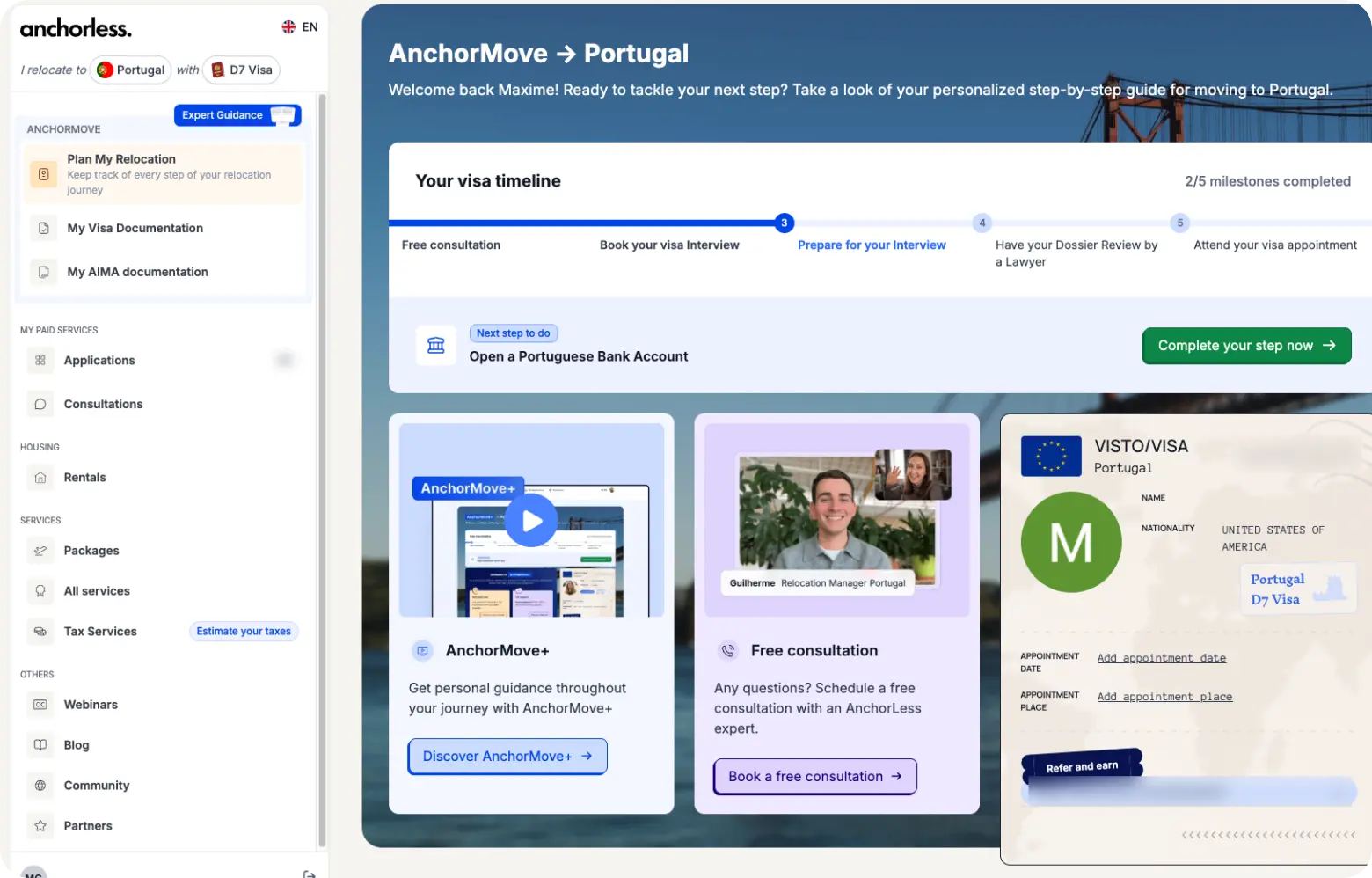
AnchorMove dashboard: your visa timeline for Portugal, next step and free consultation

Portugal visas in 6 numbers (2026)

  • 90 daysin any 180: the longest visit, with or without a visa
  • €110fee for a national visa; children under 6 free
  • 60 daysfor the consulate to decide on a residence visa
  • 4 monthsto enter Portugal and go to AIMA
  • €920a month: the 2026 minimum wage most thresholds start from
  • 10 yearsof residence to Portuguese citizenship

Which Portugal visa fits you? The 30-second check

  • You live on a pension, rents or investments: the D7 visa, from €920 a month of income and €11,040 in savings.
  • You work remotely for an employer or clients outside Portugal: the D8 digital nomad visa, from €3,680 a month.
  • You have a job offer in Portugal: the D1 work visa, or the D3 for a highly qualified job (from €1,611 a month).
  • You will run a business or freelance in Portugal: the D2 visa. The law sets no minimum investment.
  • You will study in Portugal: the study visa (D4), once a school admits you, or the D5 for an exchange.
  • You will join family who live in Portugal: family reunification (D6), usually after their two years of residence.
  • You will invest in Portugal: the Golden Visa (€500,000 in a fund, among other routes), a permit asked from AIMA with no consular visa.

Found yours? Your free account builds the checklist for that visa.

Your spouse and children can apply with you, at the same time. Two visas fit, or none? Ask us in a free call. An EU, EEA or Swiss citizen? You need no visa: our CRUE guide explains how to register.

Create my free account →

Your personal visa checklist, free. No card required.

What changed in 2025 and 2026

  • Visa fee of €110 since March 2025 (it was €90).
  • Minimum wage of €920 in 2026: the D7 needs €920 a month of income, the D8 €3,680, and a year of means is €11,040.
  • CPLP nationals need a residence visa since 23 October 2025: entering as a visitor and asking AIMA for a CPLP permit is over.
  • Family later takes two years: since October 2025, family reunification needs two years of residence first (no wait for minor children), so apply together.
  • The job seeker visa is on hold: since October 2025 it is reserved for specialized technical skills, to be listed by a regulation not yet published.
  • Citizenship after ten years of legal residence since May 2026 (seven for nationals of Portuguese-speaking countries and EU citizens), counted from your first residence permit.

Types of visas in Portugal

Portugal issues three kinds of visas, for three lengths of stay, and one route skips the consulate:

  • Schengen short-stay visa, for visits of up to 90 days in any 180, counted across the Schengen area: tourism, family, business. Citizens of many countries, the US, Canada, the UK and Brazil among them, need none and visit without a visa. The others apply at the consulate of their main destination: €90 for an adult, €45 for a child aged 6 to 12. Our Schengen calculator counts your days.
  • Temporary stay visa, for a stay of less than a year, valid for the whole stay: a study program of a year or less, seasonal work, medical treatment. It covers that stay only: to settle in Portugal, you need a residence visa.
  • Residence visa, the visas known as D1 to D8, to live in Portugal. Valid for 4 months and two entries, it lets you travel to Portugal and ask AIMA, the immigration agency, for your residence permit: 2 years at first, then 3 years at a time, permanent residence after 5 years and citizenship after 10.
  • The Golden Visa is not a consular visa: it is a residence permit for investors, asked from AIMA directly (our Golden Visa guide).

As a rule, a visit does not turn into residence: you ask for your residence visa at the consulate or visa center where you live, before you move. The rest of this guide is about the visas that let you move.

Portugal residence visas: D1 to D8 and the Golden Visa

Each residence visa matches what you will live on in Portugal. The main ones, with their 2026 thresholds:

VisaForFrom (2026)
D1A job offer in Portugal€920 a month
D2Your own business or freelance work€11,040 of means
D3A highly qualified job€1,611 a month
D4A degree at a Portuguese university€11,040 a year
D5An exchange semester or year€920 a month
D6Joining family living in Portugal2 years’ residence
D7A pension, rents or investments€920 a month
D8Remote work for clients abroad€3,680 a month
Golden VisaAn investment kept five years€250,000

Nationals of Portuguese-speaking countries apply for the same visas, with a lighter process: the CPLP regime below.

D1: the work visa

For a job in Portugal you already have: a work contract, a promise of contract or an employer’s expression of interest. The job must pay at least the minimum wage, €920 a month in 2026, and your contract is your proof of means: no savings are asked. There has been no labor market test or yearly quota since 2022, and since September 2026 you change employer by telling AIMA. A visa to come and look for work is not available: since October 2025 it is reserved for specialized technical skills, still to be listed by a regulation. Our D1 guide.

D2: the entrepreneur and freelancer visa

Three routes: a service contract or proposal in a liberal profession (freelancers), a company or an investment in Portugal (entrepreneurs), or an incubation contract with a certified incubator (the Startup Visa). The law sets no minimum investment; you show means of €11,040 for one person (€16,560 for a couple), available in Portugal. Our D2 guide.

D3: the highly qualified visa

For a highly qualified job, a service contract, or an invitation from a university, a research center or a recognized cultural entity. As an employee, you earn at least €1,611.39 a month (three times the 2026 IAS) on a contract of at least 6 months, and hold a degree or five years of comparable experience. Your family can join you without the two-year wait. Our D3 guide.

D4 and D5: the study visas

The D4 is for students admitted by a Portuguese university or polytechnic to a full-time degree program of more than a year: you show €11,040 for your first year (€920 a month), or half if your housing is secured, and a scholarship counts. Your permit lasts up to 3 years, and you may work. The D5 covers an exchange: part of your studies in Portugal through a program or an agreement with your university, with €920 a month of means. Already a student with a residence permit in another EU country? You need no visa: you notify AIMA at least 30 days ahead. Our D4 guide and our D5 guide.

D6: family reunification

For the family of someone who lives in Portugal on a residence permit: a spouse or partner, minor or dependent children, dependent parents. The resident must have held the permit for two years (15 months for a spouse they lived with for 18 months before moving; no wait for minor children), and earn enough for everyone: €920 a month, plus €460 per adult and €276 per child. AIMA decides first, within 9 months, then the family asks for its visas. Moving together avoids the wait: your family can apply for their visas at the same time as you. Our D6 guide.

D7: the passive income and retirement visa

For people who live on a regular income of their own: a pension, rents, dividends, interest or royalties. You need €920 a month of income and €11,040 in savings, available in Portugal, for one person: 50% more for a spouse and 30% more for each child. Our D7 guide.

D8: the digital nomad visa

For remote workers employed by, or working for clients in, other countries. You show an average income of €3,680 a month over the last three months (four times the 2026 minimum wage): the law asks for income, not savings. Our D8 guide.

The Golden Visa (ARI)

A residence permit for investors, asked from AIMA with no consular visa. Real estate no longer qualifies: €500,000 in a Portuguese fund, a company creating jobs or research, €250,000 in arts and heritage, or 10 jobs created. You keep the investment five years and spend 7 days in Portugal in the first year, then 14 days in every two years. Our Golden Visa guide.

Art Nouveau houses along the canal in Aveiro, Portugal

The CPLP visa: for Portuguese-speaking countries

Portugal and the other Portuguese-speaking countries, Brazil among them, signed the CPLP mobility agreement in Luanda on 17 July 2021. Where it is in force, their nationals apply for the visa of their purpose (work, study, retirement…) with a lighter process:

  • No prior opinion from AIMA: the consulate checks the Schengen Information System itself.
  • A shorter document list: the form, two photos, a criminal record certificate and proof of means. Travel insurance is not on the CPLP list.
  • Means can be replaced by a term of responsibility: a Portuguese citizen or a legal resident of Portugal guarantees your food and lodging, with a certified signature, their last IRS return and three months of bank statements. Students admitted to a university are spared the proof of means.
  • A CPLP residence permit: with your residence visa, you ask AIMA for it in Portugal, and AIMA checks your Portuguese criminal record itself.

As a CPLP national, can I come to Portugal without a visa?

To visit, often yes: Brazilians, for example, stay up to 90 days in any 180 without a visa. To live in Portugal, no. Until October 2025, a CPLP national could enter as a visitor and ask AIMA for a CPLP residence permit there; since Lei 61/2025, in force on 23 October 2025, the CPLP permit is for holders of a residence visa, asked at the consulate before you move. Our CPLP visa guide goes into detail.

Portugal visa requirements: what every residence visa asks

Each visa adds its own documents (a contract, an admission, proof of income), but every residence visa application rests on the same base:

  • A valid passport, valid at least 3 months beyond your planned stay (some consulates ask for 6 months from the appointment).
  • The application form and two recent passport photos.
  • A criminal record certificate from your country of nationality and any country where you lived for more than a year, with its apostille or legalized (not for children under 16).
  • Travel insurance covering medical expenses, urgent care and repatriation. Our travel insurance guide explains what consulates check.
  • Proof of means of subsistence, based on the minimum wage (€920 a month in 2026), available in Portugal: in practice, a statement of a Portuguese bank account.
  • Proof of accommodation: a deed, a lease (consulates usually ask for at least 12 months) or a term of responsibility from someone who hosts you.
  • The €110 visa fee, and the service fee where VFS Global or another provider takes applications.

Two Portuguese numbers come first, because the bank and the landlord ask for them: your NIF (tax number) and a Portuguese bank account. You don’t need to speak Portuguese for the visa.

Free visa checklist

Your Portugal visa, step by step, in a free account

  • Your personal visa checklist
  • Every step tracked in your dashboard
  • Expert help when you need it

Free

Create my free account

4.8/51,500+ reviews

No card required

How to apply for a Portugal visa in 7 steps

From your sofa to your Portuguese residence card. Each step says what to do and what it costs. In a free AnchorLess account, you tick them off one by one and get expert help where you need it.

  1. 1

    Choose the right visa for your situation

    Retirement or passive income (D7), remote work (D8), a job (D1 or D3), a business (D2), study (D4), family (D6) or investment (Golden Visa): your visa sets your income test and your documents.

    Take the 30-second checkOr ask us in a free call
  2. 2

    Get your NIF

    Your Portuguese tax number: the bank, the landlord and the visa form all ask for it. You can get it from abroad.

    With us: from €99By email from 24 hours

    Get my NIF
  3. 3

    Open a Portuguese bank account

    Consulates want your means available in Portugal: in practice, a statement of a Portuguese account. Once you live there, it pays your rent and bills.

    With us: €359Opened remotely

    Open my account
  4. 4

    Secure your home

    A lease (consulates usually ask for at least 12 months), a deed, or a term of responsibility from someone who hosts you.

    Lease checked by a lawyer: €99In 48 hours

    Review my leaseOr find your home with us
  5. 5

    Build your visa file

    Criminal record with its apostille, travel insurance, proof of means and accommodation, photos, and your visa’s own documents: the common list is above, each visa’s guide has the rest.

    Lawyer check of the whole file: €299Feedback in 3 business days

    Review my visa file
  6. 6

    Apply at the consulate

    Fill in the form, book your appointment at the Portuguese consulate or VFS Global center for where you live, and pay the €110 fee. The consulate has 60 days to decide.

    €110 per applicantDecision within 60 days

    Find your consulate
  7. 7

    Move to Portugal and get your residence permit

    Within the visa’s 4 months, fly over and go to your AIMA appointment. AIMA has 90 days to decide (up to 120); your first residence card lasts 2 years.

    AIMA fee: €185.60First card: 2 years

    Have your AIMA file checked (€259)

How much does a Portugal visa cost?

FeeWhenAmount
National visa fee, temporary stay or residence (children under 6 don’t pay)When you apply€110
Service fee of VFS Global or another providerWhere one handles applicationsVaries
Schengen short-stay visa, for a visit (child aged 6 to 12: €45)Before a visit€90
First residence permit, at AIMAIn Portugal€185.60

The AIMA fee is €247.30 where the reduced rate does not apply: see the AIMA Portugal fee table in our guide. The Golden Visa costs more at AIMA: €632.10 for the analysis and €6,314.20 for the permit, per person. Add the apostilles of your documents, any translation your consulate asks for, and your insurance.

How long does a Portugal visa take?

By law, the consulate has 60 days to decide on a residence visa; in practice, times vary from one consulate to another. In Portugal, AIMA then has 90 days to decide on your residence permit, which it can extend by 30.

  1. Day 0You apply at the consulate
  2. 60 daysat most for the decision
  3. 4 monthsto enter Portugal and go to AIMA
  4. 90 daysfor AIMA to decide (up to 120)
  5. 2 yearsyour first residence card
  6. +3 yearseach renewal
  7. 5 yearspermanent residence
  8. 10 yearscitizenship

Follow the 7 steps in a free account

Your personal visa checklist, every step tracked. No card required.

Create my free account →

After the visa: your residence permit at AIMA

Your residence visa is valid for 4 months and two entries: the time to move and ask AIMA for your residence permit. Many visas are issued with the AIMA appointment already scheduled: the date and office are in the paperwork the consulate gives you, so read it before you request anything. If no date was assigned, request one through AIMA’s official contact form; appointments are always free. Our guide to getting an AIMA appointment explains which option to pick.

At the appointment, AIMA takes your biometric data and checks your passport and visa, your means of subsistence, your address, your tax and social security registration if you have them, and your health cover. It needs no foreign criminal record: it checks the Portuguese one itself. AIMA has 90 days to decide, which it can extend by 30, then your card arrives at your address.

Applicant at an AIMA service desk in Portugal, getting a residence permit

How long is a Portuguese residence permit valid?

  • Residence visa: 4 months, two entries, to enter Portugal and go to AIMA.
  • First residence permit: 2 years; renewals: 3 years at a time, as long as you live in Portugal and still meet your visa’s conditions.
  • Permanent residence after 5 years with a permit; citizenship after 10.

With your permit you may work in Portugal, employed or self-employed, and visit the other Schengen countries for up to 90 days in any 180. While it is valid, don’t stay away from Portugal for more than 6 months in a row or 8 months in all without a good reason, or AIMA can cancel it. Permanent residence allows up to 24 months away in a row, or 30 months in three years.

Permanent residence and Portuguese citizenship

After five years with a residence permit, you can apply for permanent residence: you need basic Portuguese (an A2 certificate, for example), your means of subsistence and accommodation, and no prison sentence over one year in the last five years. It has no time limit, and its card is renewed every five years.

Ten years after your first residence permit is issued (seven for nationals of Portuguese-speaking countries and EU citizens), you can apply for Portuguese citizenship: you prove that you know Portuguese and, since the 2026 law, Portuguese culture, history and national symbols, citizens’ rights and duties and how the State is organized. An EU passport then lets you live and work anywhere in the EU, the EEA and Switzerland.

Which Portugal visa is right for you?

Start from what you will live on: your own income (D7), remote work (D8), a job (D1 or D3), your business (D2), your studies (D4) or an investment (Golden Visa). One visa usually fits clearly; prepare its file carefully and apply together with your family, and the move will be all the smoother.

Moving from a particular country? Our guides for moving from the US, the UK, Canada, Brazil, Germany, France, Italy and the Netherlands add your country’s side: where to apply, your documents, your taxes.

How we checked this guide

The rules, amounts and fees in this guide were checked on 26 October 2026 against the law and the official portals:

  • Lei 23/2007, the foreigners’ law (visas, permits, family, CPLP, Golden Visa), up to date with Lei 62/2026, and Decreto Regulamentar 84/2007;
  • Portaria 91/2025/1 (the €110 visa fee), Decreto-Lei 139/2025 (the 2026 minimum wage) and Portaria 1563/2007 (means of subsistence);
  • the consulates’ visa portal (vistos.mne.gov.pt) and AIMA (documents, fees, appointments);
  • the European Commission’s pages on Schengen visas and the 90/180 rule;
  • Lei 37/81, the nationality law, as amended by Lei Orgânica 1/2026.

Written by Brenda L., relocation expert at AnchorLess. Each visa has its own guide, with its full sources.

Frequently asked questions

What are the requirements for a Portugal visa?

For a residence visa: be a citizen of a country outside the EU, the EEA and Switzerland, with a valid passport, a criminal record certificate, travel insurance, proof of means of subsistence available in Portugal (based on the €920 minimum wage in 2026), proof of accommodation, and the €110 fee. Each visa adds its own condition: a job contract (D1), €920 a month of your own income (D7), €3,680 a month from remote work (D8), a university admission (D4)…

What types of visas does Portugal have?

Three kinds: the Schengen short-stay visa, for visits of up to 90 days in any 180; the temporary stay visa, for less than a year; and the residence visa (D1 to D8), to live in Portugal and get a residence permit. The Golden Visa is a residence permit for investors, asked from AIMA directly.

Which Portugal visa should I apply for?

The one that matches what you will live on: a pension or other income of your own (D7), remote work for clients abroad (D8), a job in Portugal (D1, or D3 if highly qualified), your own business (D2), studies (D4), family living in Portugal (D6) or an investment (Golden Visa). Not sure? Ask us in a free call.

How much does a Portugal visa cost?

A national visa, temporary stay or residence, costs €110 per applicant; children under 6 don’t pay. A provider such as VFS Global adds its own service fee. A Schengen short-stay visa costs €90 for an adult. In Portugal, a first residence permit costs €185.60 at AIMA (€247.30 where the reduced rate does not apply).

How long does it take to get a Portugal visa?

By law, the consulate has 60 days to decide on a residence visa. The visa is then valid 4 months, to travel to Portugal and go to AIMA, which has 90 days (up to 120) to decide on your residence permit.

Can I move to Portugal without a job offer?

Yes, with a visa that does not need one: the D7 if you live on a pension or other income of your own, the D8 if you work remotely for an employer or clients abroad, the D2 for your own business, or the D4 to study. The job seeker visa is not available: since October 2025 it is reserved for specialized technical skills, still to be listed by a regulation.

Can I apply for residency after entering Portugal as a tourist?

As a rule, no: you ask for your residence visa at the consulate or visa center where you live, before you move, then for your residence permit at AIMA in Portugal. Since October 2025, this applies to nationals of Portuguese-speaking countries too. The Golden Visa is the exception: you ask AIMA for it directly.

Can my family move to Portugal with me?

Yes. Your spouse or partner, your children and dependent parents can apply for their visas at the same time as you, to come with you. Later, family reunification (D6) needs two years of residence first, except for minor children.

Do I need to speak Portuguese to get a Portugal visa?

No, not for the visa. Portuguese counts later: basic Portuguese (an A2 certificate, for example) for permanent residence after five years, and Portuguese and knowledge of the country for citizenship.

Can I travel in Europe with a Portuguese residence visa?

Yes: with your residence visa, then your residence permit, you can visit the other Schengen countries for up to 90 days in any 180. Living or working there needs their own permit.

Team of AnchorLess
Still have questions?

Can't find the answer you're looking for? Contact our team of experts.

Book a free consultation
Beach Portugal

Start your new life in Portugal

Turn relocation stress into success with AnchorLess.

Relocating to Portugal made simple.

Logo AnchorLess

AnchorLess is not a bank, accountant, tax advisor, investment advisor, or law firm, nor are we a government or official government website. We act as an intermediary, helping connect you with accredited professionals and streamlining administrative processes for your relocation in Europe.

Instagram icon
Reddit icon
Linkedin icon
Amex logo
Visa logo
Mastercard logo
& more
Pay 4X free of charge with
Klarna logo

🇪🇸 MOVE TO SPAIN

Arrow

🇮🇹 MOVE TO ITALY

Arrow

🇪🇺 MOVING IN EUROPE

Arrow

© 2022 - 2026 anchorless.io, all rights reserved.