





Average Salary in Portugal in 2026: Gross, Net and What It Means
In short
Understanding salaries in Portugal takes more than looking at one average. The figures are best used as reference points, not as a promise of what you will earn.
Summarise this article with the AI of your choice:
Trying to work out what a good salary looks like in Portugal can get confusing quickly. You will see one number for the average salary, another for regular pay, and a very different amount once taxes and Social Security come out.
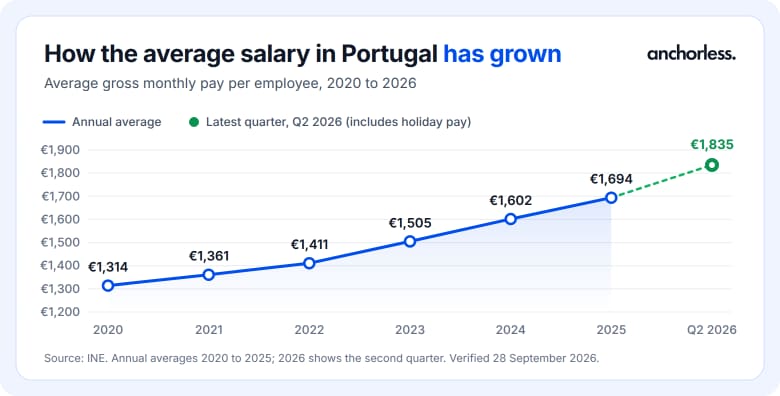
The latest official figure puts average total gross earnings at €1,835 per month in Q2 2026. But be careful with this number. Q2 is usually higher because many workers receive their holiday allowance during this period, so it should not be read as the average monthly pay for the whole year.
One "average salary" does not tell you much on its own. This article looks at which salary number is useful, how much may reach your account, how salaries are paid in Portugal, what different professions can pay, and what those numbers can mean depending on where you live.
Table of contents8
- Average pay in Portugal: total, regular and base
- What does a typical salary look like?
- Gross vs. net salary in Portugal
- Are salaries paid 12 or 14 times a year in Portugal?
- What is a good salary in Portugal?
- How much do salaries vary across Portugal?
- Salary ranges by profession in Portugal
- Common salary questions
Moving to PortugalFree
Talk to us about your move
- Tell us your plans first
- Advice tailored to your move
- Book a time that suits you
4.8/51,500+ reviews
Monthly pay in each part of Portugal, 2024
The average adds up every salary and divides by the number of employees, so a few high salaries pull it up. The median is the salary in the middle: half earn less, half earn more.
Latest complete data: 2024, when the minimum wage was €820 a month on the mainland, €850 in Madeira and €861 in the Azores.
All of Portugal
€1,576 average gross pay a month
€1,187 median gross pay a month
- Median
- €1,187
- Average
- €1,576
- Middle half of employees
- €986 to €1,686
Pick a subregion on the map or in the list.
Grande Lisboa
€1,936 average gross pay a month
€360 (23%) above the national average
€1,410 median gross pay a month
€224 (19%) above the national median
- Median
- €1,410
- Average
- €1,936
- Middle half of employees
- €1,047 to €2,221
- Rank
- 1 of 26
- Rank
- 1 of 26
Área Metropolitana do Porto Norte
€1,620 average gross pay a month
€44 (3%) above the national average
€1,238 median gross pay a month
€51 (4%) above the national median
- Median
- €1,238
- Average
- €1,620
- Middle half of employees
- €1,007 to €1,760
- Rank
- 2 of 26
- Rank
- 2 of 26
Região de Aveiro Centro
€1,492 average gross pay a month
€84 (5%) below the national average
€1,224 median gross pay a month
€37 (3%) above the national median
- Median
- €1,224
- Average
- €1,492
- Middle half of employees
- €1,015 to €1,646
- Rank
- 4 of 26
- Rank
- 3 of 26
Região de Leiria Centro
€1,435 average gross pay a month
€141 (9%) below the national average
€1,200 median gross pay a month
€13 (1%) above the national median
- Median
- €1,200
- Average
- €1,435
- Middle half of employees
- €998 to €1,588
- Rank
- 7 of 26
- Rank
- 4 of 26
Península de Setúbal
€1,545 average gross pay a month
€31 (2%) below the national average
€1,159 median gross pay a month
€27 (2%) below the national median
- Median
- €1,159
- Average
- €1,545
- Middle half of employees
- €962 to €1,645
- Rank
- 3 of 26
- Rank
- 5 of 26
Região de Coimbra Centro
€1,424 average gross pay a month
€152 (10%) below the national average
€1,152 median gross pay a month
€34 (3%) below the national median
- Median
- €1,152
- Average
- €1,424
- Middle half of employees
- €981 to €1,545
- Rank
- 9 of 26
- Rank
- 6 of 26
Baixo Alentejo Alentejo
€1,469 average gross pay a month
€107 (7%) below the national average
€1,142 median gross pay a month
€45 (4%) below the national median
- Median
- €1,142
- Average
- €1,469
- Middle half of employees
- €963 to €1,590
- Rank
- 6 of 26
- Rank
- 7 of 26
Alentejo Central Alentejo
€1,372 average gross pay a month
€204 (13%) below the national average
€1,142 median gross pay a month
€45 (4%) below the national median
- Median
- €1,142
- Average
- €1,372
- Middle half of employees
- €980 to €1,479
- Rank
- 12 of 26
- Rank
- 7 of 26
Médio Tejo Oeste e Vale do Tejo
€1,367 average gross pay a month
€209 (13%) below the national average
€1,132 median gross pay a month
€55 (5%) below the national median
- Median
- €1,132
- Average
- €1,367
- Middle half of employees
- €975 to €1,475
- Rank
- 13 of 26
- Rank
- 9 of 26
Lezíria do Tejo Oeste e Vale do Tejo
€1,364 average gross pay a month
€212 (13%) below the national average
€1,125 median gross pay a month
€62 (5%) below the national median
- Median
- €1,125
- Average
- €1,364
- Middle half of employees
- €958 to €1,469
- Rank
- 14 of 26
- Rank
- 10 of 26
Alto Minho Norte
€1,340 average gross pay a month
€236 (15%) below the national average
€1,118 median gross pay a month
€69 (6%) below the national median
- Median
- €1,118
- Average
- €1,340
- Middle half of employees
- €973 to €1,411
- Rank
- 15 of 26
- Rank
- 11 of 26
Viseu Dão Lafões Centro
€1,332 average gross pay a month
€244 (15%) below the national average
€1,117 median gross pay a month
€69 (6%) below the national median
- Median
- €1,117
- Average
- €1,332
- Middle half of employees
- €970 to €1,421
- Rank
- 16 of 26
- Rank
- 12 of 26
Cávado Norte
€1,403 average gross pay a month
€173 (11%) below the national average
€1,115 median gross pay a month
€72 (6%) below the national median
- Median
- €1,115
- Average
- €1,403
- Middle half of employees
- €969 to €1,477
- Rank
- 11 of 26
- Rank
- 13 of 26
Madeira
€1,407 average gross pay a month
€169 (11%) below the national average
€1,113 median gross pay a month
€74 (6%) below the national median
- Median
- €1,113
- Average
- €1,407
- Middle half of employees
- €988 to €1,461
- Rank
- 10 of 26
- Rank
- 14 of 26
Alto Alentejo Alentejo
€1,295 average gross pay a month
€281 (18%) below the national average
€1,113 median gross pay a month
€74 (6%) below the national median
- Median
- €1,113
- Average
- €1,295
- Middle half of employees
- €958 to €1,370
- Rank
- 20 of 26
- Rank
- 15 of 26
Azores
€1,432 average gross pay a month
€144 (9%) below the national average
€1,106 median gross pay a month
€80 (7%) below the national median
- Median
- €1,106
- Average
- €1,432
- Middle half of employees
- €971 to €1,447
- Rank
- 8 of 26
- Rank
- 16 of 26
Alentejo Litoral Alentejo
€1,481 average gross pay a month
€95 (6%) below the national average
€1,100 median gross pay a month
€87 (7%) below the national median
- Median
- €1,100
- Average
- €1,481
- Middle half of employees
- €955 to €1,508
- Rank
- 5 of 26
- Rank
- 17 of 26
Algarve
€1,320 average gross pay a month
€256 (16%) below the national average
€1,100 median gross pay a month
€87 (7%) below the national median
- Median
- €1,100
- Average
- €1,320
- Middle half of employees
- €958 to €1,397
- Rank
- 19 of 26
- Rank
- 17 of 26
Oeste Oeste e Vale do Tejo
€1,324 average gross pay a month
€252 (16%) below the national average
€1,099 median gross pay a month
€87 (7%) below the national median
- Median
- €1,099
- Average
- €1,324
- Middle half of employees
- €958 to €1,421
- Rank
- 17 of 26
- Rank
- 19 of 26
Ave Norte
€1,322 average gross pay a month
€254 (16%) below the national average
€1,073 median gross pay a month
€114 (10%) below the national median
- Median
- €1,073
- Average
- €1,322
- Middle half of employees
- €954 to €1,378
- Rank
- 18 of 26
- Rank
- 20 of 26
Beira Baixa Centro
€1,279 average gross pay a month
€297 (19%) below the national average
€1,073 median gross pay a month
€114 (10%) below the national median
- Median
- €1,073
- Average
- €1,279
- Middle half of employees
- €958 to €1,352
- Rank
- 22 of 26
- Rank
- 20 of 26
Beiras e Serra da Estrela Centro
€1,293 average gross pay a month
€283 (18%) below the national average
€1,067 median gross pay a month
€119 (10%) below the national median
- Median
- €1,067
- Average
- €1,293
- Middle half of employees
- €955 to €1,363
- Rank
- 21 of 26
- Rank
- 22 of 26
Terras de Trás-os-Montes Norte
€1,268 average gross pay a month
€308 (20%) below the national average
€1,045 median gross pay a month
€142 (12%) below the national median
- Median
- €1,045
- Average
- €1,268
- Middle half of employees
- €956 to €1,281
- Rank
- 24 of 26
- Rank
- 23 of 26
Douro Norte
€1,269 average gross pay a month
€307 (19%) below the national average
€1,044 median gross pay a month
€143 (12%) below the national median
- Median
- €1,044
- Average
- €1,269
- Middle half of employees
- €951 to €1,299
- Rank
- 23 of 26
- Rank
- 24 of 26
Tâmega e Sousa Norte
€1,211 average gross pay a month
€365 (23%) below the national average
€1,033 median gross pay a month
€153 (13%) below the national median
- Median
- €1,033
- Average
- €1,211
- Middle half of employees
- €935 to €1,236
- Rank
- 25 of 26
- Rank
- 25 of 26
Alto Tâmega e Barroso Norte
€1,207 average gross pay a month
€369 (23%) below the national average
€1,010 median gross pay a month
€177 (15%) below the national median
- Median
- €1,010
- Average
- €1,207
- Middle half of employees
- €940 to €1,224
- Rank
- 26 of 26
- Rank
- 26 of 26
Average gross pay a month
- under €1,300
- €1,300 to €1,399
- €1,400 to €1,499
- €1,500 to €1,599
- €1,600 to €1,799
- €1,800 and over
Median gross pay a month
- under €1,050
- €1,050 to €1,099
- €1,100 to €1,149
- €1,150 to €1,199
- €1,200 to €1,299
- €1,300 and over
All 26 subregions, ranked
| Rank | Subregion | Average | Median | Middle half of employees |
|---|---|---|---|---|
| 1 | Grande Lisboa | €1,936 | €1,410 | €1,047 to €2,221 |
| 2 | Área Metropolitana do Porto | €1,620 | €1,238 | €1,007 to €1,760 |
| 3 | Península de Setúbal | €1,545 | €1,159 | €962 to €1,645 |
| 4 | Região de Aveiro | €1,492 | €1,224 | €1,015 to €1,646 |
| 5 | Alentejo Litoral | €1,481 | €1,100 | €955 to €1,508 |
| 6 | Baixo Alentejo | €1,469 | €1,142 | €963 to €1,590 |
| 7 | Região de Leiria | €1,435 | €1,200 | €998 to €1,588 |
| 8 | Azores | €1,432 | €1,106 | €971 to €1,447 |
| 9 | Região de Coimbra | €1,424 | €1,152 | €981 to €1,545 |
| 10 | Madeira | €1,407 | €1,113 | €988 to €1,461 |
| 11 | Cávado | €1,403 | €1,115 | €969 to €1,477 |
| 12 | Alentejo Central | €1,372 | €1,142 | €980 to €1,479 |
| 13 | Médio Tejo | €1,367 | €1,132 | €975 to €1,475 |
| 14 | Lezíria do Tejo | €1,364 | €1,125 | €958 to €1,469 |
| 15 | Alto Minho | €1,340 | €1,118 | €973 to €1,411 |
| 16 | Viseu Dão Lafões | €1,332 | €1,117 | €970 to €1,421 |
| 17 | Oeste | €1,324 | €1,099 | €958 to €1,421 |
| 18 | Ave | €1,322 | €1,073 | €954 to €1,378 |
| 19 | Algarve | €1,320 | €1,100 | €958 to €1,397 |
| 20 | Alto Alentejo | €1,295 | €1,113 | €958 to €1,370 |
| 21 | Beiras e Serra da Estrela | €1,293 | €1,067 | €955 to €1,363 |
| 22 | Beira Baixa | €1,279 | €1,073 | €958 to €1,352 |
| 23 | Douro | €1,269 | €1,044 | €951 to €1,299 |
| 24 | Terras de Trás-os-Montes | €1,268 | €1,045 | €956 to €1,281 |
| 25 | Tâmega e Sousa | €1,211 | €1,033 | €935 to €1,236 |
| 26 | Alto Tâmega e Barroso | €1,207 | €1,010 | €940 to €1,224 |
| All of Portugal | €1,576 | €1,187 | €986 to €1,686 |
Gross pay before tax and Social Security, including regular extras and overtime, of full-time employees on full pay in 2024, by where they work. Most of the public administration is not included. Sources: INE, Quadros de Pessoal 2024; map © DGT, CAOP 2025.
Average pay in Portugal: total, regular and base
The INE (Statistics Portugal, the national statistics office) publishes several salary figures because they measure different parts of what workers are paid.
| Average gross pay a month | Q1 2026 | Q2 2026 (latest) | Full year 2025 |
|---|---|---|---|
| Total gross pay | €1,616 | €1,835 | €1,694 |
| Regular gross pay | €1,427 | €1,436 | €1,365 |
| Base gross pay | €1,333 | €1,342 | €1,277 |
All figures are INE's: Q1 2026 as revised on 14 August 2026, Q2 2026 published the same day, and the 2025 annual average published on 13 February 2026. INE counts per job, so a person with two jobs counts twice, and part-time jobs are included.
Be careful when considering quarters. Q2 and Q4 tend to be higher because holiday allowance is commonly paid around Q2 and Christmas allowance around Q4, which doesn't happen in Q1 and Q3. Based on this pattern, AnchorLess expects Q3 to be closer to Q1 and Q4 to be closer to Q2. This is an AnchorLess estimate based on the usual seasonal pattern, not a forecast of the exact values.
What is the difference between total, regular and base pay?
- Base gross pay is the fixed salary paid for normal working hours, before meal allowance and other extras.
- Regular gross pay adds payments received every month, such as the taxable part of the meal allowance (above €6.15 a day, or €10.46 on a meal card) and other monthly supplements.
But "regular" has a specific statistical meaning here. A payment can happen often in real life and still not count as regular pay. Overtime, night work and commissions, for example, are counted in total pay instead.
- Total gross pay includes the regular amount plus variable or periodic remuneration received during the period. That can include holiday and Christmas allowances, overtime, night work, commissions and other non-monthly payments.
That is why total pay can be much higher than regular pay.
In Q1 2026:
€1,616 total − €1,427 regular = €189
In Q2:
€1,835 total − €1,436 regular = €399
Regular and base pay barely changed between Q1 and Q2. The big change was in total pay.
INE's quarterly data do not show how much of those €189 or €399 came from overtime, commissions, holiday allowance or other payments. So the difference should not be read as holiday allowance alone.
What does a typical salary look like?
Averages are useful, but they do not show what a worker in the middle of the pay scale earns.
| Reality check | Amount | Period | What it means |
|---|---|---|---|
| Median gross monthly earnings | €1,186.55 | 2024, latest available | Half of workers earned less than this and half earned more. |
| Employees earning €1,000 gross base salary or less | 56% | November 2025 | Before meal allowance and extra pay such as night work, shifts, overtime or work on holidays/rest days. |
| Minimum wage (mainland Portugal) | €920 gross/month | 2026 | Legal monthly minimum on the mainland. |
| Minimum wage (Madeira) | €980 gross/month | 2026 | Regional minimum. |
| Minimum wage (Azores) | €966 gross/month | 2026 | Regional minimum. |
The 2024 national median comes from Quadros de Pessoal, the annual workforce records employers submit to the Ministry of Labour, where average monthly earnings were €1,576.03 while the median was €1,186.55.
By November 2025, 55.9% of employees were receiving €1,000 or less in gross base salary (rounded to 56% in the table), according to Social Security pay data reported by the CGTP, a Portuguese trade union confederation.
The 2026 minimum wage is €920 on mainland Portugal, €980 in Madeira and €966 in the Azores.
Why does the median matter?
The median is not the same as the average.
Imagine putting every worker's salary in order from lowest to highest. The median is the salary right in the middle: half of workers earn less and half earn more.
Take this fictional group:
€920 · €950 · €1,000 · €1,100 · €5,000
The median is €1,000, because two people earn less and two earn more.
The average is €1,794, because the €5,000 salary pulls the result sharply upward.
That is why the median is a better guide to what a typical worker in Portugal earns.
In the 2024 data, average monthly earnings were almost €390 higher than the median. So a high national average does not mean that most workers earn close to it.
Gross vs. net salary in Portugal
Your gross salary is not what reaches your bank account.
Employees normally pay 11% of their gross salary to Social Security. IRS (Portuguese income tax) withholding depends on how much you earn and your personal situation.
There is no single net salary that applies to everyone in Portugal. Your take-home pay can change according to your gross salary, marital status, dependants and whether you live on the mainland, Madeira or the Azores. For the mainland, our Portugal salary calculator estimates yours from your gross salary.
The examples below use the 2026 mainland withholding tables published by the Portuguese Tax Authority (AT) for a single employee with no dependants, plus the standard 11% employee Social Security contribution. Your employer pays a further 23.75% on top of your gross salary.
| Gross monthly salary | Social Security | Approx. IRS withholding | Approx. net/month |
|---|---|---|---|
| €920 | €101.20 | €0 | €818.80 |
| €1,500 | €165 | ~€168 | ~€1,167 |
| €2,000 | €220 | ~€301 | ~€1,479 |
| €2,500 | €275 | ~€471 | ~€1,754 |
| €3,000 | €330 | ~€663 | ~€2,007 |
These are AnchorLess calculations based on the official withholding tables, not an official estimate of Portugal's average net salary.
At the €920 mainland minimum wage, monthly IRS withholding is 0%, but the employee still pays the 11% Social Security contribution.
That leaves about €818.80, before any meal allowance paid separately.
November 2026: only half the usual IRS is withheld from pay, and from a Christmas allowance, paid in November 2026 (Despacho n.º 12523-A/2026). On €2,000 gross, that month's net pay is about €1,629 instead of €1,479. Parliament has also approved lower IRS rates for 2026, backdated to January; once they are published, the difference comes back as a refund in your 2027 tax return.
Under 35? With IRS Jovem, part of your income is tax-free during your first ten years of work: 100% the first year, 75% in years two to four, 50% in years five to seven and 25% in years eight to ten, up to €29,542.15 of exempt income a year in 2026. Tell your employer which year you are in, and the exemption shows on your pay slip.
Apply for your Portuguese NISS online in just 5 minutes
An easy, secure way to get your Portuguese NISS, officially processed with the social security office and includes your Segurança Social Direta password.
Get your Portuguese NISS now


100% online process
Apply from abroad
Password for your Segurança Social Direta account
Are salaries paid 12 or 14 times a year in Portugal?
In standard Portuguese employment, annual pay usually includes:
- 12 regular monthly salaries
- 1 holiday allowance
- 1 Christmas allowance
The holiday allowance is extra pay. Under the Labour Code, you still receive your normal salary while you are on holiday, plus the holiday allowance.
By law, unless otherwise agreed in writing, the holiday allowance is paid before the holiday period. In practice, most employers pay it in the middle of the year.
The Christmas allowance must normally be paid by 15 December.
Meal allowance is generally paid only for days you actually work, so it is normally not paid during annual leave unless a contract or collective agreement says otherwise. It is tax-free up to €6.15 a day paid with your salary, or €10.46 a day on a meal card (2026).
What are duodécimos?
Some employers and employees agree to spread the holiday and Christmas allowances across the year. This is known as paying them in duodécimos (twelfths).
This is not automatic.
It depends on what the employer and employee agree, or on rules in the employment contract or a collective agreement.
Your annual salary stays the same. Only the timing of the Christmas and holiday allowances changes.
| Annual gross salary Paid over 14 payments Allowances spread over 12 months | ||
| €28,000 | €2,000 per payment | about €2,333/month |
Portuguese salaries are usually quoted monthly rather than annually, so always check whether the amount is paid 12 or 14 times a year before comparing offers.
What is a good salary in Portugal?
There is no single amount that counts as a good salary everywhere in Portugal.
Housing is the biggest reason. €1,500 net can mean something very different for someone renting a room in a smaller city and someone renting an apartment alone in Lisbon.
Using the same 2026 payroll example (a single employee with no dependants on the mainland), the numbers look roughly like this:
| Gross monthly salary | Approx. net monthly salary | What it can mean in practice |
|---|---|---|
| €1,500 gross | €1,167 net | A modest income. Living alone can be difficult in Lisbon and other expensive rental markets. |
| €2,000 gross | €1,479 net | More room for everyday expenses, but rent can still take a large share of the budget in Lisbon, Porto and parts of the Algarve. |
| €2,500 gross | €1,754 net | More manageable for one person, especially outside the most expensive housing markets. |
| €3,000 gross | €2,007 net | Considerably more flexibility for housing, leisure, unexpected expenses and saving. |
These descriptions are AnchorLess's general assessment, not fixed rules about what is affordable.
Two people earning exactly the same salary can have completely different budgets because of rent, household size, location and other expenses.
When comparing a job offer
Check whether the salary is gross or net, whether it is paid 12 or 14 times a year, and whether a meal allowance is paid separately.
Then estimate your normal take-home pay and compare it with your housing and everyday costs.
If holiday and Christmas allowances are paid separately, treat them as extra income rather than money you need to make your normal monthly budget work.
How much do salaries vary across Portugal?
Salary levels differ considerably by location.
Among the municipalities below, 2024 average gross earnings ranged from €1,354 in Viseu to €2,121 in Lisbon.
The figures below are for 2024, the latest year with comparable data for each municipality.
Average monthly gross earnings by municipality, 2024
| Municipality | Average monthly gross earnings |
|---|---|
| Lisbon | €2,121 |
| Porto | €1,930 |
| Aveiro | €1,619 |
| Viseu | €1,354 |
| Évora | €1,485 |
| Faro | €1,484 |
These figures come from Quadros de Pessoal, the Labour Ministry's workforce records (its statistics office, formerly GEP, is now the DGCP), published by INE and PORDATA. They cover full-time employees in October 2024.
These are gross earnings, not take-home salaries.
The figures refer to the municipality, not the wider district or region.
INE also publishes earnings by nationality: in 2024, the median for non-EU employees was €1,022.50 a month nationally (€1,069.83 in Lisbon and €1,134.58 in Porto), against €1,220.71 for Portuguese employees. These figures are a general reference, not specific to expats.
What is a good salary in Lisbon?
Lisbon has the highest salary level among the municipalities in this comparison, but it also has the most expensive housing market.
As a rough budgeting guide:
| Situation | Approx. net income |
|---|---|
| Renting a room and keeping costs controlled | €1,000–€1,300 |
| Living alone (tight budget) | €1,600–€1,700 can work in some cases, but rent dominates the budget |
| Room + more flexibility for leisure or saving | €1,700–€2,000 |
| Living alone comfortably | around €2,700–€3,000 |
| Couple renting together | around €3,000 combined can provide a more comfortable budget |
"Living alone comfortably" here means being able to rent your own place while still having room for regular leisure, unexpected expenses and at least some saving.
Lisbon also has more tech, finance and international-company jobs, which, in AnchorLess's view, helps explain why some higher-paid positions are more common there than in smaller labour markets.
Salaries and rent in Porto
Porto's average gross earnings are lower than Lisbon's, while housing is usually a bit cheaper.
A T1 (one-bedroom apartment) in Porto had a median asking rent of about €1,003 per month in Q2 2026. That is an asking rent advertised on idealista, not necessarily what tenants eventually sign for. For signed new leases, INE gives a median of 14.66 €/m² in Porto in Q2 2026 (16.77 €/m² for studios and T1s), against 17.79 €/m² in Lisbon.
That means rent can still take a very large part of an ordinary local salary. €1,003 is more than half of Porto's average gross monthly earnings (€1,930).
Porto and the wider North have more manufacturing, technical and engineering jobs, alongside tech and services. In AnchorLess's view, this wider mix of jobs, including more specialized roles, helps push average salaries up.
What about salaries in the Algarve?
The Algarve has a different problem. Local salaries can be relatively low while housing in popular areas remains expensive. In Faro, average gross monthly earnings were €1,484 in 2024, compared with €2,121 in Lisbon.
Coastal towns such as Faro, Olhão, Tavira, Albufeira and Lagos can be expensive compared with local pay. Moving further inland can lower housing costs a lot.
In Faro city, the median asking rent for a T1 was around €1,001 in Q2 2026. Algarve rents can change a lot from season to season, so asking prices from a single month should be read with caution.
The labour market is different too.
In the Algarve, there is less demand for many office positions, while tourism, construction and hospitality need a lot of workers. In AnchorLess's view, that can keep some qualified office salaries low. In tourism, construction and hospitality, higher demand can push pay up.
A degree does not always mean a bigger salary. In places where there are fewer office positions but strong demand for construction, trades or hospitality workers, some of those jobs can pay as much as, or more than, entry- or mid-level office positions.
Salary ranges by profession in Portugal
People in the same profession can earn very different salaries, depending on their experience, employer and location. That is why a salary range can be more useful than a single average.
The ranges below are gross monthly salary estimates for Portugal in 2026 from WageIndicator, an independent foundation that collects and publishes salary data. They show the typical starting range and the estimated range after five years for a 40-hour working week.
| Profession | Starting range (gross/month) | After 5 years (gross/month) |
|---|---|---|
| General practitioner | €1,855–€3,485 | €2,171–€4,399 |
| Specialist medical practitioner | €1,664–€3,739 | €1,997–€4,846 |
| Dentist | €1,166–€2,530 | €1,360–€3,182 |
| Nurse | €1,153–€1,829 | €1,380–€2,365 |
| Physiotherapist | €985–€1,535 | €1,163–€1,943 |
| Software developer | €1,375–€2,257 | €1,603–€2,800 |
| Marketing & advertising specialist | €1,028–€1,661 | €1,204–€2,063 |
| HR specialist | €1,004–€1,466 | €1,163–€1,801 |
| Financial analyst | €1,225–€2,114 | €1,424–€2,613 |
| Accounting technician | €991–€1,553 | €1,018–€1,671 |
| Electrician | €995–€1,506 | €1,013–€1,537 |
| Plumber | €926–€1,145 | €942–€1,175 |
| Bricklayer | €1,012–€1,683 | €1,034–€1,748 |
| Cook | €973–€1,372 | €985–€1,447 |
| Waiter | €943–€1,411 | €957–€1,513 |
These are WageIndicator estimates, not official government figures.
The ranges are wide because they cover both the start of a career and about five years in.
That is why professions overlap: a job that needs years of study can start below one that needs less training and only pull ahead later.
A degree does not guarantee a higher salary, and it is not unusual to find people in marketing, HR, accounting or admin roles earning close to the minimum wage.
File your Portuguese IRS online, handled by expert tax accountants
A stress-free way to file your Portuguese IRS, officially submitted to Finanças by certified Portuguese tax pros. NHR and IFICI status fully supported, foreign income handled.
File my Portuguese IRS now
Filed by certified Portuguese tax accountants
NHR / IFICI status fully supported
100% online; no need to be in Portugal
Common salary questions
Is €1,500 a good salary in Portugal?
€1,500 gross is a modest salary. For the example used in this article, it comes to roughly €1,167 net per month.
It can be workable with lower housing costs or shared accommodation, but living alone in expensive rental markets can be difficult.
Is €2,000 a good salary in Portugal?
Around €1,479 net (for the example used in this article) gives more breathing room, but because of housing costs, it is a very different budget in Lisbon compared with a smaller inland city.
Is €2,500 a good salary in Portugal?
At approximately €1,754 net (for the example used in this article), €2,500 gross is much easier to manage for one person in many parts of Portugal.
In the most expensive rental markets, however, living alone can still take a large share of that income.
Is €3,000 a good salary in Portugal?
For the example used here, €3,000 gross comes to roughly €2,007 net per month.
That leaves more room for saving, though rent in Lisbon or another expensive market can still take a big share.
Can you live on €1,000 a month in Portugal?
It depends on whether you mean gross or net and, above all, on housing.
€1,000 net can be manageable with a room, inexpensive housing or low fixed costs.
€1,000 gross leaves much less: about €890 after the 11% Social Security contribution, and less again if IRS is withheld. It also gives very little room for renting on your own in the country's more expensive markets.
What is the minimum wage in Portugal in 2026?
The gross monthly minimum is:
- €920 on mainland Portugal
- €980 in Madeira
- €966 in the Azores
Every employee, including on the minimum wage, also gets holiday and Christmas allowances. Self-employed people on recibos verdes are not employees, so neither the minimum wage nor the allowances apply to them.
Bottom line
Understanding salaries in Portugal takes more than looking at one average. The figures are best used as reference points, not as a promise of what you will earn.
When looking at a job offer, compare it with salaries for your profession and location, check what you will actually receive after deductions, and consider whether the salary is paid 12 or 14 times a year.
Share this article









 MOVING IN EUROPE