Finance
OUR EXPERT
Brenda L.

Written by

Brenda.L

After completing her higher education, Brenda joined AnchorLess in 2023. She is an expert on relocation issues in Europe.
WHY YOU CAN TRUST ANCHORLESS
+10,000
Expats guided
1176

reviews noted 4.9/5

Invoices
Portugal
12/03/2026

Invoices Portugal: Essential e-Fatura Guide

validate invoices Portugal

Moving to Portugal often means learning a new administrative language. Very quickly, you start hearing the same terms over and over again: NIF, Portal das Finanças, e-Fatura, recibos verdes, IRS, SAF-T, ATCUD.

If you need to validate invoices in Portugal, the key thing to know is this: the e-Fatura portal is mostly about checking expenses linked to your NIF so they are counted correctly for IRS deductions. For expats, freelancers, and self-employed workers, the process can also affect how personal versus professional expenses are treated. On the business side, Portugal’s invoicing rules go further, with certified invoicing software, ATCUD, QR code requirements, SAF-T reporting, and specific business to government e-invoicing standards.

For many expats, the first confusion is simple. They hear “validate invoices in Portugal” and assume it refers to confirming income invoices. In practice, for most individuals, the e-Fatura portal is mainly where you check invoices tied to your tax identification number so your deductible expenses are correctly classified for IRS. For freelancers and independent workers, there is one extra layer: some expenses also need to be marked as personal, professional, or mixed.

Then there is the business side. If you issue electronic invoices in Portugal, especially through your own software or to public entities, the compliance picture is broader. Certified invoicing software, invoice series communication, ATCUD, QR code, SAF-T reporting, and business to government standards all come into play.

This guide brings those pieces together in one place so expats living in Portugal, planning to move, freelancing, or running a business can understand what matters, what does not, and where the rules split between personal tax deductions and formal e-invoicing compliance.

How to validate invoices in Portugal?

What “validate invoices in Portugal” usually means for individuals

For most residents, validating invoices in Portugal means using the e-Fatura portal to review expenses connected to your tax identification number and confirm they are in the right deduction category. This is the part that can reduce the tax you pay or improve your refund.

That is why your supermarket receipt, pharmacy bill, restaurant invoice, gym receipt, veterinary expense, and some health or education costs may all matter. If they were issued with your NIF, they can appear inside e-Fatura.

For expats, this is one of the most misunderstood parts of the Portuguese tax system. In public Reddit discussions, people regularly confuse e-Fatura validation with income reporting, especially freelancers who already issue recibos verdes or work with an accountant. In practice, these are different workflows. Your income invoices and your deductible personal expenses are not the same thing.

The e-Fatura portal validation process step by step

How to access the portal

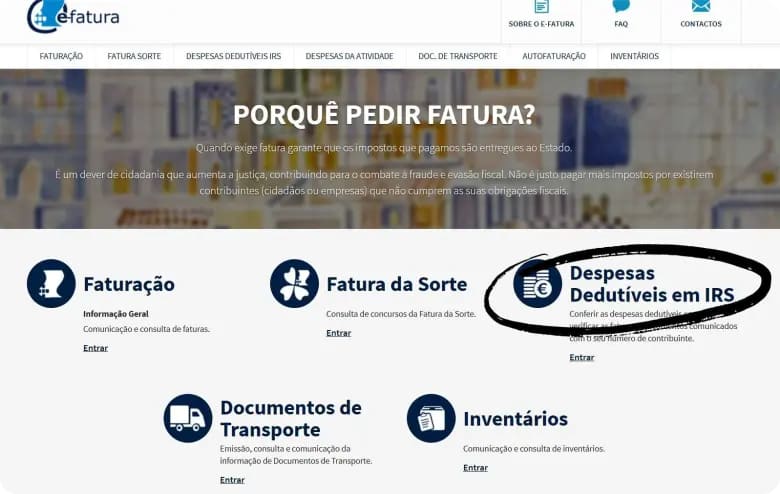
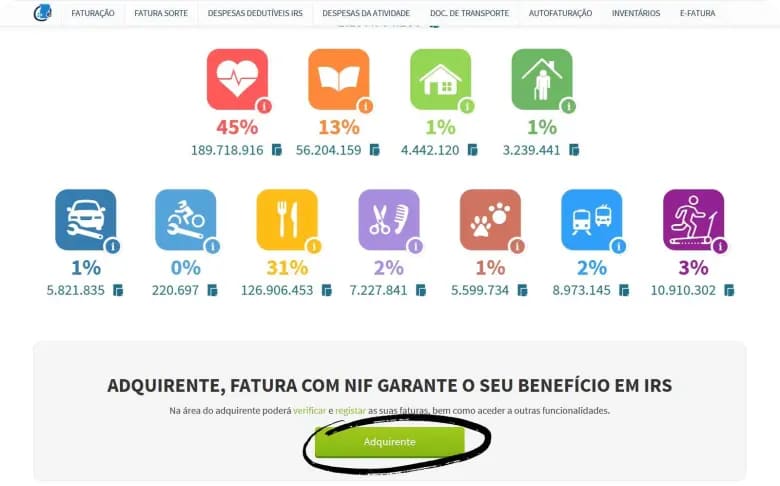
Go to the e-Fatura portal through Portal das Finanças. Inside the deductible expenses area, choose Adquirente or Consumidor and log in with your NIF and Portal das Finanças password.

If you are validating expenses for a household, each member may need access credentials, including dependents.

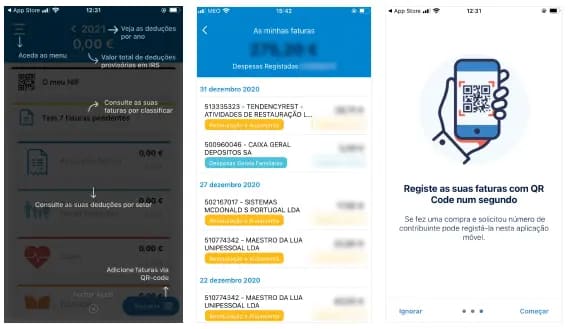
You can also access e-Fatura through the e-Fatura app.

digital invoice concept image

How to check invoices

Once inside, you can check invoices, review provisional deductions, and open the area for invoice verification. The system also lets you search for invoices already communicated by merchants.

If an invoice is missing, it may simply not have been uploaded yet. In public expat discussions, one recurring point is that some invoices only show up later, often in the following month, so monthly check-ins are more useful than leaving everything for February.

e-fatura how it works guide

How to validate pending invoices

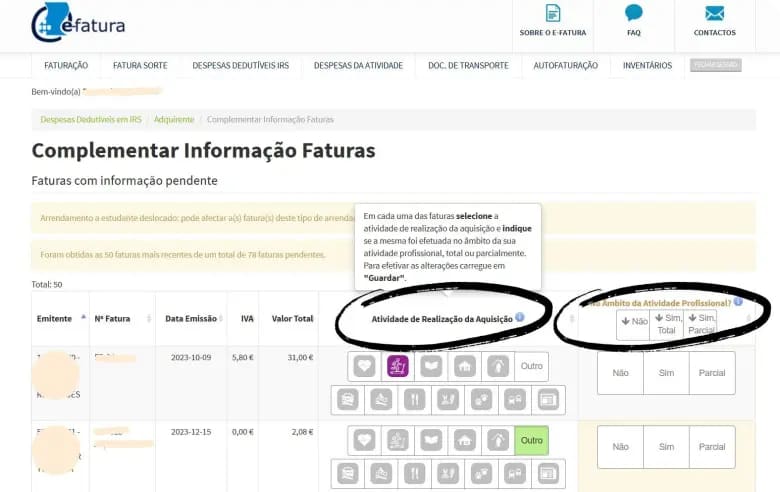
If the platform shows pending items, click the option to validate pending invoices or complete additional invoice information. A pending invoice usually means one of two things:

  • The Portuguese tax authority could not automatically determine the correct category, often because the merchant has multiple business activity codes.
  • Or you are self-employed and must indicate whether the expense is personal, professional, or mixed.

You then assign the invoice to the proper category and save it. If several invoices come from the same supplier and belong to the same category, the portal may let you apply the same classification to all of them.

Step-by-step invoice validation

Before the steps, one detail is worth clarifying in the article: the official interface usually shows the menu labels in Portuguese, so readers will normally see paths such as FATURAÇÃOADQUIRENTE or ConsumidorVerificar FaturasRegistar Faturas, and Resolver Pendências or Complementar Informação Faturas. The Portuguese tax authority also says consumers should regularly classify invoices either in the e-Fatura app or in Portal das Finanças. 

Step 1. Access the e-Fatura portal

First, access the e-Fatura portal through Portal das Finanças and open the consumer area. In the official help structure, the route appears under FATURAÇÃO > ADQUIRENTE / Consumidor.

This is the starting point for anyone trying to validate invoices in Portugal and begin the validation process. You’ll need your NIF password to login into this area.

Step 1 workflow guide
step 2 guide illustration

Step 2. Review your provisional deductions

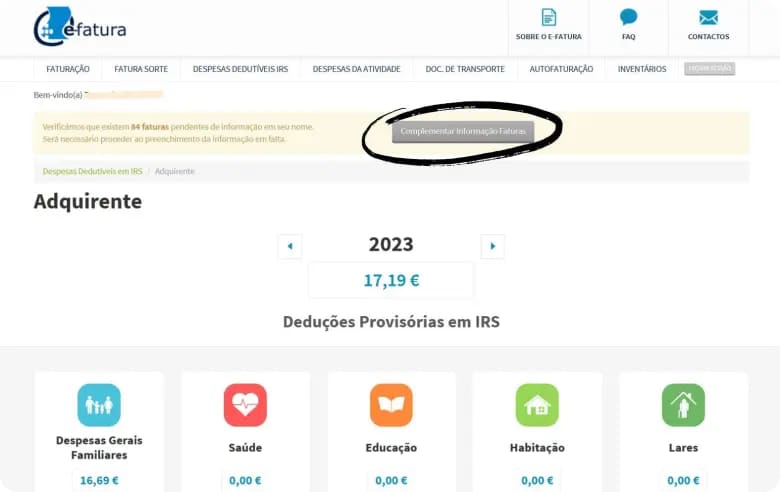
After logging in, you will see the area with your provisional IRS deductions. This is where the portal shows the expense sectors already associated with your NIF, such as Despesas Gerais FamiliaresSaúdeEducaçãoHabitação, and Lares. It gives you a quick way to check invoices and see whether anything still needs attention. To validate pending invoices, you’ll need to click ‘Complementar Informação Faturas’ in the warning at the top.

blog step three guide

Step 3. Open the invoice verification area

After clicking **Complementar Informação Faturas (**this is the route taxpayers use to consult invoices already communicated by merchants and to identify missing, pending, or misclassified entries) you should confirm whether invoices were communicated and whether they were inserted in the correct sector, and if not, you can validate them accordingly.

Step 4. Validate pending invoices one by one

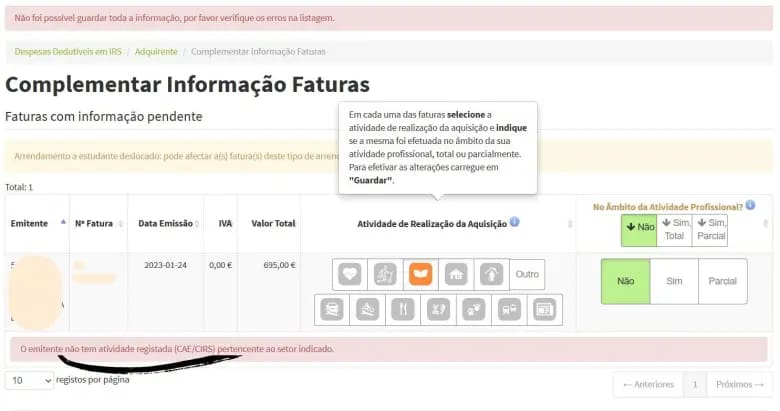
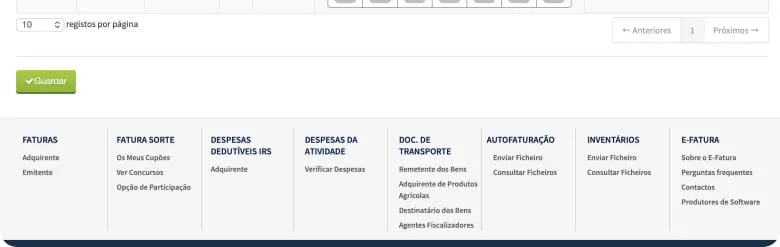
If the portal shows pending items, open Resolver Pendências or Complementar Informação Faturas and classify them one by one. After choosing the correct option, click Guardar.

step by step guide image

If you are a freelancer or independent worker, this is the step that matters most. The system may ask whether the expense was totally related to your activity, partially related to it, or private. That extra classification layer is part of normal compliance for self-employed taxpayers in Portugal. 

Step 5. Correct or add invoices when needed

If an invoice is in the wrong category, select it and use Alterar to reclassify it. If an expense is missing entirely, use Registar Faturas to enter it manually. If you did not give your NIF at the time of purchase, you may still communicate the invoice through the e-Fatura app by reading the QR code (if want to). For manually registered invoices, the tax authority says you should keep the supporting document for four years.

Step 6. Link medical prescriptions when necessary

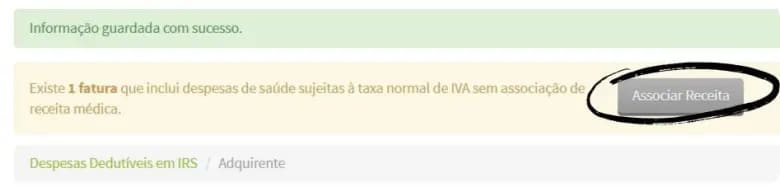
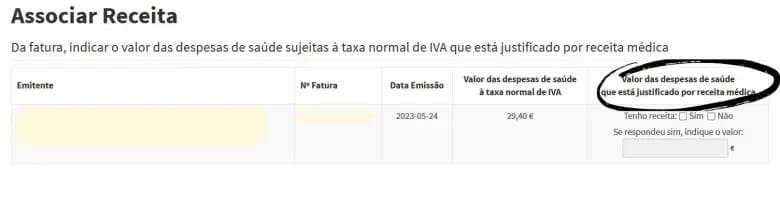
For some health expenses, especially those taxed at the standard 23% VAT rate, simply having the invoice is not enough. To deduct these as health expenses in IRS, you also need to indicate that there is a valid medical prescription and ensure the expense is correctly validated in e-Fatura. Otherwise, the expense may not be accepted in the health category.

step six process guide
step 7 guide blog image
step prescription medication guide

Step 7. Save everything and do not leave it to the last week

Once you finish, save all changes.Pending invoices have to be validated individually, so keep checking them during the year instead of leaving everything for the end. If you miss the deadline, some expenses such as health, education, lares, and imóveis may still be entered manually in the IRS return, but general family expenses and the IVA-benefit categories depend much more heavily on timely validation.

You can finalize everything by clicking ‘Guardar’ at the bottom of the page.

person saving money success

If you are a freelancer or self-employed

For independent workers, the validation process becomes more important. Some invoices have to be marked as:

  • personal
  • professional
  • mixed or partial

This matters because Portuguese tax rules treat self-employed expenses differently from ordinary household deductions. In other words, if you work on recibos verdes, do not assume e-Fatura is only an annual consumer task. It also interacts with how part of your business-related spending is recognized.

What expats in Portugal usually get wrong

  • Many expats think asking for a NIF on a receipt is optional paperwork rather than a tax habit that affects deductions.
  • Many freelancers confuse validating expense invoices with reporting income.
  • Many new residents wait until late February, then discover they still need to sort personal versus professional expenses, missing invoices, or health receipts that require a prescription link.

The pattern is clear. Portugal rewards people who check e-Fatura regularly, not just once at year end.

Main IRS deduction categories in e-Fatura

General family expenses (Despesas gerais e familiares/Outros)

This is the broad default category for everyday personal spending that does not fit a more specific sector. In practical terms, this usually includes things like supermarket purchases, clothing, electricity, water, gas, telecoms, and similar day-to-day costs. For tax year 2025, the official Finanças guide states a deduction of 35% up to 250 euros per taxpayer, with a higher rule for single-parent households.

Health (Saúde)

The health category includes eligible medical expenses and health insurance, but the detailed treatment depends on VAT and documentation. The official deduction guide states a general deduction of 15% up to 1,000 euros, health items taxed at 23% generally need a valid medical prescription to count properly as health expenses.

Education (Educação)

Education includes eligible school and training costs. For tax year 2025, the official guide states a deduction of 30% up to 800 euros, with specific increases possible in some student-rent situations.

Housing (Habitação)

Housing covers eligible rent and, in some older legacy cases, certain mortgage-interest situations. For tax year 2025, the official deduction guide shows 15% of eligible rent with a current cap of 600 euros, while older qualifying mortgage-interest cases remain capped separately.

Lares

This category covers eligible expenses with care homes, home support, and similar institutions. The official rule remains 25% with a cap of 403.75 euros.

VAT-benefit categories that also matter in e-Fatura

Vehicle repairs (reparação de automóveis or motociclos), restaurants and accommodation (restauração e alojamento), hairdressers or beauty institutes (cabeleireiros)

These sectors fall under the VAT-benefit rules. The official deduction guide shows that these invoices can generate a deduction of 15% of the VAT paid, subject to the global cap that applies to this group.

Public transport passes and tickets (Transporte públicos coletivos)

For monthly passes and certain public transport tickets, the official guide shows a more favorable rule: 100% of the VAT paid, within the applicable cap structure.

Veterinary expenses and veterinary medicines (Atividades veterinárias)

These are also eligible, but under a different VAT percentage. The official guide states that veterinary medicines qualify at 35% of the VAT paid, within the same overall cap logic for VAT-benefit categories.

Newspapers and magazine subscriptions (Jornais e revistas)

The current official guide includes eligible newspapers and magazines, including digital ones, with 100% of the VAT paid counting under the relevant cap.

Gyms and certain fitness or sports activities (Ginásios)

The official guide also includes gym-fitness and certain recreational or sports-teaching services, with a deduction of 30% of the VAT paid, again inside the same overall cap structure.

The category expats most often misunderstand

For many expats, the confusing part is that e-Fatura categories are about deductible expenses, not your freelance income invoices.

If you are self-employed, there is an extra layer on top of the normal categories: the tax authority says you must also classify whether a given expense is personaltotally professional, or partly professional. That is why freelancers often see more pending items than ordinary employees.

!: If an invoice does not belong clearly to health, education, housing, lares, or one of the VAT-benefit sectors, it will usually end up working like a general family expense rather than a special deduction category.

What are the requirements for electronic invoicing?

Individual expense validation versus formal electronic invoices

This is where many articles online blur two separate topics.

For residents and expats using e-Fatura as consumers, the focus is on validating deductible expenses.

For businesses issuing electronic invoices, the focus is on requirements, legal form, system setup, and ongoing compliance.

These are related, but they are not the same.

The core requirements for businesses

If you issue invoices in Portugal through your own system, the compliance framework can include:

Certified invoicing software

Portugal maintains a certified software model. Businesses that fall within the relevant rules and thresholds may need certified invoicing software approved by the tax authorities. The logic behind certification is integrity, traceability, and auditability of invoice data.

Digital signature and qualified electronic signature

Portuguese law also sits within the wider EU trust-services framework. A qualified electronic signature carries the legal effect of a handwritten signature across the EU. In Portugal, PDF invoices continue to be accepted as electronic invoices through the current transition period that runs until the end of 2026, which is why many businesses are still using PDF workflows while preparing for stricter digital-signature compliance.

Invoicing rules and invoice content

Portugal’s invoicing rules also require invoices to include essential data such as supplier and customer identification, tax identification numbers where applicable, sequential numbering, description of goods or services, VAT rates, tax amounts, and other mandatory fields under the VAT Code.

When this matters for expats

If you are an expat freelancer issuing invoices only through Portal das Finanças, some of the technical burden is lighter. But if you open a company, adopt third-party billing software, or invoice public entities, these electronic invoices rules become much more relevant.

What is the deadline for invoice validation?

The deadline for invoice validation changes by year

The deadline for invoice validation is not always the same calendar date every year.

The practical rule is simpler: the deadline is usually the end of February, and if that date falls on a weekend or holiday, it moves to the next working day.

For expenses from 2025, the Portal das Finanças calendar pointed to 2 March 2026 for validating invoices from the previous year.

Do not confuse this deadline with monthly business reporting

Expats who freelance or run a small business often mix up two separate deadlines:

The annual consumer-side deadline to validate invoices for IRS deductions.

And the issuer-side reporting duty to submit invoices or invoice elements regularly to the tax authorities.

These are not the same thing.

The annual e-Fatura deadline is about your deductible expenses as a taxpayer or household member.

The monthly issuer deadline is about invoice communication and business reporting, including monthly SAF-T style obligations and invoice-data submission schedules, depending on how your invoicing process is set up.

Why the deadline matters

If you miss the invoice-validation deadline, you may still recover some categories later in the IRS return, especially health, education, care homes, and certain property expenses. But the VAT-related benefit categories are much stricter. In those cases, missing the validation window can mean losing the deduction entirely.

That is why good accountants and good tax planners in Portugal usually recommend checking e-Fatura every month.

How to ensure compliance with Portuguese tax laws?

Start with the Portuguese tax authority’s logic

To ensure compliance with Portuguese tax laws, it helps to understand how the Portuguese tax authority sees the system.

Portugal’s model is built around one big idea: the tax authorities want reliable fiscal data, traceable invoice series, and consistent reporting. This is why the country uses e-Fatura for consumers, invoice communication for issuers, software certification, QR code, ATCUD, and the audit file for tax known as SAF-T.

For individuals, compliance means asking for invoices with your NIF, keeping records, checking pending expenses, and making sure they are correctly classified.

For businesses, compliance means using the right issuing method, keeping invoice series configured correctly, and meeting the reporting rules that apply to your structure.

A practical compliance routine for expats

If you are an employee or regular resident

Use your NIF whenever the expense could be deductible. Then log into e-Fatura monthly and confirm that your invoices are appearing in the right categories.

If you are self-employed

Check whether each relevant expense is personal, professional, or mixed. This is one of the most common freelancer error points in Portugal.

I#### f you run a company

Make sure your invoicing method matches Portuguese law, especially if you use software outside the Portal das Finanças environment.

What is the role of ATCUD in invoicing?

ATCUD is now a mandatory compliance field in many business workflows

ATCUD is one of the central elements of modern invoice compliance in Portugal. It is a unique document code that links a document to a pre-communicated series and a sequential number.

In practical terms, this means the invoice is easier for the tax authority to trace and validate.

How it works

Before using an invoice series, the business communicates the series and receives a validation code. That code becomes part of the final ATCUD string. Once the series is active, each invoice in that sequence uses the code.

This is why ATCUD is not just decorative text on an invoice. It is part of the control structure.

ATCUD and QR code

Portugal also requires a QR code on relevant invoicing documents in the certified-software environment. Together, ATCUD and QR code make invoice data easier to trace, verify, and audit.

Important detail for Portal das Finanças users

If documents are issued directly in Portal das Finanças, the series communication is automatic, and the system includes the relevant ATCUD logic for those documents. That is useful for smaller operators who are not building their own invoice engine.

How to configure invoice compliance details?

What businesses need to configure

If you need to configure invoice compliance details in Portugal, the setup usually revolves around six areas.

1. Tax identification data

Supplier and customer tax identification fields need to be correctly structured, especially when VAT treatment depends on the counterpart’s status.

2. Series and ATCUD

Your invoice series must be created properly, communicated to the tax authority, and linked to the correct validation code before use.

3. QR code and output format

Your system should produce the required QR code and display invoice elements correctly in the final output.

4. SAF-T and reporting export

Your software should be able to generate the appropriate reporting and audit file for tax outputs, especially if you are not using the native Portal das Finanças flow.

5. Business to government requirements

If you invoice public entities, business to government compliance is a separate layer. Portugal’s public-sector e-invoicing framework uses CIUS-PT aligned with the European standard, and eSPap remains the main reference point for those technical rules.

6. Portal das Finanças versus external software

If you use Portal das Finanças directly, some compliance details are handled by the state platform. If you use your own software, you must configure and test much more yourself.

A practical rule for expats building a company

If you are a solo freelancer with simple invoicing, using the government portal may reduce complexity.

If you are scaling, hiring, integrating accounting tools, or invoicing institutions, you should treat invoice compliance as a proper systems project, not an afterthought.

What are the invoicing rules in Portugal?

The invoicing rules in Portugal are strict because the country uses invoicing as a frontline tool against tax evasion and under-reporting.

At a high level, Portugal expects invoices to be issued correctly, recorded properly, and communicated in a way that supports audit trails and tax supervision.

The rules expats should understand first

Every invoice starts with the basics

Portuguese invoices must follow the VAT Code rules on timing, sequential numbering, and mandatory content.

e-Fatura is not the same as your bookkeeping software

The fatura portal and e-Fatura ecosystem matter for both consumers and issuers, but they do different jobs. Consumers use it to track expenses and deductions. Issuers use related infrastructure to communicate invoice data and comply with formal obligations.

E-invoicing compliance depends on your role

For a normal resident, e-invoicing compliance mostly means giving your NIF when relevant and validating pending expenses.

For a freelancer or company, it can mean certified software, invoice-series control, ATCUD, QR code, reporting obligations, and in some cases structured public-procurement invoicing.

Reporting requirements are ongoing

Portugal’s reporting requirements are not limited to annual tax season. Businesses also face recurring invoice-data reporting duties. That is one more reason expats who start invoicing in Portugal should not rely on generic international advice alone.

Key Takeaways

Portugal’s invoice system can look intimidating at first, especially if you are reading a mix of expat forum tips, accountant messages, and legal guidance all at once. But the structure becomes much easier once you separate the two main layers.

For individuals, e-Fatura is mostly about checking expenses with your NIF, validating pending invoices, and protecting your IRS deductions.

For freelancers and businesses, invoicing compliance is broader. It includes software, reporting, ATCUD, QR code, and the technical rules that sit behind formal electronic invoices.

That is the real takeaway for expats living in Portugal or preparing to move. Ask for invoices with your NIF, check e-Fatura regularly, do not confuse personal deduction validation with business invoice reporting, and get professional help once your setup goes beyond simple consumer use.

When you understand which side of the system you are dealing with, Portugal’s invoicing rules stop feeling random and start feeling manageable.

Share this article

Share this article

Join a community of 10,000+ expats
Get the weekly tips, success stories, and step-by-step guides we share with our members to make their move a success.
Star Trustpilot
Star Trustpilot
Star Trustpilot
Star Trustpilot
Star Trustpilot
I love AnchorLess! They have been fantastic for my move to Portugal with the NIF, checking account, lawyer and tax consultation. I will be happy with when this process is over, but at least the journey has been smoother with them.
LD
Lisa D
From South Africa
Star Trustpilot
Star Trustpilot
Star Trustpilot
Star Trustpilot
Star Trustpilot
Guilherme was the best! I had so many questions and moving parts and he was responsive, always professional, and went above and beyond to help me with everything! He is a PRO!!!!
DS
Debra Savage
From The United States

Our readers also viewed

irs portugal expats guide
IRS Portugal
Tax Return Portugal
17/04/2025
Understand IRS Portugal (Imposto sobre o Rendimento das Pessoas Singulares): who pays as a resident ...
Brenda
Brenda
Content Manager
irs jovem portugal immigrants expats
Youth IRS
IRS Jovem Portugal
06/02/2025
Discover tax benefits for young expats in Portugal. Optimized insights for youth IRS advantages.
Brenda
Brenda
Content Manager

More than a blog, an ecosystem

AnchorLess team
Webinars Hub

Join our free webinars and get concrete answers to your most pressing relocation questions.

conversation

Community

Connect with thousands of current and future expats. You're not alone on this journey.

AnchorLess partner

Partners

Insurance, housing: we've hand-picked and vetted the best services, so you don't have to.

Beach Portugal

Start your new life in Europe

Turn relocation stress into success with AnchorLess.

Relocating to Europe made simple.

Start to relocate now

Arrow icon
Talk to us for free
AnchorLess support team
4.9/5 Excellent
Star
Star
Star
Star
Star
Logo AnchorLess

AnchorLess is not a bank, accountant, tax advisor, investment advisor, or law firm, nor are we a government or official government website. We act as an intermediary, helping connect you with accredited professionals and streamlining administrative processes for your relocation in Europe.

Instagram icon
Facebook icon
Reddit icon
Linkedin icon
Amex logo
Visa logo
Mastercard logo
& more
Pay 4X free of charge with
Klarna logo

🇵🇹 MOVE TO PORTUGAL

Arrow

🇪🇸 MOVE TO SPAIN

Arrow

Resources

Terms and conditions

Privacy Policy

Disclaimer Policy

© 2022 - 2026 anchorless.io, all rights reserved.