Moving in Spain
OUR EXPERT
Brenda L.

Written by

Brenda.L

After completing her higher education, Brenda joined AnchorLess in 2023. She is an expert on relocation issues in Europe.
WHY YOU CAN TRUST ANCHORLESS
+10,000
Expats guided
1183

reviews noted 4.9/5

NIE
EX15
18/03/2026

Obtain Your Spain NIE with EX15 Form

ex15 form Spain document

If you are planning a move to Spain, one of the first administrative steps you may run into is the EX15 form Spain process. This is the official form used to request a Foreigner Identity Number, or NIE, and in some cases certain certificates. For expats, that makes it one of the most important early documents to understand, especially if you need to deal with Spanish authorities, tax matters, contracts, or other formal procedures linked to Spain.

The good news is that the process is much easier once you understand what the form is for, how to fill it out, where to submit it, and which documents you need. This guide walks you through the essentials in a practical way, with a strong focus on clarity for expats who are preparing to move to Spain.

What is Form EX15 used for?

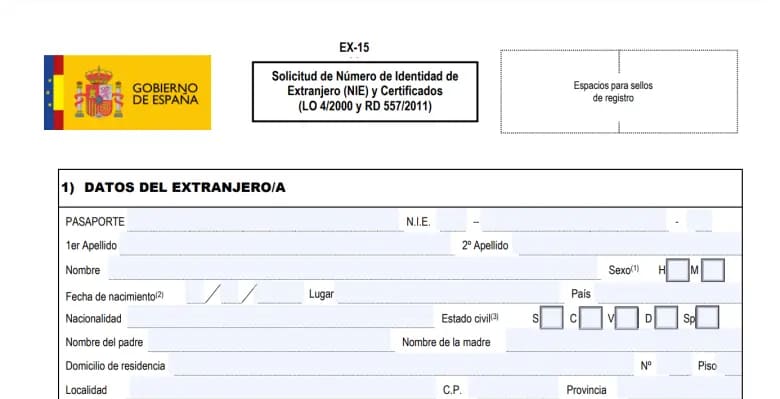
The EX15 form Spain is the official application used to request a Spanish NIE and certain certificates. Its full name is the application for the Foreigner Identity Number and certificates.

For most expats, the main reason to use Form EX15 is to request the NIE. However, it can also be used for resident and non resident certificates in certain situations. That is why it is important to understand that EX15 is not a residence card and it is not the same as a residence permit procedure.

Why the EX15 form matters for expats

If you are moving to Spain, the EX15 form is often one of the first administrative forms you will need to deal with. Many newcomers start searching for housing, opening bank accounts, arranging tax matters, or preparing contracts before they realize that the NIE is required for many of those steps.

Because of that, understanding the EX15 form Spain process early can save time and reduce stress. It helps you move from research mode into actual preparation with the right paperwork.

What the EX15 form does not do

The EX15 form is used to request the number itself or certain related certificates. It does not grant residency by itself. If your goal is to register as an EU resident or obtain a residence card, that usually involves a different form and a different process.

This distinction matters because many expats confuse the NIE with residence status. The NIE is an identification number for foreigners. It may be part of your wider relocation process, but it is not automatically proof that you have residence rights in Spain.

How to fill it out the EX15 form?

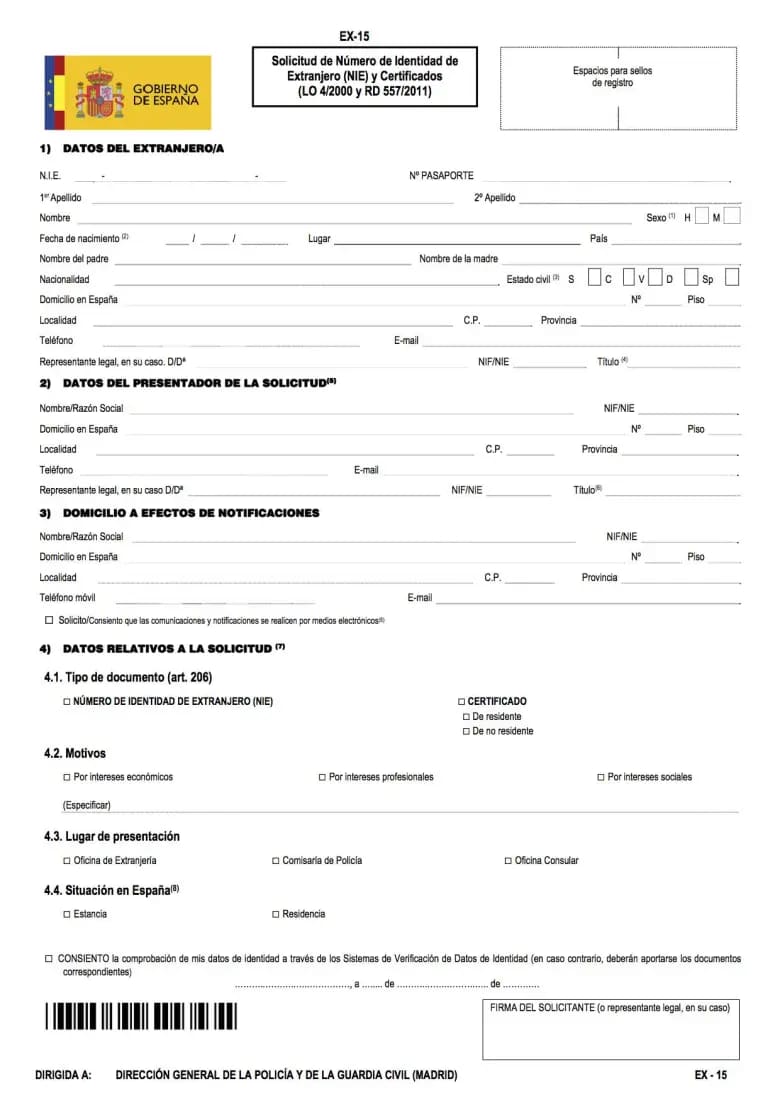
The form itself says it must be filled in in capital letters, with black pen or typed, and submitted as original plus copy. It also specifies the date format as dd/mm/yyyy.

blog header illustration

Before you fill it out

Have these ready next to you: your passport, your address and contact details, the reason you need the NIE, and your Modelo 790 Código 012 payment receipt. The Police lists the EX-15 form and the proof of payment as part of the required documentation for the NIE request.

Step 1: Fill in section 1, “Datos del extranjero/a”

In the first block, enter your own personal details exactly as they appear on your passport: first surname, second surname, given name, sex, date of birth, place of birth, country, nationality, marital status, parents’ names, residential address, mobile number, and email. The form also includes a box for passport and NIE. For a first NIE request, in practice you normally identify yourself with your passport details. The form’s fields for this section are listed on page 1 of the official PDF.

A few small details matter here: mark H / M / X for sex, and the instructions note that X can only be marked by people who have that status recognized in their country of origin. For marital status, the form uses S / C / V / D / Sp, meaning single, married, widowed, divorced, or separated. The official instructions also say the birth date must be written with 2 digits for day, 2 for month, and 4 for year.

Step 2: Only fill section 2 if someone else is presenting the application for you

Section 2 is called “Datos del representante a efectos de presentación de la solicitud”. The instructions say this section is completed only if the person submitting the application is different from the applicant. So if you are filing the EX-15 yourself, leave this section blank. If someone is presenting it for you, enter that representative’s name or company name, ID document, address, phone, and email.

Step 3: Fill section 3, “Domicilio a efectos de notificaciones”

This section is for the address where official notices should be sent. You can put your own details again here, or another contact address if you want notifications to go somewhere else. The form also includes a checkbox to consent to notifications through the DEHú electronic notification system, and the instructions say that requires a valid electronic certificate or Cl@ve.

The lines marked “Espacios para sellos de registro” are for the administration, so leave those blank.

Step 4: On page 2, write your full name again

At the top of page 2, there is a line for “Nombre y apellidos del titular”. Write your full name there. Then move to section 4, which is the most important part of the form for an NIE request.

Step 5: In section 4.1, mark the type of document

In 4.1 Tipo de documento, tick “Número de Identidad de Extranjero (NIE)” if you are requesting the NIE. The same EX-15 form can also be used for a resident certificate or non-resident certificate, but for an NIE application you should mark the NIE box. The Police procedure page also identifies EX-15 as the form used for the NIE request.

Step 6: In section 4.2, mark your reason and specify it clearly

In 4.2 Motivos, tick one of the three boxes: intereses económicosintereses profesionales, or intereses sociales. Right below that, where it says “Especificar”, write a short and specific reason. The official form requires you not only to choose the category, but also to specify the reason.

The safest way to write this is with a simple one-line explanation in Spanish, such as:

  • Apertura de cuenta bancaria
  • Firma de contrato de arrendamiento
  • Compra de inmueble
  • Constitución de sociedad

Step 7: In section 4.3, mark where you are filing

In 4.3 Lugar de presentación, tick the box that matches where you will submit the application: Oficina de ExtranjeríaComisaría de Policía, or Oficina Consular. The Police says NIE requests are made directly to the Police, through Immigration Offices or Police Stations in Spain, or through Spanish Consular Offices abroad if the applicant is outside Spain.

Step 8: In section 4.4, mark your situation in Spain

In 4.4 Situación en España, choose Estancia or Residencia. On the form, these are the only two options shown. In practical terms, people usually mark Estancia if they are in Spain temporarily and Residencia if they already hold residence status. The form itself presents these as the categories you must choose between.

Step 9: Fill in place, date, and signature

At the bottom, write the citydaymonth, and year, then sign where it says “Firma del solicitante”. If there is a legal representative, that person signs instead. Do not forget this part. The signature line is an explicit part of the official form.

Step 10: Do not fill page 3

The third page of the current official EX-15 is only instructions. You do not need to write anything there. It explains how to complete the form, including uppercase letters, black ink, original plus copy, and the notes attached to each section.

Final check before submission

Before you go to your appointment, check these five things:

  1. Your name matches your passport exactly.
  2. You marked NIE in section 4.1.
  3. You marked one motive and wrote a clear reason in section 4.2.
  4. You signed the form.
  5. You printed original and copy and included the Modelo 790 Código 012 proof of payment.

Practical instructions to complete the form correctly

IUse this sequence:

  • Download the official PDF.
  • Complete your personal details exactly as shown on your passport.
  • Choose the correct type of application.
  • Write a clear explanation of your reason for applying.
  • Review the form carefully before submission.
  • Sign it before you submit it.

If possible, complete the form neatly and clearly so there is no confusion during processing.

What is NIE number in Spain?

The NIE, or Foreigner Identity Number, is a personal and unique identity number assigned to foreign nationals who need to interact with Spain for economic, professional, or social reasons.

In practical terms, the NIE is the identification number that allows a foreign person to carry out many important formalities in Spain. It is often needed for tax related matters and for administrative procedures that require official identification.

Why expats need a NIE?

For expats wishing to move to Spain, the NIE can become relevant very quickly. It may be requested when dealing with contracts, financial matters, government paperwork, or other formal steps linked to daily life in Spain.

This is why the NIE is often one of the first items on an expat relocation checklist. Even if you are still outside Spain, it may make sense to look into the process early if you already know you will need to establish legal, financial, or administrative ties with the country.

NIE and residence permit are not the same thing

One of the most common misunderstandings is thinking that the NIE and a residence permit are the same. They are not. The NIE is an identity number. A residence permit is a separate immigration status or authorization.

You may have an NIE without having completed all residence related procedures, depending on your situation and the reason you applied for it. That is why understanding the scope of the EX15 form Spain is so important.

How to apply for NIE in Spain?

The application for the NIE follows a fairly simple sequence. If you are applying for the NIE, the process usually begins with Form EX15 and continues with payment of the relevant fee, collecting the required documents, booking an appointment if necessary, and submitting the application in the correct place.

What documents are needed for NIE?

The documents required for a standard NIE application are usually straightforward, but they need to be complete and consistent. Most applicants should prepare the following items before the appointment or submission.

Main documents required

You will usually need the completed EX15 application form, signed by the applicant, along with a valid passport or another accepted identity document and proof of payment for the fee.

The information on the form should match your passport exactly. That includes your personal details, such as your full name, nationality, and other identification data.

Supporting documents for the application

In addition to the form and identity document, applicants are typically asked to provide documentation that explains the reason for the application. This could relate to economic, professional, or social reasons, depending on your case.

The supporting documents should be relevant to your request and consistent with what you wrote in the application form.

Is a birth certificate required?

For most adult applicants, a birth certificate is not one of the standard documents required for a basic NIE application. However, in some special cases, such as applications involving minors or legal representatives, additional documents may be requested. In those situations, a birth certificate or other civil status documents may become relevant.

Originals, copies, and signatures

Your documentation should be properly completed, signed where required, and organized with originals and copies. A common problem in NIE applications is bringing only copies or forgetting to sign the form. Even a simple omission can slow down the process.

Where to submit NIE application?

Where to submit the NIE application depends mainly on whether you are already in Spain or still abroad.

If you are in Spain

If you are in Spain, the application can generally be submitted through a local police authority or immigration office. In practice, many applicants deal with a local police station that handles foreigner matters or with a dedicated immigration office.

Before going, you may need a cita previa appointment, depending on the location and the type of application.

If you are outside Spain

If you are not yet in Spain, the application may be submitted through the Spanish consulate responsible for your area. This can be especially useful for expats who want to start the process before their move.

Why the right office matters

Not every office handles every type of foreigner procedure in the same way, and local practice can differ. That is why checking the correct contact point, office, appointment system, and location in advance is an important part of the process.

Common mistakes to avoid with EX15 form Spain

Even though the EX15 form is not especially long, small errors can cause delays.

Incomplete form fields

One common issue is leaving parts of the application incomplete or unclear. Make sure all relevant sections are filled out properly and that your explanation of the reason for the request is specific enough.

Missing signature or proof of payment

Another frequent problem is forgetting to sign the form or forgetting to include proof of payment. These are simple mistakes, but they can stop the process immediately.

Using the wrong procedure

Some expats search for the EX15 form when what they actually need is a different immigration or residence related procedure. Before submitting anything, make sure the NIE request is the correct step for your situation.

Key Takeaways

The EX15 form Spain is one of the key documents expats should understand before moving to Spain. It is the official form used to request the NIE and certain certificates, and for many foreigners it is an essential part of setting up their administrative life in the country.

If you want the process to go smoothly, focus on the essentials. Use the correct application form, complete it carefully, prepare the required documents, pay the fee through the proper channel, and submit everything to the right office or consulate.

For expats, the biggest advantage is not just knowing what the EX15 form is, but knowing how to use it correctly. Once you understand that, the path to getting your NIE becomes much more manageable.

Share this article

Share this article

Join a community of 10,000+ expats
Get the weekly tips, success stories, and step-by-step guides we share with our members to make their move a success.
Star Trustpilot
Star Trustpilot
Star Trustpilot
Star Trustpilot
Star Trustpilot
I love AnchorLess! They have been fantastic for my move to Portugal with the NIF, checking account, lawyer and tax consultation. I will be happy with when this process is over, but at least the journey has been smoother with them.
LD
Lisa D
From South Africa
Star Trustpilot
Star Trustpilot
Star Trustpilot
Star Trustpilot
Star Trustpilot
Guilherme was the best! I had so many questions and moving parts and he was responsive, always professional, and went above and beyond to help me with everything! He is a PRO!!!!
DS
Debra Savage
From The United States

Our readers also viewed

nuss spain beach resort
NUSS
Expats
25/02/2026
Moving to Spain? Learn what the NUSS Spain number is, who needs it, and how expats can apply online ...
Brenda
Brenda
Content Manager
spain nie number for foreigners
NIE Number Spain
Tax ID Spain
15/08/2025
Get your NIE number in Spain as a foreigner with this step-by-step guide: where to apply (Consulate ...
Brenda
Brenda
Content Manager

More than a blog, an ecosystem

AnchorLess team
Webinars Hub

Join our free webinars and get concrete answers to your most pressing relocation questions.

conversation

Community

Connect with thousands of current and future expats. You're not alone on this journey.

AnchorLess partner

Partners

Insurance, housing: we've hand-picked and vetted the best services, so you don't have to.

Beach Portugal

Start your new life in Europe

Turn relocation stress into success with AnchorLess.

Relocating to Europe made simple.

Start to relocate now

Arrow icon
Talk to us for free
AnchorLess support team
4.9/5 Excellent
Star
Star
Star
Star
Star
Logo AnchorLess

AnchorLess is not a bank, accountant, tax advisor, investment advisor, or law firm, nor are we a government or official government website. We act as an intermediary, helping connect you with accredited professionals and streamlining administrative processes for your relocation in Europe.

Instagram icon
Facebook icon
Reddit icon
Linkedin icon
Amex logo
Visa logo
Mastercard logo
& more
Pay 4X free of charge with
Klarna logo

🇵🇹 MOVE TO PORTUGAL

Arrow

🇪🇸 MOVE TO SPAIN

Arrow

Resources

Terms and conditions

Privacy Policy

Disclaimer Policy

© 2022 - 2026 anchorless.io, all rights reserved.