DNI Spain: Essential Guide for 2026
In short
For a foreigner in Spain, the DNI is a word to recognise, not a document to chase. It belongs to Spanish citizens, and the day you hear "DNI?" from a landlord or a form, the right move is to hand over your NIE and carry on.
If you are planning a move to Spain and you have started reading about the DNI, here is the short version before you spend an afternoon on it: you probably will never have one. The DNI is the national ID card for Spanish citizens. As a foreigner, the document that runs your life in Spain is the NIE, not the DNI.
That does not make the DNI useless to understand. A landlord will ask for your "DNI." A bank form will have a "DNI" field. A delivery app will not let you check out without one. Knowing what the word means, and what to hand over instead, is the difference between a five-minute task and a confused afternoon. So this guide covers what the DNI is, why it keeps coming up, and the document you actually need so none of it slows you down.
Table of contents7
What is DNI in Spain?
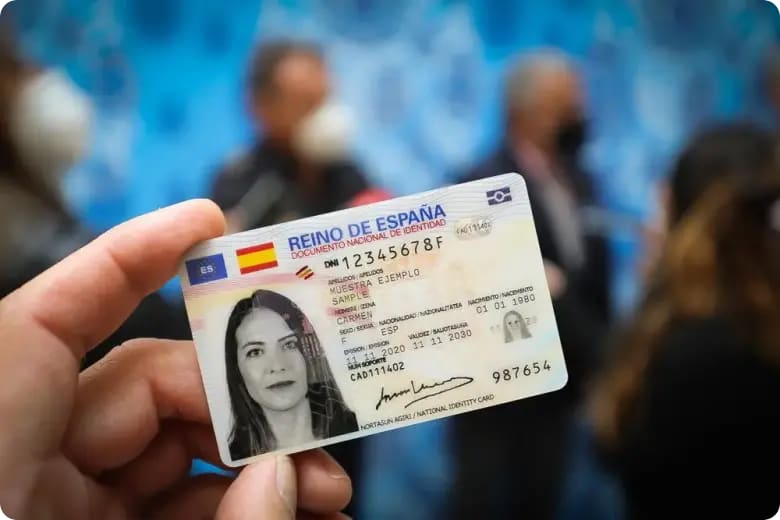
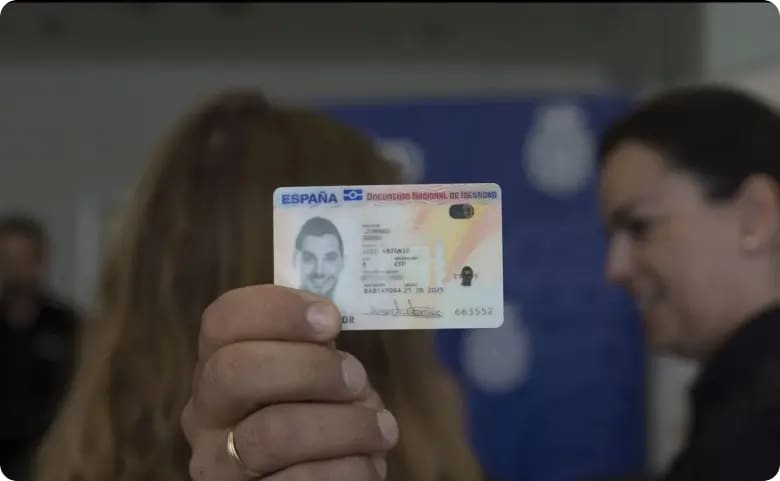
The DNI (Documento Nacional de Identidad) is Spain's national identity document card for Spanish citizens. It proves who you are, your personal details, and your Spanish nationality, and it is the one document that does all of that on its own.
It is issued by the Ministry of the Interior through the national police (Dirección General de la Policía), and it is a public, official, personal document that cannot be transferred to anyone else. Spanish law treats it as full proof of identity, so public bodies and private companies have to accept it for that purpose.
Two more things sit inside it. It is a smart card with a chip, which means it doubles as a tool for electronic identificationand for signing documents electronically, online or in person. That second life of the DNI, the digital one, is the part that occasionally matters to foreigners, and we come back to it below.
Every Spanish national has the right to one, and it becomes compulsory at age 14 for Spanish citizens living in Spain. It is also required for Spanish nationals over 14 who live abroad and then move to Spain for six months or more. If that does not describe you, you are in the right place for the rest of this guide.
What is the validity of a DNI?
A DNI's validity depends on the holder's age, running from 2 years for small children up to long-term validity for people over 70. The bands set by the Ministry of the Interior are:
| Age at issue or renewal | How long the DNI is valid |
|---|---|
| Under 5 | 2 years |
| 5 to 29 | 5 years |
| 30 to 69 | 10 years |
| 70 and over | More than 10 years, with an end date still printed on the card |
So the often-repeated line that a DNI "never expires" after 70 is not quite right. It is a long fixed validity with a date on it, not a card without an expiry. There is also an exceptional 1-year validity in odd cases, for example when fingerprints cannot be taken temporarily or a required document is missing.
One detail that trips people up: the electronic certificates inside the chip are valid for only 2 years, even when the physical card is good for ten. They can be renewed without issuing a new card. That gap between "the card is valid" and "the chip's certificates are valid" is exactly the kind of thing nobody mentions until your digital signature stops working.
Apply for your Spanish NIE online in just 5 minutes
Your NIE number up to 3X cheaper than hiring a lawyer for that!
Get your Spanish NIE


DNI, NIE, NIF and TIE: what is the difference?
The DNI is for Spanish citizens, the NIE is the identification number for foreigners, the NIF is a tax number, and the TIE is the physical residence card for many non-EU residents. They overlap enough to cause real confusion, so here is the clean version.
| Term | What it is | Who it is for |
|---|---|---|
| DNI | National identity card | Spanish citizens |
| NIE | Foreigner identification number (Número de Identidad de Extranjero) | Any foreigner with economic, professional, or social ties to Spain |
| NIF | Tax identification number | Everyone who pays tax in Spain |
| TIE | Foreigner identity card (physical card) | Many non-EU residents authorised to stay over six months |
The connection that makes it click: for a Spanish citizen, the NIF is simply their DNI number plus a control letter. For a foreigner, the NIF is their NIE. Same logic, different document. The Spanish Tax Agency says as much directly, and warns people not to confuse the NIE (a number) with the TIE (a card).
The catch worth holding onto is that the NIE is only a number. It identifies you to the authorities, but on its own it does not prove that you live in Spain legally or that you can work. That proof comes from your residence document: a TIE if you are outside the EU, or an EU registration certificate if you are an EU citizen.
How does the DNI work if you are a foreigner?
As a foreigner, you do not get a DNI. You get a NIE, and depending on your status, a TIE or an EU registration certificate as well. That is the whole answer. The DNI only enters your life if you later become a Spanish citizen.
Which means the practical skill is not "how do I get a DNI." It is "what do I do when something asks me for one."
A form, a landlord, or a bank just asked me for my DNI. What do I give them?
In almost every case, you give your NIE. Spanish systems were built around the DNI number, so the word "DNI" is often used loosely to mean "your ID number here." When a foreigner is on the other side of the form, that field takes your NIE.
A few specifics:
- Online forms with only a "DNI" field: enter your NIE. The format is accepted in most systems, even when the label does not say so. Badly built private forms occasionally choke on it, and when that happens the fix is usually a phone call rather than a different number, because the NIE is the only ID number you have.
- In person, asked for "tu DNI": hand over your TIE card if you have one (it shows your photo and NIE), or your passport plus your NIE certificate if you do not.
- A form that genuinely needs a Spanish citizen's DNI, such as certain civil registry or voting procedures, is one you are not eligible for as a non-citizen anyway, so the missing DNI is the answer, not a problem to solve.
Once you stop expecting a DNI and start leading with your NIE, the friction mostly disappears.
Signing documents and proving your identity online without a DNIe
Foreigners cannot get the electronic DNI (DNIe), but you can get the same digital powers another way: through an FNMT digital certificate or the Cl@ve system. This is the part of the DNI story that actually affects your admin life.
Spanish bureaucracy increasingly happens online, and a lot of it expects you to identify yourself and sign electronically the way a Spaniard would with their DNIe chip. The two routes open to foreigners are the FNMT digital certificate, available to foreign residents with a NIE and passport, and Cl@ve, which you can register for with an EU registration certificate, a TIE, or a residence permit. With one of those, you can file taxes, book appointments, and sign official documents from your laptop, no Spanish ID card required.
If sorting that out sounds like one more portal to fight, it is the kind of thing we handle for people through our Spanish digital certificate service, so you get the signing capability without the FNMT website.
When can a foreigner actually get a DNI?
A foreigner can only get a DNI after becoming a Spanish citizen. Once you are naturalised, you use the same DNI process as anyone born Spanish, and your old foreigner documents get handed in along the way.
How long that takes depends entirely on your background. The general route is ten years of legal residence, but there are much shorter paths: commonly two years for nationals of Ibero-American countries, Portugal, Andorra, the Philippines, and Equatorial Guinea, and one year for the spouse of a Spanish citizen, among others. These categories have conditions and exceptions, so treat them as a starting map and confirm your own case before you count on a timeline. The point for this guide is simpler: the DNI is the document at the end of the citizenship road, not something you arrange when you arrive.
How is a DNI applied for and renewed in Spain?
Even though you will not be the one applying, it is worth knowing how it works, because your Spanish partner, your children born in Spain, or your future naturalised self will go through it. And the appointment system involved is the same one that will test your patience for your NIE.
How to apply for a DNI in Spain
A first DNI is done in person at a National Police documentation unit, after booking a cita previa (prior appointment). You book it through the official appointment site (citapreviadnie.es) or by calling 060, then show up with your documents and pay the fee.
The fee is €12 for issue or renewal, set by law, the same in every office, with no surcharges. It is free in specific cases, including renewing a valid card because your address or personal data changed, and for members of large families.
What documents are needed for a DNI?
For a first DNI you bring a birth certificate issued specifically for the DNI, a recent colour photo, and a recent empadronamiento certificate. Spelled out:
- A literal birth certificate (certificación literal de nacimiento) issued for the purpose of obtaining a DNI.
- A recent passport-sized colour photo with a plain background.
- A certificate or volante of empadronamiento proving your address, issued within the last three months.
Someone who has just naturalised brings one extra thing: their previous TIE or EU registration certificate showing their NIE, which they hand in when the first DNI is processed.
How to renew a DNI in Spain
A DNI is renewed in person within the last 180 days before it expires, with a recent photo and the €12 fee. If your address changed, you bring an updated empadronamiento, unless you let the office verify it electronically. A lost, stolen, or damaged card has to be replaced promptly, and theft or loss should be reported to the police as soon as you can.
A reality note from the queue. Booking the appointment is the hard part, and it is harder than the official process suggests. As of early 2026, expat communities and relocation services across Spain report that cita previa slots vanish almost immediately in high-demand cities like Madrid and Barcelona, that the portal crashes during peak windows, and that bots scoop up slots and resell them. The DNI uses its own appointment channel, but the appointment scarcity is the shared headache of every Spanish ID procedure, including the NIE you will actually need. Plan around it early.
Apply for your Spanish NIE online in just 5 minutes
Your NIE number up to 3X cheaper than hiring a lawyer for that!
Get your Spanish NIE
What's new in 2026: the digital DNI and the MiDNI app
Spain's DNI rules were rewritten in 2025, and from April 2026 a mobile version of the DNI must be accepted across Spain. This is the freshest part of the story, and most English-language guides have not caught up.
The governing law is Real Decreto 255/2025, published on 2 April 2025, which regulates both the physical and the digital DNI and replaced the old 2005 decree. It brings Spain in line with the EU regulation on the security of identity documents. The current generation of the card is the DNI 4.0.
The headline change is MiDNI, the official app launched on 2 April 2025. After a twelve-month adaptation period, from April 2026 public and private entities are required to accept it, with the same legal value as the physical card. It works through a QR code generated by the national police, and it covers everyday uses like hotel check-in, age verification, car rental, parcels, and identifying yourself at a notary. It offers three privacy levels, from showing only your photo, name, and over-18 status, up to your full data.
Why this matters to you as a foreigner: MiDNI is built on having a valid physical DNI, so it is a Spanish-citizen tool, not one you can use. But you will start seeing "show your MiDNI" appear next to "show your DNI" on forms and at counters, and now you know it is the same thing in a different wrapper, and the same answer applies. You present your NIE-based document instead.
What foreigners should know about DNI Spain
A few short answers to the questions that come up once the basics land.
Can I use my NIE where a DNI is requested?
Yes, in nearly every situation your NIE is the number that goes where a "DNI" is asked. Spanish forms use "DNI" as shorthand for "your national ID number," and for a foreigner that role is filled by the NIE. The exceptions are procedures only open to Spanish citizens, which you would not be completing anyway.
Is my DNI number the same as my NIF?
For you as a foreigner, your tax number (NIF) is your NIE. There is no separate DNI number in your life. For a Spanish citizen, their DNI number and NIF are the same string. For you, the NIE does both jobs.
Can I travel in Europe with a DNI?
The DNI is a valid travel document inside the EU for Spanish citizens, but as a foreigner you travel on your passport. Your NIE or TIE proves your status in Spain, not your right to cross borders. Keep your passport as your travel ID, and in some cases your residence card alongside it.
Do I need a DNI to open a bank account or sign a contract in Spain?
No. You need a NIE. Opening an account, signing a lease, getting a phone contract, or starting a job all run on your NIE, not a DNI. Some banks will also ask for proof of address or residence, but the ID number they want is your NIE.
Can my children get a DNI if one parent is Spanish?
Yes, a child who holds Spanish nationality can get a DNI, regardless of where they were born. Spanish parents can request one from birth once the child is registered, which is genuinely useful for travel within Europe. A child who is not a Spanish national uses a NIE like any other foreigner.
The simplest way to get your company's Spanish NIF
The NIF (Número de Identificación Fiscal) is the tax ID the Spanish authorities assign to your business. Any foreign company selling on a Spanish marketplace, registering for EPR compliance, or running a one-off operation in Spain needs one. It's what lets the Agencia Tributaria recognize your company on Spanish soil, even without a local office or subsidiary.
Start my application now
Receive your company's Spanish NIF in 48 hours
No paperwork, notary, or translations needed
We file directly with the Agencia Tributaria
How can AnchorLess help you?
Here is the honest takeaway: there is nothing for us to do about your DNI, because you will not have one. What we do handle is the document that actually carries your life in Spain, the NIE, if you intend to live in Spain, or the NIF Spain, if you are simply handling business.
The NIE is the first thing nearly every other step depends on, from your Spanish bank account (that we also handle) to your rental contract to your job, and the appointment system that issues it is the same overloaded one we described above.
We get it sorted for you online, without the cita previa refresh-at-midnight ritual, so you arrive with the number already in hand. If that is the part of your move you would rather skip, you can get your NIE, NIF or bank account in Spain with AnchorLess.
Final thoughts
For a foreigner in Spain, the DNI is a word to recognise, not a document to chase. It belongs to Spanish citizens, and the day you hear "DNI?" from a landlord or a form, the right move is to hand over your NIE and carry on.
Sort that one number out early, and the entire DNI question stops being a question at all.
Share this article