Is there inheritance tax in Portugal?
Not under that name: what you inherit is taxed by the stamp duty, the imposto do selo, at 10%, on what each heir receives. Most families pay nothing:
- Exempt: the spouse or de facto partner, children and grandchildren, parents and grandparents.
- Taxed at 10%: everyone else: brothers and sisters, nephews and nieces, cousins, friends.
It applies to what is in Portugal, whoever inherits and wherever they live: a house or land, money and crypto held in a Portuguese bank, a car registered there. A property counts at its tax value (the valor patrimonial tributário on its tax record), not its market price, and the deceased’s debts are deducted. Personal and household goods, life insurance and social security death grants are not taxed.
The tax office sends the bill after the declaration; it is paid by the end of the two months that follow the notice, or, above €1,000, in up to 10 instalments of at least €200, one every six months.
Exempt doesn’t mean nothing to do
Even when every heir is exempt, the death must still be declared (the participação on the Modelo 1), listing every property, account and car. That is why a child who owes no tax still needs a Portuguese NIF, and still has a deadline.
Does each heir need a Portuguese NIF?
Yes. The estate gets its own tax number, the NIF of the herança indivisa (it starts with a 7), and its record lists the deceased, the cabeça de casal and every heir with their NIF. The tax office’s own leaflet is plain: the declaration can only be filed once the estate’s NIF exists, and it goes in with the NIF and the ID of the deceased and of all the heirs. IRN asks for every heir’s NIF too, and the land registry records it when the house goes into your names.
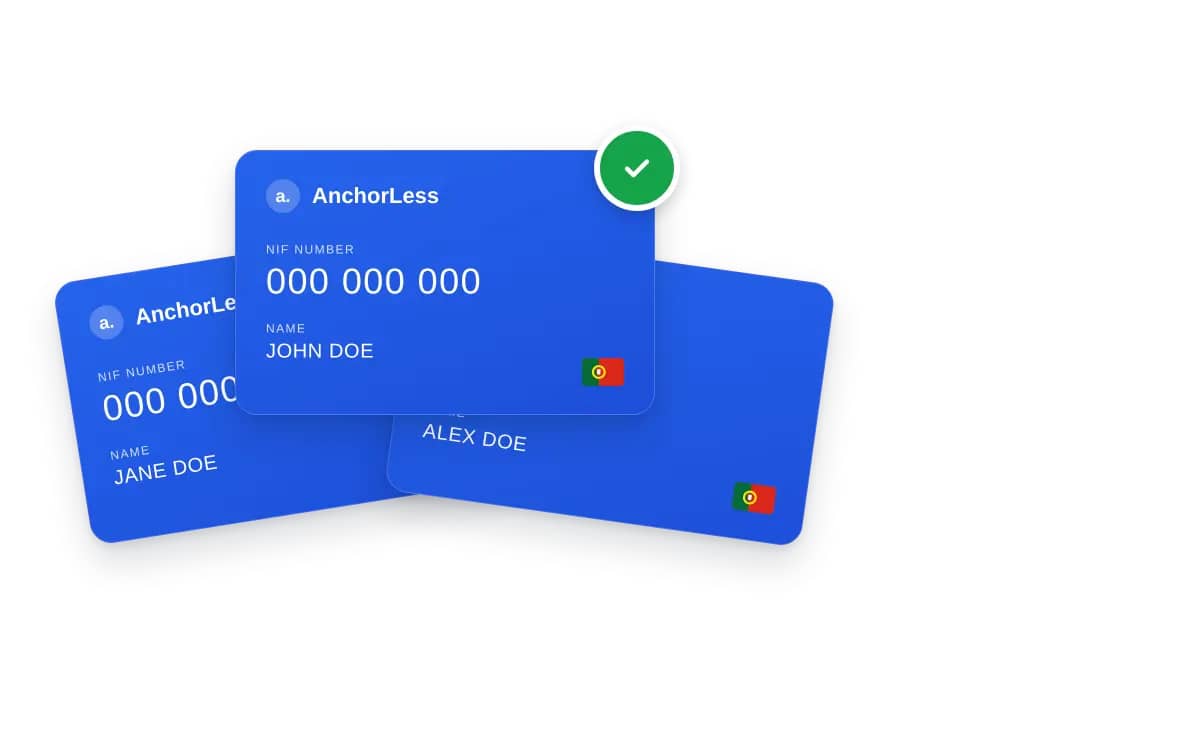
- One NIF per heir: three children inheriting a house need three NIFs.
- Start it first. Since 1 July 2025, people without a Portuguese citizen card ask for a NIF through the tax office’s online desk (e-balcão), by a representative, or in person by appointment: from abroad it is the step that takes longest.
- Children of Portuguese emigrants: a Portuguese citizen card comes with a NIF; if you never had one, you need your own, as a parent’s doesn’t count for you.
How to get a NIF from abroad
- In Portugal, at a tax office, by appointment, with your passport and a proof of your address abroad.
- Through a representative with your power of attorney, on the tax office’s e-balcão.
- Or let us do it: we get your NIF online, for each heir, through our partner lawyers. From €99.
And a fiscal representative?
Not to get the NIF. But once you have a tax relationship with Portugal, such as a house or a car in your name, an heir who lives outside the EU and the EEA has 15 days to appoint a fiscal representative or sign up for the tax office’s electronic notifications. Heirs in the EU or the EEA never have to. A non-resident cabeça de casal asks for the estate’s NIF through their representative. See what a fiscal representative does.
Inheriting in Portugal from abroad: the 8 steps
The order matters: the NIFs come before the declaration, and the declaration before the bank releases anything. Most steps can be done for you, with a power of attorney.
1
Get the death certificate
A death in Portugal, or a Portuguese citizen’s death abroad once transcribed (by the consulate or any registry office), is in the Portuguese civil registry: order the certificate online. For anyone else who died abroad, use the foreign certificate, translated.
Week 1Online
Order the death certificate2
Get a Portuguese NIF for each heir
Every heir needs one before the estate can be declared, the cabeça de casal first. From abroad, it is the step that takes longest: start it now.
Weeks 1–2One per heir
Get my NIF3
The cabeça de casal asks for the estate’s NIF
The cabeça de casal runs the estate until it is divided: the surviving spouse, otherwise the executor, otherwise the closest heir. Only they can ask for the estate’s NIF, on the tax office’s portal, or through their fiscal representative if they live abroad.
Weeks 2–4
4
Declare the death to the tax office
The participação (Modelo 1), with the death certificate, the will if any, the NIF and ID of the deceased and every heir, and the list of what they owned in Portugal. Even if nobody owes tax.
By the end of month 3Even when exempt
5
Find the bank accounts
Banco de Portugal tells heirs, free, in which banks the deceased had accounts. The banks release the money once the declaration is filed, or the tax paid.
From month 1Free
6
Prove who the heirs are
The habilitação de herdeiros, at a notary or at IRN’s Balcão das Heranças: the document banks, registries and buyers ask for. At IRN it can include the division and the land registry, for €425.
After the NIFs€425 at IRN
7
Divide and register
The heirs share out the estate (the partilha) and register each property in the new owners’ names, within two months of the division: later, the registry fee doubles.
Two months after the division
8
Keep the estate in order
Until it is divided, the estate owes the house’s IMI, files the deceased’s last income tax return and declares any rent. Selling later? The gain is declared in the next year’s return.
Every year
File my IRS
- Day 0the death
- Weeks 1–2the certificate, each heir’s NIF
- Weeks 2–4the estate’s NIF
- By the end of month 3the declaration, and IRN’s procedure started
- After the noticeany tax paid within two months
- Thenthe habilitação, the division, the land registry
Doing it from abroad? Most steps go through a power of attorney: see without travelling to Portugal.
The 3-month deadline, in dates
The declaration is due by the end of the third month after the month of death, from the cabeça de casal and from every heir who received something, exempt or not. When the cabeça de casal declares every heir, the others don’t file again.
- A death on 15 March 2026: by 30 June 2026.
- A death on 28 October 2026: by 31 January 2027, a Sunday, so Monday 1 February 2027.
The tax office can give up to 60 days more, only for a reason you prove. IRN’s simplified procedure (the Balcão das Heranças) should also be started by the end of that third month.
If you miss it
- A fine of €150 to €3,750 for a declaration filed late or never.
- The money stays frozen: banks may not release the deceased’s deposits, shares or crypto before the declaration is filed or the tax paid.
- The tax office acts alone: it gives you 10 to 30 days to file, then assesses the estate itself, and the assets can be treated as concealed.
Which country’s law decides who inherits?
Who inherits, and in what shares, is a different question from the tax. For a death on or after 17 August 2015, the EU’s succession regulation applies the law of the country where the deceased last lived, for everything they owned, the Portuguese house included, unless their will chose the law of their nationality. Before that date, Portugal applied the law of the deceased’s nationality.
- A Portuguese emigrant who lived in France and died after August 2015 without choosing: French law decides who inherits the house in Portugal. The Portuguese tax and paperwork still apply to it.
- The deceased lived outside the EU (the UK, the US): that country’s own rules come into play, and can send the house back to Portuguese law. Ask a lawyer before you act.
- Portuguese law, when it applies, protects close family: with a spouse and children, two thirds of the estate are reserved for them, whatever the will says.
A will made abroad by a Portuguese citizen counts in Portugal only if it was made in a solemn form (before a notary, for instance). For use in other EU countries, a European Certificate of Succession proves who the heirs are; it is optional. The regulation doesn’t cover tax, and it doesn’t apply in Denmark and Ireland.
The deceased’s bank accounts in Portugal
Not sure where the money is? Banco de Portugal tells heirs, free of charge, in which Portuguese banks the deceased had accounts. Ask in person or by post, with the habilitação, the tax office’s certificate naming the cabeça de casal, or, for a child, the death record and your own birth record.
- Frozen until declared: banks may release the deposits only once the stamp duty is paid or, for exempt heirs, the declaration is filed.
- Joint accounts: the deceased’s share is set aside; the other holders keep using theirs.
- Don’t leave it: deposits untouched for 15 years go to the State.
When heirs disagree, when there are debts, or when you want out
Heirs who disagree
Any heir can ask for the division at any time. When everyone agrees, it is done at a registry office or a notary; when they don’t, through an inventário, at a notary or in court, which the heir who starts it chooses. Until then the estate stays undivided and keeps owing its taxes. A law of August 2026 lets the Government create a court sale of a property kept undivided for more than two years; on 28 October 2026 it was not yet in force.
Debts
The estate pays the funeral and the deceased’s debts first. Heirs answer only up to the value of what they inherit.
Refusing an inheritance
You can refuse (the repúdio), but only the whole inheritance, with no conditions, and for good. When the estate holds a property, it is done by a deed or an authenticated document: from abroad, through a power of attorney or a Portuguese consulate. Your own children may then inherit in your place. The right to accept lapses after ten years.
Selling the inherited house
A non-resident who sells a house in Portugal declares the gain in the Portuguese income tax return of the next year, between April and June. Half of the gain is taxed, at the progressive income tax rates. For an inherited house:
- The purchase price is the value at the death: the tax value used for the stamp duty, even when you were exempt, not what your parents paid.
- The purchase date is the death: a house your parents bought in the 1970s is taxed on the gain since they died.
- Selling your share of the undivided estate to a co-heir, rather than the house itself, is not taxed as a gain, according to the tax office since July 2025.
For the return, see our Portuguese income tax filing, with a certified accountant; to plan before you sell, book a tax consultation. Buying in Portugal instead? See buying a house in Portugal as a foreigner.
Will your own country tax it too?
Often, yes: Portugal taxes what is in Portugal, and the country where the deceased lived, or where you live, may tax the same inheritance under its own rules. Portugal has no inheritance tax treaty with France or the Netherlands.
- France: when the deceased lived in France, France taxes everything they owned, the Portuguese house included, and deducts the tax paid abroad. A child who paid no stamp duty in Portugal has nothing to deduct.
- The Netherlands: a Dutch national who dies within 10 years of leaving the Netherlands is treated as still living there.
Inheriting in Spain as well? See our guide to inheritance tax in Spain.










 MOVING IN EUROPE