Can Brazilians move to Portugal?
Yes. As a Brazilian, you can visit Portugal without a visa for up to 90 days in any 180, counted across the whole Schengen area. To live there longer, you need a residence visa from the Portuguese consular network in Brazil, then a residence permit from AIMA, the immigration agency, in Portugal. ETIAS, the EU’s online travel authorization for visitors, is not in operation yet.
With a Portuguese or EU passport, no visa
If you are also Portuguese, you simply live in Portugal as a citizen. If you hold the passport of another EU country, Italy for instance, you live there on that passport, without a visa: after three months, you have 30 days to register at the town hall (câmara municipal) and get your registration certificate (CRUE).
Portuguese roots?
A child of a Portuguese parent, born in Brazil, is Portuguese by origin once the birth is registered in the Portuguese civil registry, or by declaring it. A grandchild of a Portuguese citizen by origin can be too, by declaration, with effective ties to the Portuguese community; since May 2026, that includes proving knowledge of Portuguese culture, history and symbols. Our guides to citizenship by descent and citizenship through a grandparent explain the routes, and we order Portuguese birth certificates (€59) for the file.
Which Portugal visa is right for Brazilians?
The visa depends on what you will live on in Portugal. Brazilians apply for the same visas as everyone else, under the CPLP regime (below). Find your situation, then read our guide to that visa.
| You will live on | Visa | From (2026) |
|---|
| A pension, rents or investments | D7 | €920 a month |
| Remote work for an employer or clients abroad | D8 | €3,680 a month |
| Your own business or freelance work in Portugal | D2 | €11,040 of means |
| A highly qualified job in Portugal | D3 | €1,611 a month |
| Another job offer in Portugal | D1 | €920 a month |
| Studies at a Portuguese university | D4 | Your admission |
| An investment you keep five years | Golden Visa | €250,000 |
Most retirees apply for the D7: an INSS or private pension, rents or dividends count, if regular and documented. Working remotely for Brazilian employers or clients? The D8.
The work visas need a job before you apply: a contract or promise of contract from an employer in Portugal, which you find yourself (the D1), or a highly qualified one (the D3). The job seeker visa is not available: since October 2025 it is reserved for people with specialized technical skills, to be listed by a regulation that has not been published.
The Golden Visa is not a consular visa: you apply to AIMA directly. Real estate no longer qualifies, and most routes need €500,000.
Not sure which one fits? Ask us in a free call.
The CPLP regime: what it changes for Brazilians
Brazil and Portugal are parties to the CPLP mobility agreement, signed in Luanda on 17 July 2021 by the Portuguese-speaking countries. Portugal's foreigners' law gives their nationals a lighter visa process:
- No prior opinion from AIMA: the consulate checks the Schengen Information System itself, which takes a step out of the process.
- A shorter document list: the form, two photos, your criminal record certificate and proof of means. Travel insurance is not on the CPLP list.
- Means can be replaced by a term of responsibility: a Portuguese citizen or a legal resident of Portugal guarantees your food and lodging, with a certified signature, their last IRS return and three months of bank statements. Students admitted to a university are spared the proof of means.
- A CPLP residence permit: with your residence visa, you ask AIMA in Portugal for the permit. AIMA checks your Portuguese criminal record itself.
What changed in 2025
Until October 2025, a Brazilian could enter Portugal as a visitor and ask AIMA for a CPLP residence permit there. Since Lei 61/2025, in force on 23 October 2025, the CPLP permit is for holders of a residence visa, and consulates may refuse a CPLP visa on other grounds than an alert in the Schengen system. Our CPLP visa guide goes into detail.
From Brazil to Portugal in 7 steps
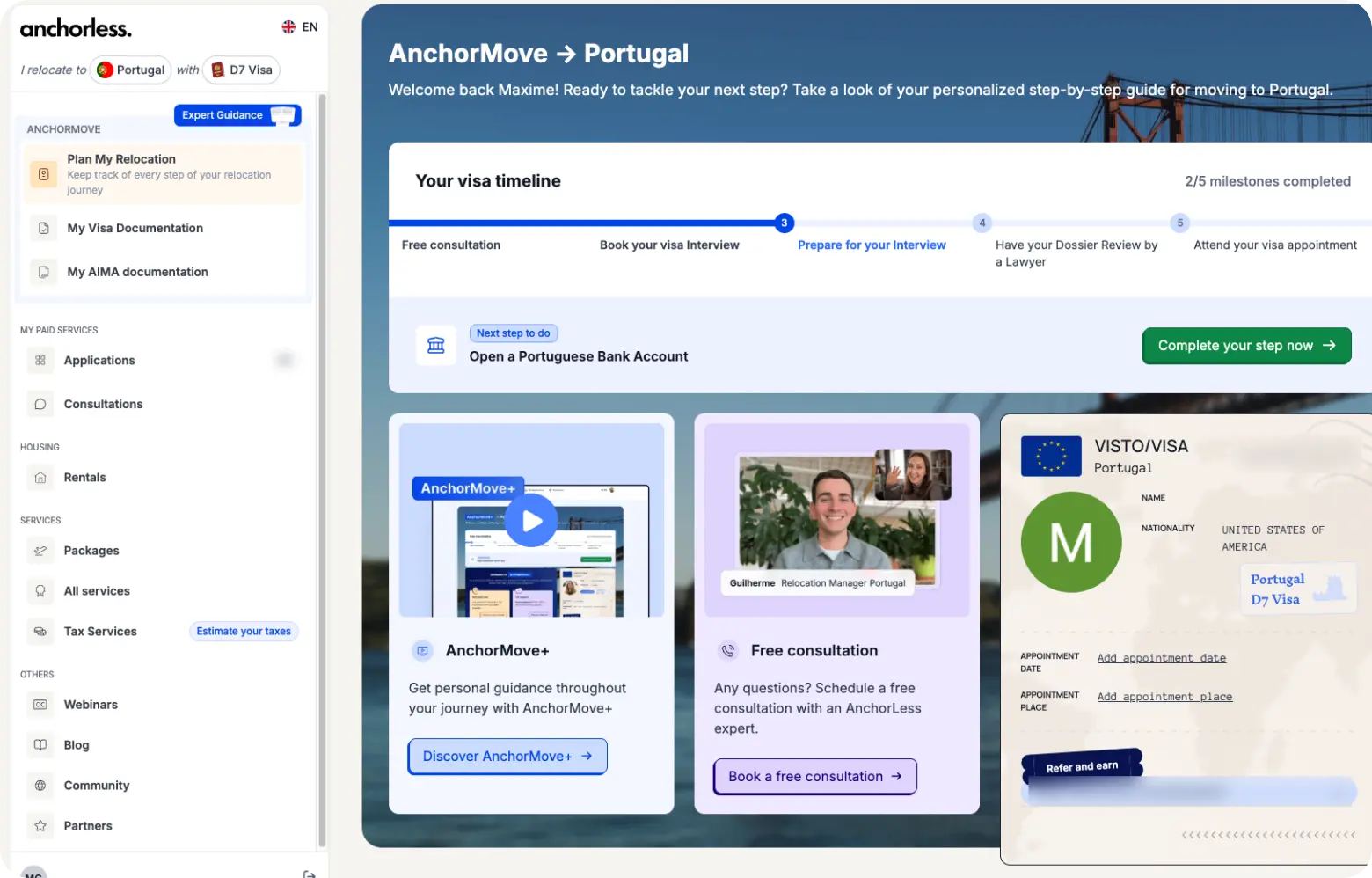
From your home in Brazil to your Portuguese residence card. Each step says what to do and what it costs. In a free AnchorLess account, you tick them off one by one and get expert help where you need it.
1
Choose the right visa
A pension or rents: the D7. Remote work: the D8. Your own business: the D2. A job offer you already have: the D1, or the D3 if highly qualified. Studies: the D4. Each sets its own income and documents.
Find my visaOr ask us in a free call2
Get your NIF
Your Portuguese tax number: banks and landlords ask for it, and you will need it for everything once you live there. You can get it from Brazil.
With us: from €99By email from 24 hours
Get my NIF3
Open a Portuguese bank account
For the D7, the checklist asks for proof that your means are available in Portugal: a Portuguese account holds them. For every visa, a Portuguese IBAN makes rent and bills simpler.
With us: €359Opened remotely
Open my account4
Secure your home
For the D7, your file shows where you will live: a lease, a deed, or a term of responsibility from someone who hosts you. Have the lease checked before you sign.
Lease checked by a lawyer: €99In 48 hours
Review my leaseOr find your home with us5
Build your file and apply at VFS
Your Polícia Federal certificate with its apostille, your Imposto de Renda return, the proof your visa asks for, your CDAM (PB4) or travel insurance: the full checklist is below. Then book at a VFS Global center, or at your vice-consulate, and pay the €110 fee.
Lawyer check of the whole file: €299Feedback in 3 business days
Review my visa file6
Fly to Portugal and get your residence permit
Within the visa’s 4 months, go to your AIMA appointment. AIMA has 90 days to decide (up to 120); your first residence card lasts 2 years. As a Brazilian, you don’t pay its grant fee.
AIMA fee for Brazilians: €159.20First card: 2 years
Have your AIMA file checked (€259)7
Get your NISS, your SNS number and equal rights
Working in Portugal? You need a social security number (NISS): the online request is free. Still in Brazil, or would rather not deal with it? We register you for you, 100% online. Get your SNS user number at your health center, then ask AIMA for the Estatuto de Igualdade.
Online request: freeDone for you, from abroad: €349
Have it done for me
How much does it cost to move to Portugal from Brazil?
The official fees per person, before flights, your first rent and your move:
| Fee | When | Amount |
|---|
| Consular visa fee (children under 6 don’t pay) | When you apply | €110 |
| VFS Global’s service fee, in reais | When you apply | Ask VFS |
| Polícia Federal criminal record certificate | Before you apply | Free |
| Apostille, at a cartório | Before you apply | Set by state |
| CDAM (PB4), from the Ministério da Saúde | Before you leave | Free |
| First residence permit at AIMA, for Brazilians | In Portugal | €159.20 |
AIMA’s 2026 table exempts Brazilians from a permit’s grant fee: you pay the analysis (€99.80) and the card (€59.40), not €185.60 (our reading; see the fee table in our AIMA guide).
How long does it take?
By law, the consulate has 60 days to decide on a residence visa. While your file is being examined, only VFS Global gives news of it: the Embassy does not. In Portugal, AIMA then has 90 days to decide on your residence permit, which it can extend by 30.
- Day 0you apply in Brazil
- 60 daysat most for the decision
- 4 monthsto enter and go to AIMA
- 90 daysfor AIMA to decide
- 2 yearsyour first card
- 3 yearspolitical rights
- 5 yearspermanent residence
- 7 yearscitizenship
Your Polícia Federal criminal record certificate and its apostille
Portuguese consulates ask for a criminal record certificate from your country of nationality and from any country where you lived more than a year (not under 16). In Brazil, the checklists VFS Global hands out ask for the Polícia Federal’s certificate, issued in the last 30 days, with the Hague apostille.
Getting the Polícia Federal certificate
- It is free and issued online, at once, on gov.br: the Certidão de Antecedentes Criminais says “nada consta” when there is no final conviction in your name.
- Someone with the same name, or a mismatch with your CPF? The site gives you a protocol number to take to a Polícia Federal unit with your documents; the certificate then takes up to 15 days.
- It is valid 90 days, but the checklist wants one from the last 30, and in Portuguese it needs no translation.
The apostille
The Apostille Convention has been in force for Brazil since 14 August 2016, and Portugal is a party too: your Brazilian documents get an apostille instead of a legalization.
- Any cartório registered with the CNJ issues it, within five days at most; every notary and registry office of the state capitals must offer it.
- Its price is set state by state: one apostille costs what a power of attorney without declared value costs in your state, and each document needs its own.
- Brazilian consulates abroad don’t apostille documents: get it done in Brazil before you leave, or by a relative there.
The same goes for the birth and marriage certificates of a family application.
Where to apply: VFS Global and the consulates in Brazil
Portugal’s consular network in Brazil takes visa applications through VFS Global, its official service provider. Its visa centers are in Brasília, São Paulo, Rio de Janeiro, Salvador and Nova Lima (Belo Horizonte). Portugal also has vice-consulates in Belém, Curitiba, Fortaleza, Porto Alegre and Recife; in the last four, for now, each sets how you submit your application. Our directory of Portuguese consulates in Brazil has their addresses.
- You can book at the VFS center of your choice. Booking asks for an upload of your passport’s data page and a live photo taken with your webcam or phone.
- Since 20 July 2026, applicants for degree studies, for visas as family of a Portuguese or EU citizen, and for family reunification after AIMA’s approval can walk in without an appointment.
- Work visas follow the procedure on the Embassy of Portugal in Brasília’s website.
Portugal visa documents checklist for Brazilians
Every visa has its own list, and the CPLP regime lightens it. The general list, with what the visa rules add:
- The national visa application form, filled in and signed, and two recent identical photos;
- A passport valid more than 3 months beyond your planned stay, and a copy;
- Your Polícia Federal certificate with its apostille, and the request for a check of the Portuguese record;
- Proof of means: for the D7, proof of your pension or income, your Imposto de Renda return and proof that your money is available in Portugal; or a term of responsibility (above);
- Proof of a home in Portugal for the D7: a lease, a deed, or a term of responsibility;
- The proof your visa asks for: a contract for the D1 and D3, an admission letter for the D4, income from abroad for the D8;
- A statement of why you want to live in Portugal (our motivation letter guide shows how);
- Your CDAM (PB4), or travel insurance covering medical expenses, urgent care and repatriation;
- The €110 fee.
The checklists VFS gives in Brazil date from 2020: check the current one before you book.
The CDAM (PB4): public healthcare in Portugal
Under the social security agreement, the CDAM (once PB4, now PT/BR-13) from Brazil’s Ministério da Saúde lets you use Portugal’s public health service as a Portuguese citizen would, and the visa checklists accept it in place of travel insurance. Ask for it online, before you move, with your gov.br account: it is free, the ministry asks for proof of residence in Brazil, and its analysis can take up to 90 days. For Portugal, it is valid 6 months, 1 year or 5 years, depending on the reason for your trip.
After the visa: your move and your AIMA appointment
Your residence visa is valid for 4 months and two entries: the time to move and get your residence permit. Many visas are issued with the AIMA appointment already scheduled: the date and office are in the paperwork you receive with your visa. If no date was assigned, request one from AIMA; appointments are always free. Our AIMA guide explains how.
At AIMA, you ask for the CPLP residence permit or the permit of your visa, give your fingerprints and photo, and show your passport and visa, your means and your address. You don’t need your Polícia Federal certificate again: AIMA consults the Portuguese record itself.
AIMA has 90 days to decide, which it can extend by 30. Your first permit lasts 2 years and renewals 3; as a Brazilian, you don’t pay its grant fee. Permanent residence comes after 5 years, citizenship after 7.
Before you leave Brazil, ask about a baggage certificate for your household goods. Once in Portugal, change the address of your NIF to your new home.
The Estatuto de Igualdade: equal rights for Brazilians
The Treaty of Porto Seguro, signed by Portugal and Brazil on 22 April 2000, gives Brazilians who live in Portugal a status no other foreigners have: the Estatuto de Igualdade. With it, you have the same rights and duties as a Portuguese citizen, except diplomatic protection in a third country, and the offices of President, President of Parliament, Prime Minister and president of a supreme court, the armed forces and the diplomatic career. AIMA received 22,614 requests in 2025.
Who can ask, and how
- Any adult Brazilian who lives in Portugal with a valid residence permit, at any time.
- You send AIMA its form, by post or at a counter, with a copy of your residence permit and an original certificate of nationality from a Brazilian consulate in Portugal.
- It is free: the law exempts the request, the procedure and the documents from any fee.
- The status ends if your residence permit lapses or you lose Brazilian nationality.
Political rights, after three years
After three years of residence, you can also ask for political rights, at the same time or later: you then exercise political rights in Portugal as the Constitution and the law allow, within the limits above. But their use in Portugal suspends their exercise in Brazil. For local elections, gov.pt lists the right to vote after two years of residence and to stand after four.
Before you leave Brazil: your exit from the Receita Federal
Moving abroad for good, you tell the Receita Federal in two steps, and from then on Brazil taxes only your income from Brazil.
- The Comunicação de Saída Definitiva do País: online and free, from the day you leave until the last day of February of the following year. You need your CPF, the receipt number of your last income tax return and your título de eleitor.
- The Declaração de Saída Definitiva do País: the next year, within the usual income tax window (23 March to 29 May in 2026), it reports your income and assets from 1 January to the day before you left. Its tax is paid in one go, by the same deadline.
- Without the communication, you remain a Brazilian tax resident for your first 12 months abroad.
- Tell your payers in Brazil (employer, banks, brokers, tenants, funds) that you no longer live there, and from what date, so they withhold tax as for a non-resident.
- A non-resident cannot keep a MEI, and a company with a non-resident partner or manager cannot stay in the Simples Nacional.
The exit is for tax only: Itamaraty confirms it changes nothing to your consular services, and you keep your CPF. After it, Brazil withholds tax at source on what you receive from Brazil: 25% on work income and on private pensions (previdência complementar), the ordinary progressive table on INSS pensions, 15% on rents and most other income, and 10% on dividends since January 2026. Tell the payer if the tax convention below lowers or removes that tax.
Taxes: the Brazil–Portugal convention and your Portuguese IRS
Brazil and Portugal’s tax convention of 16 May 2000, in force since 2001 and unchanged, decides between them by your permanent home, then your centre of vital interests (article 4). Once you live in Portugal:
- Your INSS pension, and any pension paid under Brazilian social security law, is taxable only in Brazil (article 18(2)), at source, by the ordinary progressive table since the STF’s 2024 ruling, with no deductions and no yearly return.
- A private pension paid for a past job is taxable only in Portugal (article 18(1)): tell the payer in Brazil, which otherwise withholds 25%.
- A public-service pension paid by the Brazilian State, a state or a municipality to a Brazilian national is taxable only in Brazil (article 19(2)).
- A salary for work you do in Portugal, remotely for a Brazilian employer included, is taxable only in Portugal (article 15). Freelance fees paid by Brazilian clients can be taxed in Brazil too (article 14).
- Rents from a property in Brazil can be taxed in Brazil (article 6), dividends at 15% at most and interest at 15% at most (articles 10 and 11).
When Brazil may tax an income that Portugal taxes too, Portugal deducts the Brazilian tax from its own tax on that income (article 23).
Your taxes in Portugal
You become a Portuguese tax resident after more than 183 days in Portugal in any 12 months, or earlier with a home you intend to keep as your habitual residence. You then file a Portuguese return (IRS) every year, from 1 April to 30 June, for the year before. The NHR regime is closed to anyone who becomes resident from 2025; its successor, the IFICI, taxes income from qualifying jobs at 20% for 10 years, and leaves pensions out.
This is not tax advice: your case depends on your income and assets. Put your questions to a lawyer in a 40-minute tax consultation (€249), have your IRS filed by a certified accountant, and read our guide to IFICI, the “NHR 2.0”.
Your INSS and the Brazil–Portugal social security agreement
Brazil and Portugal have a social security agreement, signed in 1991, in force since 1995 and widened in 2013. What it means for you:
- Your INSS benefit follows you: ask for its payment into a bank account in Portugal, online on Meu INSS, before you move; it takes up to 30 days. The BPC/LOAS cannot be paid abroad.
- Proof of life once a year, in your birthday month: at a Brazilian consulate, or on the INSS form signed before a notary and apostilled, or by a junta de freguesia with an apostille. It is valid 90 days; you send it through Meu INSS or by post.
- Your years add up: periods of insurance in both countries count together for old-age, disability and survivors’ pensions, and each country then pays for its own periods. You claim in the country where you live: in Portugal, through the Segurança Social’s Centro Nacional de Pensões.
- Working in Portugal, you contribute to Portuguese social security. A worker posted by a Brazilian employer can stay with the INSS for up to 60 months with a posting certificate, and a self-employed person working in Portugal for up to 24.
- If your two pensions together fall short of the minimum pension where you live, that country pays the difference.
Healthcare in Portugal for Brazilians: the CDAM, the SNS and private insurance
Any foreign national living legally in Portugal can get an SNS user number (número de utente), given at your first visit to a public health center or hospital. For the SNS to cover your care, your record needs your ID, your Portuguese NIF, your full address in Portugal and a valid residence document; you can then register with the health center of your area, where you also validate your CDAM (above).
In an emergency, call 112. The SNS 24 line, 808 24 24 24, answers health questions day and night. Our guide to Portuguese healthcare goes further.
Private health insurance
A private health insurance (seguro de saúde) covers what its contract lists: conditions you already have are usually excluded, and some covers start after a waiting period. A “plano de saúde” is only a discount card on a network of providers. In 2025, an individual policy cost on average €452 per insured person (ASF, the insurance supervisor). Our guides to health insurance for expats and to insurance in Portugal compare the options.
Buying a home in Portugal: property taxes and inheritance
To buy a home in Portugal, you need a NIF: the taxes on the purchase are paid under it. Three taxes apply:
| Tax | When | Rate |
|---|
| IMT, the property transfer tax | Once, when you buy | 0% to 7.5% |
| Stamp duty (Imposto do Selo) | Once, when you buy | 0.8% |
| IMI, the municipal property tax | Every year | 0.3% to 0.45% |
IMT and stamp duty are worked out on the price or the taxable value of the property (valor patrimonial tributário), whichever is higher, and stamp duty is paid before the deed. On the mainland, a home you buy to live in permanently pays no IMT up to €106,346 in 2026; above, the rate rises by brackets up to 7.5%. A second home pays from 1%.
IMI is due every year from whoever owns the home on 31 December, on its taxable value: each municipality sets its rate between 0.3% and 0.45%. Our guides to buying a house in Portugal as a foreigner, to mortgages and to home insurance go further.
Inheritance: Portuguese stamp duty and the Brazilian ITCMD
In Portugal, an inheritance pays 10% stamp duty on what is located in Portugal: a home, money in a Portuguese bank, a car registered there. Your spouse or de facto partner, descendants and ascendants (children, grandchildren, parents, grandparents) are exempt. The death is reported to the tax office (Finanças) by the end of the third month after it.
In Brazil, inheritance tax, the ITCMD, is a state tax, and since Lei Complementar 227 of January 2026 the law says which state taxes the estate of someone who lived abroad. If you die while living in Portugal:
- a property in Brazil is taxed by the state where it lies;
- money, investments and other movable assets by the state where each heir lives in Brazil, or, for heirs who also live abroad, the state where the assets are.
Each state sets its rates, which must be progressive since the 2023 tax reform, within a ceiling set by the Senate. Brazil and Portugal have no inheritance tax treaty: theirs covers income tax only. A notary can tell your heirs what they would pay in each country.
Driving in Portugal with a Brazilian license, and your belongings
Brazil is one of the Portuguese-speaking countries whose licenses Portugal accepts, even after you become a resident, as long as:
- your CNH was issued or last renewed less than 15 years ago;
- you are under 60;
- it is valid, and not seized, suspended or withdrawn;
- you are old enough in Portugal for its categories.
That permission is valid in Portugal only. Outside those conditions, a resident exchanges the license within 90 days of settling, and anyone who wants another category, or to drive for a ride-hailing platform, exchanges it too. The exchange is done online at IMT, with no driving test: a medical certificate from your doctor, your ID and residence permit, your CNH and a certificate of its authenticity from the authority that issued it or a consulate; it costs €30, 10% less online. Our license exchange guide has the steps.
Shipping your household goods
When you move your home to Portugal, your personal belongings enter free of import duty if you owned and used them for at least 6 months before you leave, you lived outside the EU for at least 12 months, and they arrive within 12 months of your move; for 12 months, you can’t lend, rent out or sell them without telling customs. Our baggage certificate guide explains the paperwork, and our guide to moving with pets covers your dog or cat.
Bringing your car
Moving your residence, you pay no vehicle tax (ISV) on one car if you are over 18, lived in Brazil for at least six months, and owned the car there for at least six months before you moved, bought with Brazil’s taxes paid. You ask customs within 12 months of your move, with proof of your residence in Brazil and the car’s papers. The exemption is once every ten years, and you cannot sell, rent or lend the car for 12 months after it gets its Portuguese plates. Buying in Portugal instead? See our guides to buying a car and to car insurance.
Permanent residence and Portuguese citizenship
After five years with a residence permit, you can ask AIMA for permanent residence, with basic Portuguese. The card is renewed every five years.
After seven years of legal residence, as a national of a Portuguese-speaking country, you can apply for Portuguese citizenship (since Lei Orgânica 1/2026; it was five, and most other foreigners now wait ten). Your years can be added up if they fall within nine years. You are presumed to know the language; you still prove, by a test or a certificate, that you know Portuguese culture, history and national symbols, and the rights and duties of citizens. You also declare your adherence to the rule of law, show you can support yourself, and must have no conviction that bars it. The new test is still to be set by regulation.
Married to a Portuguese citizen for more than three years, you can become Portuguese by declaration instead. A great-grandchild of a Portuguese citizen by origin can apply after five years of legal residence.
You keep your Brazilian nationality: Portugal does not ask you to give it up, and since Constitutional Amendment 131 of 2023, a Brazilian loses Brazilian nationality only by asking for it expressly.
Living in Portugal as a Brazilian
You won’t be alone: nearly 494,000 Brazilians lived in Portugal at the end of 2025, according to AIMA’s yearly report, 31.1% of all foreign residents and the largest foreign community for the sixth year running.
Brazilian consulates and voting from Portugal
Brazil has consulates-general in Lisbon, Porto and Faro, each for its own districts, and honorary consulates in Fátima and Loulé; you book through Itamaraty’s e-consular system. Lisbon covers the center and south as far as Setúbal, Madeira and the Azores; Porto the north and Coimbra; Faro the Algarve, Beja and Évora. They issue the certificate of nationality the Estatuto de Igualdade asks for, and the proof of life for your INSS pension.
- Voting: abroad, Brazilians vote only in the presidential election, and voting stays compulsory from 18 to 70. Transfer your voter registration to Portugal online, with Título Net Exterior, more than 150 days before an election. Someone not in order with the electoral courts cannot get a passport.
- Your gov.br account: its text messages reach Brazilian phone numbers only, so keep a Brazilian number for Meu INSS and the other services you use from Portugal.
Moving from another country? See our guides to moving to Portugal from the US, the UK, Canada, Germany, France, Italy and the Netherlands.
Cost of living in Portugal, and where to settle
Rent is the biggest line. On new leases, the median rent in Portugal was €10.17 per m² a month in the second quarter of 2026, up 10.2% in a year (INE): €15.24 in Greater Lisbon, €11.99 on the Setúbal peninsula and €11.56 in the Algarve. Pay is set against it: the minimum wage is €920 a month in 2026, paid 14 times a year, or €1,073 a month over 12. That €920, the D7 minimum, is a legal floor, not a comfortable budget.
Our guides go into detail for Lisbon, Porto, the Algarve and Madeira.
Where to settle: Lisbon, Porto, the Algarve, the Silver Coast or Madeira?
Give yourself time to see the cities first: our scouting trip guide helps you plan one.











 MOVE TO PORTUGAL
 MOVE TO SPAIN
