Do non-residents pay inheritance tax in Spain?
Yes. Spain’s inheritance tax, the impuesto sobre sucesiones (death duties, as the British say), is due from non-residents too, on what they inherit in Spain: a home, the money in a Spanish bank, a car. When you live abroad, Spain taxes only those assets, and the State’s tax agency collects the tax from its office in Madrid, even when the deceased lived in a Spanish region. Each heir is a taxpayer, on their own share. Not sure whether you count as living abroad? See Spanish tax residency.
Which region’s rules apply
- The deceased lived in Spain: the rules of the region where they lived, the one where they spent most days of the last five years.
- The deceased lived abroad: the rules of the region where most of the value of the Spanish estate lies.
Since 11 July 2021, this right is every non-resident’s, in the EU or not: an heir in London, New York or Sydney uses the same regional allowances as one in Paris. Pages written before then, and some since, still say otherwise. You can also choose the State’s rules instead, when they come out lower.
The Basque Country and Navarre have their own inheritance taxes, not covered in this guide.
Inheritance tax in Spain by region: what each heir pays
Spanish inheritance tax depends on your relationship to the deceased and on the region whose rules apply. The State’s rules alone are heavy: a scale from 7.65% to 34%, after an allowance of €15,956.87 for a child aged 21 or more, a spouse or a parent. The regions cut it, most of all for children and spouses. The law sorts heirs into four groups:
- Group I: children and grandchildren under 21.
- Group II: children and grandchildren aged 21 or more, the spouse, parents and grandparents.
- Group III: brothers and sisters, nephews and nieces, uncles and aunts, step-children and parents-in-law.
- Group IV: cousins, more distant relatives and anyone unrelated.
What one heir pays on €350,000, region by region
One heir receives a €300,000 home and €50,000 in a Spanish bank, all in one region:
| Region | Child, 35 | Spouse | Nephew |
|---|
| Andalucía | €0 | €0 | €93,630 |
| Valencia region | €431 | €431 | €79,319 |
| Catalonia | €14,625 | €315 | €74,868 |
| Madrid | €641 | €641 | €52,523 |
| Balearic Islands | €0 | €0 | €33,610 |
| Canary Islands | €62 | €58 | €105 |
| Murcia | €641 | €641 | €105,105 |
| State rules only | €64,148 | €64,148 | €105,105 |
The home was not the deceased’s main home, the heir had little wealth of their own, no disability and no gifts from the deceased in the four years before, and the return is filed in full and on time. Household goods (by law 3% of the estate, unless you prove less) are left out. The nephew’s figures assume the deceased had no children.
How the regions differ
- Andalucía: a €1,000,000 allowance for children, spouses and parents, then 99% off: they pay nothing below €1 million each. Nephews get €10,000 and no bonus.
- Valencia region: €100,000 and 99% off for children, spouses and parents, on what is declared in full and on time. Since 1 June 2026, brothers, sisters, nephews, nieces, uncles and aunts by blood get 25% off, 50% from 1 June 2027.
- Catalonia: 99% off for the spouse only. Children aged 21 or more and parents get a bonus that shrinks as the inheritance grows: 60% on the first €100,000, 55% on the next, 50% up to €300,000, less beyond; children under 21, 99% on the first €100,000. A spouse, child or parent aged 75 or more gets a further €275,000 allowance.
- Madrid: 99% off for children, spouses and parents, 50% for brothers, sisters, nephews and nieces.
- Balearic Islands: 100% off for children, spouses and parents; 60% for brothers, sisters, nephews, nieces, uncles and aunts by blood who don’t inherit alongside the deceased’s children, 35% otherwise (€54,616 instead of €33,610 for the nephew above). Both bonuses require the home’s declared value to stay within its reference value plus 20%.
- Canary Islands: 99.9% off for groups I, II and III: a nephew pays almost nothing.
- Murcia: 99% off for children, spouses and parents; nephews pay what the State’s rules give.
The deceased’s main home gets a further allowance for a spouse, children and parents: 95% of its value under the State’s rules, up to €122,606.47 per heir, if they keep it ten years; each region has its own rate, cap and years. A holiday home in Spain of someone who lived abroad was not their main home.
Does each heir need a NIE to inherit in Spain?
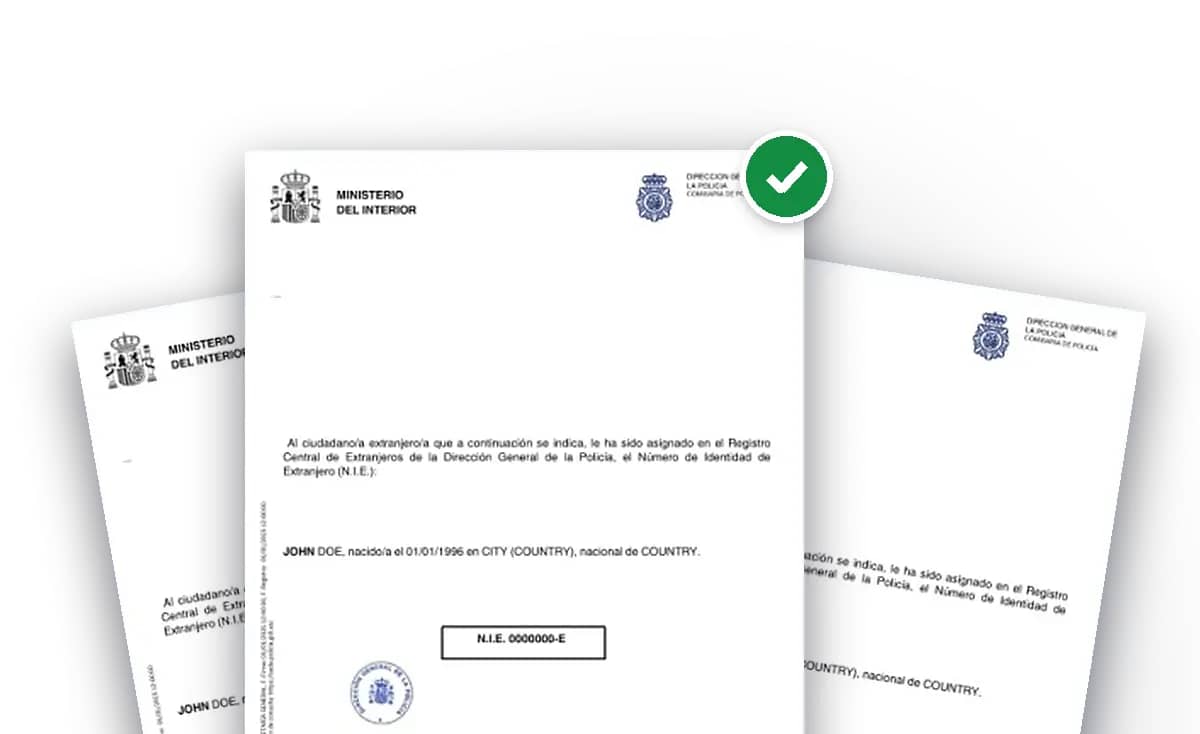
Yes, in practice. The notary’s deed of acceptance states the tax number of every heir, heirs represented by an attorney included, and a foreigner’s Spanish tax number (NIF) is the NIE, the número de identidad de extranjero. Without it the notary can still sign, but records the missing number, and the Land Registry refuses to register the home in your name until a deed gives it. The inheritance tax return asks for each heir’s Spanish tax number too, and Tráfico transfers a car only against a passport and a NIE.
- One NIE per heir: three children inheriting a flat need three NIEs.
- Start it first. From abroad it is the step that takes longest: Spanish consulates take two to eight weeks, by appointment, for people who live in their district.
- Not needed for the wills certificate, where a passport is enough, or for the yearly non-residents’ tax on the home, which has a code of its own.
For the tax return alone, the tax agency can also give you a tax number beginning with M through a Spanish consulate; the deed, the Land Registry and Tráfico ask for the NIE. Once you have a NIE, register it with the tax agency on form 030 before you file: the agency treats it as your tax number from then on.
How to get a NIE from abroad
- In Spain, in person at a police station, with the EX-15 form and the €9.84 fee; the police have 5 days to decide.
- At a Spanish consulate in your country, which charges its own fee: see the Spanish consulates and embassies.
- Or let us do it: we get your NIE online, from abroad, for each heir, and attend the appointment for you.
Our guides to the NIE number and to the EX-15 form go through each route.
How to settle an inheritance in Spain from abroad, in 8 steps
From the death certificate to the Land Registry: what to do at each step, and who does it.
1
Start a NIE for each heir
Every heir’s NIE goes into the notary’s deed, and the Land Registry won’t register the home without it. From abroad it is also what takes longest: start it in the first weeks, while you gather the certificates.
With us: from €199Apply online in 5 minutes
Get my NIE2
Get the death certificate
A death in Spain is in the Spanish Civil Registry: order the certificate online or by post. A death abroad needs the foreign certificate with the Hague apostille and a sworn translation into Spanish; from another EU country, ask for the EU multilingual standard form with it, which needs neither.
EU: multilingual form, no apostille
3
Order the wills and life-insurance certificates
From 15 working days after the death, the Ministry of Justice says whether the deceased made a will in Spain, before which notary, and which life policies covered them. One form 790 (code 006) orders both, €3.86 each; from abroad, post it to Madrid with the death certificate. They are issued within 10 working days and 7 working days.
€3.86 per certificateA passport is enough
4
Find out who inherits
With a Spanish will, ask its notary for an authorised copy. With a will made abroad, the notary also wants proof of the foreign law and the wills-registry certificate of the deceased’s country, when it has one. Without a will, close relatives ask a Spanish notary for a declaration of heirs.
Declaration of heirs: 20 working days or more
5
List what there is, and decide
Ask each bank for its balances at the date of death, and gather the home’s title deed and its IBI receipt, with the cadastral reference. Debts as well? Under Spanish law, accept with the benefit of inventory, which limits what you owe to what the estate is worth, or renounce, before a notary.
Ask us in a free call6
Sign the deed, in Spain or by power of attorney
The heirs, or their attorneys, sign the deed of acceptance and allocation before a Spanish notary: who receives what, and at what value. Can’t travel? Sign a power of attorney at a Spanish consulate, before a notary in your country with the apostille, or with a Spanish notary by videoconference.
Each heir’s NIE in the deed
7
File the inheritance tax and the plusvalía
Within 6 months of the death, each heir files form 650 with the tax agency’s office in Madrid, which handles heirs who live abroad, and pays. Heirs outside the EU and the EEA name a representative living in Spain. At the same time, declare the plusvalía to the town hall of the home.
6 months from the deathExtension: ask within 5 months
8
Register the home, release the money, transfer the car
With the deed and proof of the taxes, the Land Registry registers the home within 15 days, and the banks release the money. A car goes to Tráfico within 90 days of the deed that allocates it, with a passport and a NIE (€55.70).
Car: 90 days
These timings are our estimate, not a rule: no official source gives one. At best, an inheritance settled from abroad takes about three months; the tax deadline sets the pace. What most often pushes heirs into the extension is a NIE that isn’t there yet, or a question about a foreign law.
- Day 0the death: the 6-month clock starts
- From week 3the wills and insurance certificates
- Month 1–2the will or the declaration of heirs, the bank balances
- Month 2–4the deed at the notary
- Before month 5the extension, if you need one
- Month 6form 650 and the plusvalía, filed and paid
The 6-month deadline, and what happens if you miss it
The tax is due from the day of the death, whatever the heirs do: the 6 months run from that day, not from the will, the deed or your acceptance. For a death on 15 March 2026, the return is due by 15 September 2026, and an extension must be asked for by 15 August 2026.
- The extension: one, of 6 more months, if you ask within the first 5 months, online or by a written request with the death certificate, the heirs and the approximate value of the assets. Without an answer within a month, it is granted. You then pay late-payment interest from the end of the first 6 months.
- Filing late on your own: a surcharge of 1% of the tax plus 1% for each full month, 15% after 12 months plus interest; a quarter less if you pay it all on time.
- If the tax agency finds it first: a penalty of 50% to 150% of the unpaid tax.
- A regional bonus can depend on it: in the Valencia region, the 99% for children and spouses applies only to what is declared in full and on time.
- A lawsuit over the inheritance stops the clock; an inventory or an undisputed declaration of heirs doesn’t.
- Four years: how long the tax agency has to claim the tax, from the end of the filing period.
Even when the tax comes to zero, file the return: a 99% bonus is claimed in the return, not instead of it. Two other clocks start at the death: the town hall’s plusvalía (6 months, a year if you ask), and a car, which whoever keeps it reports to Tráfico within 90 days.
Spanish inheritance law: which law decides who inherits
Spain’s tax and the law of the inheritance are two different things. Who inherits, and in what shares, follows the EU Succession Regulation for every death since 17 August 2015:
- The law of the country where the deceased habitually lived when they died: a German who lived in Germany leaves a flat in Alicante under German law.
- Or the law of their nationality, if their will chose it; a will made before 17 August 2015 under that law counts as the choice.
- Spanish notaries and registrars apply it to everyone, British and American estates included, although the UK is not bound by it.
- Spain’s forced shares, two thirds reserved to the children, apply only when Spanish common law governs; some regions, Catalonia and Galicia among them, have their own.
A will made abroad, and the UK grant of probate
A will is valid in form if it follows the law of the place where it was made, of the testator’s nationality, domicile or habitual residence, or, for a home, of Spain. For a will made abroad, the notary asks for its apostille and translation, proof of the foreign law, and the wills-registry certificate of the deceased’s country when there is one. A UK grant of probate? Spain’s registry authority ruled in 2020 and again in 2025 that it is not needed when British law governs; the Spanish consulate in London still says a British will works with the grant of probate, so a notary may ask for it.
The European Certificate of Succession
If the deceased lived in another EU country (except Denmark and Ireland), the heirs can ask there for a European Certificate of Succession. The Land Registry accepts it as the title of succession, and the tax agency takes it instead of the death certificate and the will, translated into Spanish, by any translator.
Can you settle an inheritance in Spain without travelling?
Yes. The steps happen in Spain, but you can give someone there a power of attorney to sign the deed and file the tax for you:
- At a Spanish consulate, which acts as a Spanish notary: such a power needs no apostille. The London consulate, for one, doesn’t handle inheritances but prepares the power.
- Before a notary in your country: the power then needs the Hague apostille and a translation into Spanish.
- With a Spanish notary by videoconference, since 9 November 2023, for a power for specific acts, such as accepting one inheritance; general powers can’t be signed this way. You log in with an electronic ID.
The London consulate’s advice: don’t sign a general power, or a power to sell, before you know what you inherit, the tax and the fees. A power limited to this inheritance is enough.
The deceased’s Spanish bank accounts
Once the bank knows of the death, the accounts are frozen until the estate is divided, except to pay the funeral and the bills the deceased had authorised. To release the money, the bank asks for the deed of acceptance and proof that the inheritance tax was paid, or isn’t due.
- No cash to pay the tax first? The tax agency can let you pay it from the inherited accounts: ask before you file, on paper, with one return per bank. Or ask for a partial assessment just to release the deposits: computed without allowances, it counts towards the final tax.
- A joint account: if either holder could sign alone, the other holder still can; if every signature was needed, the heirs sign in the deceased’s place. Who owns the money is another question.
- The bank can’t make you open an account to receive the money: it must offer a free way, such as cash; a transfer or a cheque may carry a fee.
Debts, renouncing, and a co-heir who won’t sign
When Spanish law governs the inheritance:
- Accepting it plainly makes you liable for the deceased’s debts with your own assets too. Accepting with the benefit of inventory, before a notary, limits it to what the estate is worth.
- Renouncing is done before a notary. Renouncing in favour of a named co-heir counts as accepting and passing it on.
- There is no deadline to accept, but a co-heir or a creditor can have a notary give you 30 days: then silence counts as plain acceptance.
- Heirs who disagree on the division go to court, and a lawsuit over the inheritance stops the tax deadline.
Under another country’s law, these questions follow that law: ask a lawyer who knows it.
Plusvalía: the town hall’s tax on an inherited home
The heir also owes the town hall a tax on the rise in value of the land under the home, the plusvalía municipal: declare it within 6 months of the death, or a year if you ask. The Land Registry won’t register the inheritance before it is declared.
- No gain, no tax: the value declared for inheritance tax is compared with what the deceased paid.
- Otherwise you pay on the lower of two bases: the land’s cadastral value times a coefficient for the years the deceased owned it, or the real gain. Each town sets its rate, up to 30%.
- Towns may cut it by up to 95% for children, spouses and parents, on conditions of their own: check the town’s tax ordinance.
- For deaths from 1 December 2026, new maximum coefficients apply, if Parliament validates the decree that sets them.
Will you pay inheritance tax twice?
Possibly. Spain lets only heirs who live in Spain deduct an inheritance tax paid abroad, and its tax agency lists inheritance-tax treaties with France, Greece and Sweden. Under the French treaty, a Spanish home is taxed only in Spain, but Spanish bank accounts and securities only in France, when the deceased lived there. Elsewhere, any relief for the Spanish tax comes from your own country’s rules: ask a tax adviser there.
Inheriting in Portugal as well? There, close family pays no tax but still declares the death within three months: see our guide to inheritance tax in Portugal.












 MOVING IN EUROPE