





Moving to Another EU Country With a Residence Permit: Long-Term Residence and Your Rights

In short
So, can you move to another EU country with permanent residence? If you are an EU citizen, yes, freely, though your permanent residence does not travel with you and you rebuild it in the new country. If you are a non-EU national, it comes down to one line on your card.
Summarise this article with the AI of your choice:
If you have permanent residence in one EU country, can you pack up and move to another one? It is one of the most common questions people ask after they finally get settled, and the honest answer is the one nobody likes: it depends on what kind of "permanent" you have.
This guide covers what "permanent residence" actually buys you across borders, the one distinction that decides everything, and what changes depending on whether you are an EU citizen or a non-EU national. It walks through your mobility rights, whether you can work in a second country, the conditions and documents involved, how the application works, and the step-by-step process.
It ends with where Portugal and Spain fit, since both run a specific route for people moving on from another EU country, and a plain bottom line you can act on.
Table of contents9
- Can I move to another EU country? The short answer first
- The one distinction that changes everything
- What are the mobility rights?
- Can I work in another EU country?
- What are the conditions for moving?
- What documents do I need to move?
- How to apply for a residence permit in the second country
- What is the process for moving to another EU country?
- Where this trips people up
Moving in EuropeFree
Talk to us about your move
- Tell us your plans first
- Advice tailored to your move
- Book a time that suits you
4.8/51,500+ reviews
Can I move to another EU country? The short answer first
It depends on your status, and there are three very different answers. Your right to move to another EU country to live, not just visit, comes down to whether you are an EU citizen, a non-EU national with a national permanent permit, or a non-EU national with EU long-term resident status.
Freedom of movement is one thing, your residence rights are another, and permanent residency in one country does not automatically carry to the next.
Here is the whole article in one table.
| Your status | Can you move to another EU country to live? | What it means |
|---|---|---|
| EU citizen (with or without permanent residence) | Yes | You have free movement to live, work, study, look for work, or retire anywhere in the EU. |
| Non-EU national with EU long-term resident status | Yes, with conditions | You can apply to live in another participating EU country for work, study, training, or another valid reason. You apply there and must qualify. |
| Non-EU national with a national permanent permit only | Usually no, not automatically | Your permit is permanent inside the country that issued it. For a different EU country, you normally need a fresh residence route. |
| Non-EU family member of an EU citizen | Maybe, derivative | Your right usually flows from the EU citizen moving to or living in another EU country, with you joining them. |
The rest of this guide unpacks each row, because the gap between "yes" and "usually no" is where people lose months.
The one distinction that changes everything
If you are a non-EU national, the single fact that decides your cross-border rights is whether your card says "long-term resident – EU" or just says permanent residence under national law.
They sound interchangeable. They are not. One opens a door to other EU countries. The other is a very good permit that stops at the border.
What is a valid residence permit?
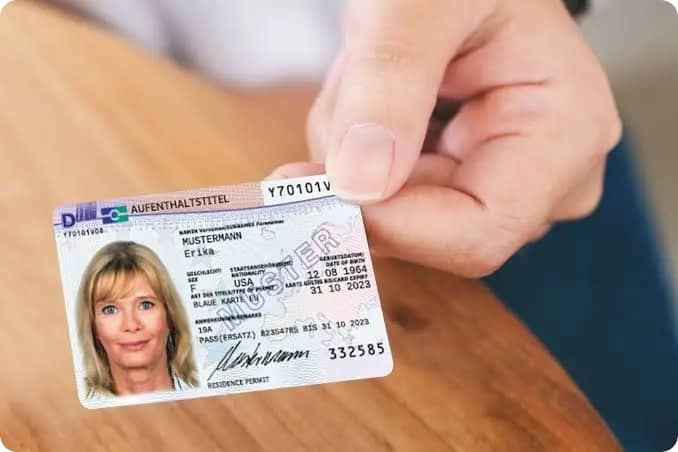
A residence permit is the card a member state issues to a non-EU national to live there legally, and across the EU it follows one common format.
A valid residence permit means a current, genuine card issued by an EU member state, produced in the EU's uniform format under Regulation (EC) No 1030/2002, with the holder's biometric data. The type of residence permit is what matters for moving, and the type is printed right on the card.
There are three broad kinds of residence permit card for non-EU nationals:
- A national temporary permit, tied to a purpose such as work, study, a passive-income visa, or a digital nomad route. Most first permits are this.
- A national permanent or long-term permit, granted under one country's own law after several years of residence.
- An EU residence permit for long-term residents, granted under EU law, which carries the remark "long-term resident – EU" (you may see it written as Residente de longa duração – UE, Residencia de larga duración-UE, Soggiornante di lungo periodo – UE, or Daueraufenthalt-EU).
The most useful thing you can do before planning any move is read the exact words on your card. That one line decides which of the sections below applies to you.
National permanent residence: strong at home, quiet abroad
A national permanent residence permit gives you secure, often indefinite status, but only in the country that issued it. Permanent, it turns out, is a homebody.
Residency is a national competence, so a permanent permit from Portugal, Spain, France, Germany, or anywhere else is permanent there, and does not automatically let you live or work in a different EU country.
What it usually gives you: long-term or indefinite residence in that country, stronger protection against removal, easier renewals, access to work and services under national law, and short Schengen travel if it was issued by a Schengen country.
What it usually does not give you: an automatic right to relocate to another EU country, an automatic right to work there, or any transfer of your permanent status to a new country.
EU long-term residence: the permit with cross-border rights
EU long-term resident status is a specific EU-law status for non-EU nationals who have lived legally in one EU country for at least five years, and it is the one that can carry mobility rights.
The European Commission describes it as a secure, permanent status that grants rights similar to those of EU citizens in areas such as work, education, social security, and access to goods and services. Critically, it is the status the EU built to let people move and work in other member states.
To get it, under Directive 2003/109/EC you generally need five years of legal, continuous residence, stable and regular resources, and sickness insurance, and the authorities must decide within six months. The permit is valid for at least five years and renews automatically. This is the status that turns "I live here" into "I might be able to move there."

What are the mobility rights?
Your mobility rights split sharply by status: EU citizens have free movement, EU long-term residents have a conditional route to move and apply in a second country, and national permanent residents have neither on that permit alone.
Mobility here means the right to enter another member state and establish residence there, which is very different from the right to visit.
If you are an EU citizen: freedom of movement
EU citizens can move to another EU country to live, work, study, look for work, or retire, full stop. Under the Free Movement Directive 2004/38/EC, you can live in another EU country for up to three months with nothing more than a valid identity card or passport.
For stays over three months you may need to register and show your basis of residence, for example as a worker, self-employed person, student, or someone with sufficient resources.
Moving to Portugal? Our guides for movers from Germany, France, Italy and the Netherlands walk you through that registration and the rest of the move, step by step.
After five years of continuous legal residence in that new country, you acquire permanent residence there, which removes the conditions entirely.
Does your permanent residence move with you?
No. Permanent residence does not travel. If you hold permanent residence in one EU country as an EU citizen and you move to another, you do not arrive permanent.
You start again under free-movement rules and build up to permanent residence in the new country over five years. And there is a quiet expiry to watch: you can lose your permanent residence if you live outside that country for more than two consecutive years. Permanent is durable, not portable.
If you hold EU long-term resident status
An EU long-term resident in one country may move to a second EU country for more than three months to work, study, train, or settle for another valid reason, as long as they apply for and are granted a residence permit there.
You do not transfer your permit. You apply in the second country, meet its conditions, and receive a new permit from it. After five years of residence in that second country, you can become an EU long-term resident there too.
This is real mobility, but it is application-based mobility, not the automatic kind EU citizens enjoy.
Where this does not apply: Ireland and Denmark
EU long-term resident mobility works across almost all member states, with two standing exceptions: Ireland and Denmark.
Both opted out of the long-term residents directive, so do not assume your "long-term resident – EU" card will be treated the same way there. Ireland also sits outside the Schengen area and runs its own visa rules, so even short visits follow a separate process.
For their own national permits, see our guides to residence permits in Ireland, Cyprus and Malta and to Nordic residence permits, Denmark included.
Can I work in another EU country?
Usually a residence permit only lets you work in the country that issued it. Working in another EU country normally needs either EU citizenship, EU long-term resident mobility, an EU Blue Card, or a specific route, not just a valid residence permit.
Employment rights are not attached to the plastic card, they are attached to your status.
If you are an EU citizen
EU citizens have full employment rights across the EU and need no work permit to take a job in another member state. This is the strong version of mobility, and it is the benchmark every other status is measured against.
If you hold EU long-term resident status
You can work in a second EU country, but only after you apply there and are approved, and the second country can still put conditions on access to its labour market.
Holding "long-term resident – EU" gets you in the door for an employment application. It does not hand you a job-ready work authorisation in every country automatically.
The catch: the labour-market test
For the employment route, a second country is allowed to examine its labour market and apply its own rules before letting you work.
Some countries, Spain among them, keep national work-permit requirements that apply to long-term residents arriving from another member state. So "I have EU long-term resident status" can still meet "but first we check the job market here."
The one-year restriction window
Once you receive your residence permit in the second country, you are entitled to equal treatment with its citizens, although some restrictions on labour-market access can apply for the first year.
After that first year, those specific restrictions fall away. It is a speed bump, not a wall, but it is worth planning around if your move depends on starting work immediately.
If you hold a national permanent permit only
A national permanent permit does not authorise work in another EU country. Even if it lets you work freely at home, it stops at the border for employment purposes. To work elsewhere, you need that country's own route.
A quick note for completeness: a few permits carry their own, separate mobility rules, such as the EU Blue Card for highly qualified workers, and the schemes for researchers, certain students, and intra-corporate transferees. Those are work-and-talent routes with their own thresholds and procedures, not general rights attached to every residence card, and they are a different topic from permanent residence.
What are the conditions for moving?
If you are moving on EU long-term resident status, the second country can ask you to prove resources, sickness insurance, and accommodation, and it sets the conditions for moving your family with you.
These are the residence rights and obligations that come with the route, and they are the same family of conditions you met to get long-term status in the first place.
Money and health cover
Expect to show stable and regular resources to support yourself and your family without relying on social assistance, plus sickness insurance covering all risks in the new country.
Countries evaluate resources by their nature and regularity, and some also apply integration measures such as a language requirement. None of this is a surprise if you have done the first five-year status before, it is the same logic, repeated by a new authority.
Family reunification
Family members who were already a family with you in the first country can move with you, and the second country issues them their own residence permits.
If the family was not yet formed in the first country, family reunification usually runs as a separate application in the destination. Either way, your family does not arrive automatically resident, they arrive as applicants whose case is tied to yours.
Social security and equal treatment
Once you hold the residence permit in the second country, you are entitled to equal treatment with its nationals in areas such as employment, education, social security, and tax, with the labour-market restriction noted above and a few other limits countries may apply.
Equal treatment is the real prize of long-term resident status. It is what makes the paperwork worth it.
What documents do I need to move?
At minimum: a valid passport or travel document, your current residence card showing your status, and the supporting evidence the second country requires, submitted in person in most cases.
Because the EU's residence cards carry biometric data and the EU's new entry system records biometrics at the border, expect your identity and history to be checked carefully and digitally.
A typical document set for an EU long-term resident moving to a second country includes:
- A valid passport or travel document, with enough validity left.
- Your residence permit card from the first country, the one marked "long-term resident – EU," or a certified copy.
- A criminal record certificate from the country that granted your long-term status, properly authenticated.
- Proof of resources and, where required, accommodation.
- Sickness insurance or proof you are covered by the national health service.
- The country's application form and proof you paid the fee.
Documents from outside the destination country usually need to be translated and legalised or apostilled. And yes, most second countries require you to apply in person at an immigration office or appointment, and to appear again to collect your biometric residence card. The system still likes to see your face.
How to apply for a residence permit in the second country
You apply in the destination country, on its official application form, and you do it soon: as a rule no later than three months after you enter, with the destination deciding within a set deadline.
This is an administrative procedure run by the new country, not a transfer of your old permit, so its forms, fees, and requirements govern.
The shape of the application is consistent across countries:
- You submit the application on the destination's official form, in person at the competent immigration office, by appointment.
- You attach the requirements for application: your long-term resident card, passport, criminal record, proof of resources, accommodation, and sickness insurance.
- Some countries let you apply before you arrive, from the first country, which can save you the scramble after landing.
- The authority must decide within its legal deadline. The directive caps the second country's decision at four months, and national procedures can be shorter.
Miss the three-month application window and your legal stay in the new country can unravel, even though your long-term status came from somewhere else. The clock starts the day you arrive, and it does not care that you are still hunting for an apartment.
What is the process for moving to another EU country?
The process is: confirm your status, pick the destination's correct route, gather and legalise your documents, apply in the second country within three months, collect your residence card, and register locally for tax and social security.
For EU long-term resident mobility, you generally do not need a visa for this, which is one of the few genuinely smooth parts.
Step by step:
- Read your card. Confirm whether it says "long-term resident – EU" or only national permanent residence. This decides everything that follows.
- Match the route. Find the destination country's specific route for long-term residents arriving from another member state, or, if you only have a national permit, the normal residence route that fits you (work, self-employment, passive income, study, family).
- Build the file. Passport, long-term resident card, authenticated criminal record, proof of means and accommodation, sickness insurance, translations and apostilles.
- Apply in the second country. On its official form, in person, no later than three months after entry, or before you arrive if that country allows it.
- Get your residence card. Once approved, you receive a residence permit and, after appearing for biometrics, your physical card from the new country.
- Register on the ground. Get your local tax number, register your address, and sort social security, the practical paperwork that makes the move real.

Where this trips people up
A few patterns catch people again and again. Worth knowing before they catch you.
The "my permanent residence covers the EU" myth
The most common mistake is assuming a national permanent permit lets you live or work anywhere in the EU. It is a recurring question on expat forums and Q&A sites, and the answer is consistent: a permanent permit from one country applies in that country.
The status with cross-border rights is the EU long-term resident permit, and even that requires you to apply in the second country.
The deadline that voids your move
The three-month application window in the second country is a hard edge, not a guideline.
People treat the move as done once they arrive, then discover that residence in the new country still depends on a timely application. Mark the date you enter and start the paperwork immediately.
The reform that is not law yet
Several relocation sites describe a friendlier set of rules, a three-year path to long-term status, no labour-market test in the second country, longer permitted absences, as if they already apply. They do not.
The European Commission proposed a recast of the long-term residents directive in 2022, but negotiations between the Council and the Parliament stalled and the file has not been adopted.
The law in force is still Directive 2003/109/EC as amended in 2011. Plan around the rules that exist today, not the ones still stuck in Brussels.
So, can you move to another EU country with permanent residence? If you are an EU citizen, yes, freely, though your permanent residence does not travel with you and you rebuild it in the new country. If you are a non-EU national, it comes down to one line on your card.
A national permanent permit keeps you permanent at home and lets you visit Schengen short-term, but it does not move you. EU long-term resident status does open a real route to live and work in another member state, and even then you apply in the second country, meet its conditions, and beat a three-month clock.
The cleanest next step costs you nothing: read the exact words on your residence card. If it says "long-term resident – EU," you have options worth mapping. If it says permanent residence under national law, you will likely need a fresh route in your destination. Either way, that is where we start.
Share this article










 MOVING IN EUROPE