2026 guide for Italian expats and retirees

Moving to Portugal from Italy in 2026

No visa, but seven steps: from your AIRE registration to your health cover and taxes in Portugal.

  • No visa: you move with your Italian ID card
  • AIRE: register within 90 days of your move
  • Your pension: where it is taxed, private or public

Get the free relocation checklist

Arrow
No card required
•
4.8/5 on Trustpilot
Star
Star
Star
Star
Star
Porto at dusk, the Douro river and the Ribeira riverside under an orange sky
Atlantic cliffs and sea stacks on the coast of Portugal

Moving to Portugal from Italy takes no visa: as an EU citizen, you can live in Portugal on your Italian ID card for three months, and stay longer if you work, study or have enough money of your own, such as a pension. At the end of 2024, 40,021 Italians were living in Portugal, more than any other EU nationality.

What you do need is paperwork, in both countries: your registration with AIRE within 90 days, a tax number (NIF), the EU registration certificate (CRUE) from your Câmara Municipal, health cover (the S1 if you draw an Italian pension) and a clear answer on where your pension is taxed. This guide takes you through the 7 steps, from AIRE to Portuguese citizenship.

Get your free checklist to move from Italy
Check
Personal checklist for your relocation
Check
Ensure you forget nothing and stay compliant
Get the free relocation checklist
Arrow
No card required
•
Excellent
Star
Star
Star
Star
Star
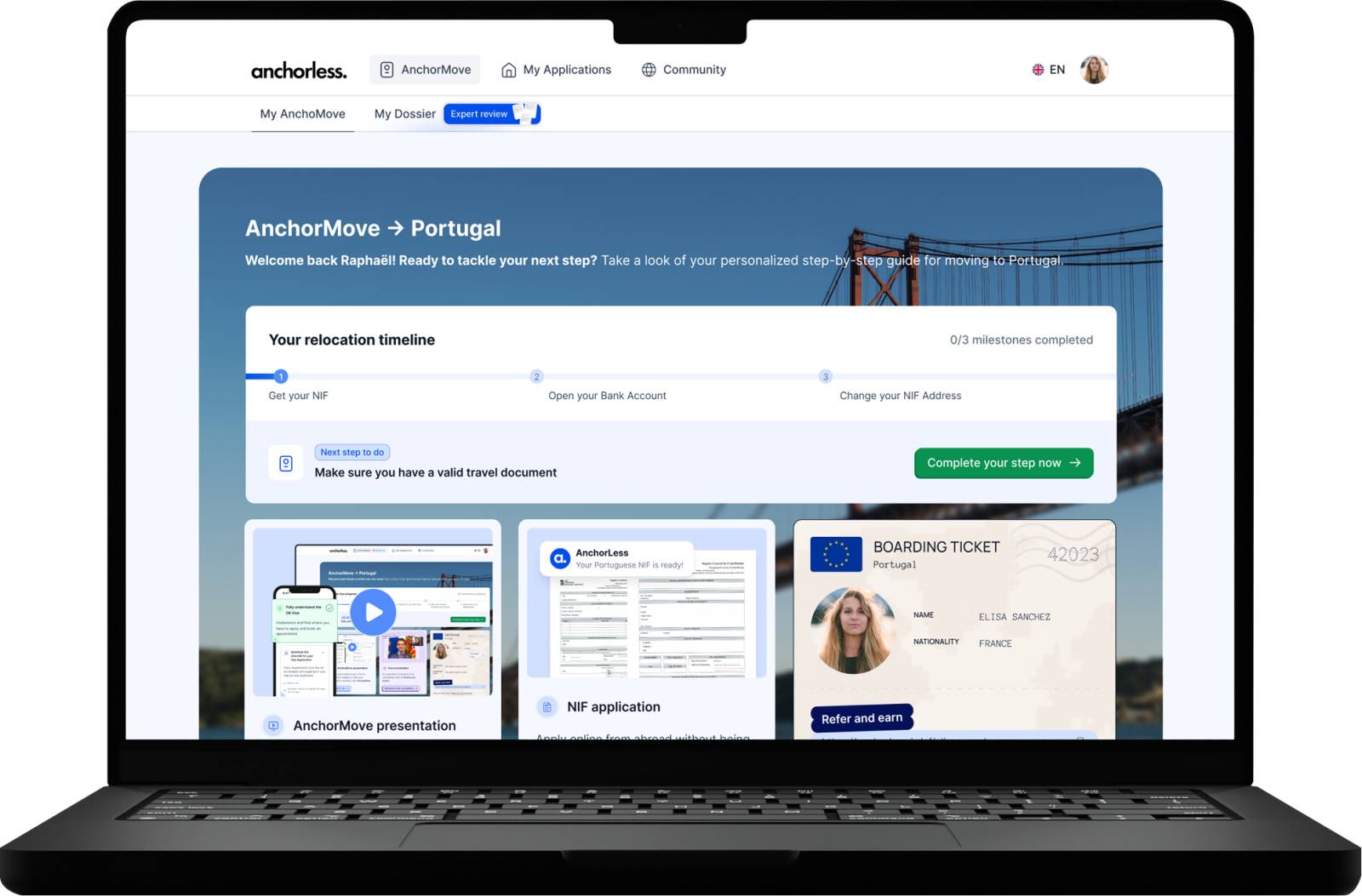
AnchorMove on a laptop: your relocation timeline for Portugal, from your NIF to your bank account

Moving from Italy in 6 numbers (2026)

  • 3 monthsin Portugal on your Italian ID card alone
  • 90 daysafter your move to register with AIRE
  • €18for your registration certificate at the Câmara (€15 online)
  • 183 daysin Portugal in 12 months: beyond them, you are a tax resident
  • 40,021Italians living in Portugal at the end of 2024
  • 7 yearsto Portuguese citizenship, keeping your Italian one

What you need as an EU citizen: the 30-second check

  • You have a valid Italian ID card or passport. It is all you need to enter Portugal and stay three months.
  • You will work, study or live on your own means in Portugal: a job or self-employment, a course, or enough money of your own, such as a pension, with health cover.
  • You have a home in Portugal: its address goes on your registration certificate, and its lease or a utility bill on your AIRE registration.
  • You will register at your Câmara Municipal within 30 days after your first three months.
  • You will tell Italy you are leaving: AIRE within 90 days, INPS if you draw a pension, and your ASL for an S1.

Yes to all five? You can move without any visa.

Your spouse or children are not EU citizens? They have a route of their own, with a residence card from AIMA (see below). A doubt about your case? Ask us in a free call.

Create my free account →

Your personal relocation checklist, free. No card required.

What changed in 2024, 2025 and 2026

  • Citizenship after seven years for EU citizens since May 2026 (it was five), with a new test of Portuguese language, culture and history still to be set by regulation.
  • Italian tax residence since 2024: being on a Comune's population register is now only a presumption you can rebut; what counts is where you live, where your personal and family ties are, and your days in Italy, part days included.
  • A fine for not registering with AIRE since the 2024 budget law: €200 to €1,000 for each year.
  • No more NHR for newcomers: nobody who becomes a Portuguese tax resident from 2025 can get it, and its successor, the IFICI, is for qualifying jobs, not for pensions (see Taxes).
  • The two-year wait for family reunification (since October 2025) is not for you: the foreigners' law that sets it excludes EU citizens and their families, whatever their nationality.

Do Italian citizens need a visa to live in Portugal?

No. As an EU citizen, you enter Portugal with your Italian ID card or passport, with no visa, and can live there for up to three months with no other formality. To stay longer, you need to work (employed or self-employed), study, or have enough money of your own and health cover. Then you register at your Câmara Municipal: no visa, no residence permit, no AIMA appointment.

The same rights cover citizens of the other EU countries, Iceland, Liechtenstein, Norway and Switzerland. Our guide to Portugal residency for EU citizens goes into detail.

Family members who are not EU citizens

Your spouse or partner, your children under 21 or dependent on you, and your dependent parents can live in Portugal with you, whatever their nationality. They enter with their passport and need a visa only if EU rules require one for their nationality; that visa is free and fast-tracked.

After three months, within 30 days, they ask AIMA for a residence card as family of an EU citizen, with their passport, proof of the family link and your registration certificate. AIMA has up to three months to issue it, and it is valid for five years.

Before you leave Italy: AIRE, taxes, pension and health

Register with AIRE within 90 days

Moving to Portugal for more than 12 months, you must register with AIRE (Anagrafe degli italiani residenti all'estero), the register of Italians living abroad, within 90 days of your move. You do it online on the Foreign Ministry's Fast It portal; the consular office of the Italian Embassy in Lisbon passes it on to your Comune, which keeps your AIRE file. Your registration counts from the day you file a complete request.

To prove your address in Portugal, the Embassy asks for a utility bill in your name (water, electricity or gas), a work contract, a lease of at least one year, renewable, or the papers of a business you open there. It does not accept your CRUE, a certificate from the junta de freguesia, your NIF, a bank account or a mobile phone bill.

Not registering in time costs a fine of €200 to €1,000 for each year, set by your Comune; €20 if you file less than 90 days late, before any check. AIRE is also what lets you renew your passport or ID card at the consulate, and vote from Portugal: by post in national elections and referendums, and at the consulate's polling stations for Italy's seats in the European Parliament (or for Portugal's, if you choose).

Your Italian tax residence

Italy taxes your income from all over the world for any year in which, for most of the year (183 days, 184 in a leap year, part days included), you lived in Italy, had your domicile there (the place of your main personal and family ties) or were on a Comune's population register. Since 2024 that registration is only a presumption: you can prove you lived abroad.

There is no split year with Portugal. Leave in the first half of the year, with your family, and register with AIRE at once, and you can be a non-resident in Italy for that whole year. Leave later, and you remain an Italian tax resident for that year, while Portugal taxes you from your first day there: the Italy–Portugal convention then decides which country comes first (your permanent home, then the centre of your vital interests). As a non-resident, Italy taxes only your income from Italy, as far as the convention allows.

Your Italian pension and health insurance

INPS pays pensions abroad through Citibank, to a Portuguese account or to an Italian one: give your new bank details (IBAN and BIC) to the INPS office that manages your pension and to the bank. Paid outside Italy, your pension comes with a yearly proof of life (esistenza in vita): Citibank sends you a form, which an "acceptable witness" countersigns, such as the consular office in Lisbon, an honorary consulate or a patronato, and you have 120 days to send it back. Late, you are paid once in cash at a counter of Citibank's local partner, and if you don't collect it, your pension is suspended.

Until INPS applies the tax convention, it withholds Italian tax: send it the EP-I form with the Portuguese tax office's certificate of your tax residence (see Taxes). Drawing an Italian pension and not working in Portugal? Ask your ASL for the S1 form (see Healthcare).

Free relocation checklist

Your move from Italy, step by step, in a free account

  • Your personal relocation checklist
  • Forget nothing, stay compliant
  • Expert help when you need it

Free

Create my free account

4.8/51,500+ reviews

No card required

Moving to Portugal from Italy in 7 steps

From your AIRE registration to your Portuguese tax return. Each step says what to do and what it costs. In a free AnchorLess account, you tick them off one by one and get expert help where you need it.

  1. 1

    Plan your move and tell Italy you are leaving

    No visa to apply for. Check that you will work, study or live on your own means, ask your ASL for the S1 if you draw an Italian pension, and register with AIRE on Fast It within 90 days of your move, with a lease or a utility bill.

    No visa neededAIRE: within 90 days

    Talk to us for free
  2. 2

    Get your NIF

    Your Portuguese tax number: landlords, banks and the tax office ask for it. Get it at a tax office or a Loja do Cidadão (by appointment), or from Italy through a representative. As a resident of an EU country, you need no tax representative.

    With us: from €99By email from 24 hours

    Get my NIF
  3. 3

    Open a Portuguese bank account

    Your own Portuguese IBAN for rent, bills and a salary in Portugal, opened remotely before you move, once you have your NIF. Your INPS pension can be paid into it.

    With us: €359Opening in 2–4 weeks (estimated)

    Open my account
  4. 4

    Find your home

    Your address goes on your registration certificate, and a lease of at least a year proves it for AIRE. Rents on new leases had a median of €10.17 per m² in Portugal in the second quarter of 2026, €15.24 in Greater Lisbon. Have the lease checked before you sign.

    Lease checked by a lawyer: €99In 48 hours

    Review my leaseOr find your home with us
  5. 5

    Register at your Câmara Municipal (CRUE)

    After three months in Portugal, you have 30 days to register at the Câmara Municipal where you live, with your ID card or passport and a sworn statement that you work, study or have enough means. You get the EU registration certificate (CRUE), valid five years. Then update your NIF address.

    €18 (€15 online)Valid 5 years

    Update my NIF address (€99)
  6. 6

    Get your NISS and your SNS user number

    Working in Portugal? You need a social security number (NISS): the online request is free. Still in Italy, or would rather not deal with it in Portuguese? We register you with Social Security for you, 100% online, with your account password. For public healthcare, get your SNS user number at your health center. Drawing an Italian pension? Hand in your S1 at the Segurança Social where you live.

    Online request: freeDone for you, from abroad: €349

    Have it done for me
  7. 7

    Become a tax resident and file your IRS

    You are a Portuguese tax resident after more than 183 days in Portugal in 12 months, or sooner with a home you intend to keep as your habitual residence. File your IRS return every year, from 1 April to 30 June. The Italy–Portugal convention decides which country taxes each income: a private-sector pension in Portugal, a public-service pension in Italy.

    183 days, or a homeIRS: 1 April to 30 June

    Book a tax consultation (€249)File my IRS

How much do the official steps cost?

Official stepCost
Registration certificate (CRUE) at the Câmara, over 25€18
The same, requested online€15
Social security number (NISS), requested onlineFree
Driving license registration at IMTFree

Under 25, the certificate costs €15 at the counter and €12.50 online (details).

How long does the move take?

There is no visa to wait for: you can move as soon as your home is ready. The deadlines to keep are in both countries: your license registered with IMT within 60 days of settling, AIRE within 90 days of your move, and your CRUE within 30 days after your first three months.

  1. Before you goNIF, bank, home, S1
  2. Day 0you move
  3. 60 dayslicense at IMT
  4. 90 daysAIRE registered
  5. Month 4CRUE at the Câmara
  6. Next springyour first IRS
  7. 5 yearspermanent residence
  8. 7 yearsPortuguese citizenship

Follow the 7 steps in a free account

Your personal relocation checklist, free. No card required.

Create my free account →

The EU registration certificate (CRUE) in detail

The Certificado de Registo de Cidadão da União Europeia, or CRUE, formalizes your right to live in Portugal. You need it if you stay more than three months, and you ask for it at the Câmara Municipal of the area where you live, within 30 days after your first three months. It carries your name, your address and the date of registration.

What to bring

  • Your valid Italian ID card or passport;
  • A sworn statement that you work in Portugal (employed or self-employed), have enough means for yourself and your family with health cover, or study at a recognized school with enough means and health cover.

That is the whole list in the law and on AIMA's page: no lease, no bank statements, no NIF required. A family member who is an EU citizen too gets a certificate of their own, with proof of the family link.

Cost, validity and fines

Over 25, €18 at the counter or €15 online; under 25, €15 at the counter or €12.50 online; €7.50 under 6; free for a baby under one year (AIMA's 2026 fee table). The certificate is valid five years, or for your planned stay if it is shorter. Not registering in time can cost a fine of €400 to €1,500, halved when it is negligence.

The Italian Embassy does not take the CRUE as proof of your address for AIRE: keep your lease or a utility bill for that. Once you have the certificate, change the address of your NIF to your Portuguese home: for the tax office, a new address counts only once you have reported it, and a change of tax residence status must be reported within 60 days. Our CRUE guide walks you through the appointment.

Healthcare in Portugal for Italians: S1, SSN and the SNS

Your European Health Insurance Card (the TEAM) is for temporary stays: it covers the care that becomes medically necessary during a stay, not a new life in Portugal. Once you live there, your cover depends on your situation:

  • You draw an Italian pension and don't work: ask your ASL for the S1 and hand it in at the Segurança Social where you live. You get care in Portugal at the level the Portuguese system gives its own insured, paid by Italy.
  • You work in Portugal: Portuguese social security applies and you use the national health service (SNS) as a resident. Posted by an Italian employer? Your ASL gives you an S1, and Italy pays for your care in Portugal.
  • You live on your own means, with no job and no Italian pension: plan health cover of your own, from a private insurer; our health insurance guide compares the options.

Once you are registered with AIRE, says the Ministry of Health, you can no longer use the Italian national health service (SSN) in Italy: your care is in Portugal.

Any foreign national living legally in Portugal can get an SNS user number (número de utente), given at your first visit to a public health center or hospital. For the SNS to cover your care, your record needs your ID, your Portuguese NIF, your full address in Portugal and a valid residence document. You can then register with the health center of your area. Our healthcare guide goes further.

Your Italian supplementary cover and private insurance in Portugal

Have an Italian supplementary health fund or policy (fondo sanitario integrativo)? Ask it before you leave what it still pays once you live in Portugal.

In Portugal, private health insurance (seguro de saúde) covers what its contract lists, within its limits. Conditions you already have are covered unless the contract excludes them, and it usually does; some covers start only after a waiting period. A "plano de saúde" is not insurance but a discount card on a network of providers. In 2025, an individual policy cost on average €452 per insured person (ASF, the insurance supervisor). Our guide to insurance in Portugal lists the main insurers.

Taxes: Portuguese tax residence and the Italy–Portugal convention

You become a Portuguese tax resident if you spend more than 183 days in Portugal, in a row or not, in any 12-month period, or fewer days if you have a home there that you intend to keep and live in as your habitual residence. You are then resident from your first day of presence, and you file your IRS return online every year from 1 April to 30 June, for the year before. Report a change of residence status to the tax office within 60 days.

In Italy, once you are no longer a tax resident, you are taxed only on your income from Italy, as far as the tax convention allows (when that happens).

Woman smiling on a video call with a tax lawyer, at her desk at home

Your Italian pension: taxed in Portugal or in Italy?

Italy and Portugal signed a tax convention in Rome on 14 May 1980, in force since 1983. For pensions, it draws a clear line:

  • Private-sector pensions (article 18), paid for a past job, are taxable only in the country where you live. Once you are a Portuguese tax resident, Portugal taxes them with your other income, at the ordinary IRS rates, after a deduction of €4,587.09 per pensioner in 2026.
  • Public-service pensions (article 19), paid by the Italian State, a region or a local authority, directly or from their funds, for work done for them, are taxable only in Italy, unless you live in Portugal and are Portuguese: then only Portugal taxes them. A pension for work in a public body's industrial or commercial activity follows the private-sector rule.

INPS keeps withholding Italian tax until it applies the convention. Send the INPS office that manages your pension the EP-I form, in the original, by post, with the certificate of your tax residence from the Portuguese tax office and, if asked, proof of your AIRE registration. Tax withheld in earlier years can be refunded by the Agenzia delle Entrate on request.

The NHR regime is closed: nobody who becomes a tax resident from 2025 can get it. Its successor, the IFICI, taxes income from qualifying jobs (research, higher education, highly qualified professions in some companies, startups) at 20% for 10 years, and its exemption of foreign income leaves pensions out.

Our tax lawyers answer your questions in a 40-minute call (€249), and our certified accountants file your Portuguese IRS. IFICI or NHR? We review your options too.

Buying a home in Portugal: property taxes and inheritance

To buy a home in Portugal, you need a NIF: the taxes on the purchase are paid under it. Three taxes apply:

TaxWhenRate
IMT, the property transfer taxOnce, when you buy0% to 7.5%
Stamp duty (Imposto do Selo)Once, when you buy0.8%
IMI, the municipal property taxEvery year0.3% to 0.45%

IMT and stamp duty are worked out on the price or the taxable value of the property (valor patrimonial tributário), whichever is higher, and stamp duty is paid before the deed. On the mainland, a home you buy to live in permanently pays no IMT up to €106,346 in 2026; above, the rate rises by brackets from 2% to 8%, then becomes a single 6% above €660,982 and 7.5% above €1,150,853. A second home pays from 1%, and IMT is not the same in Madeira and the Azores.

IMI is due every year from whoever owns the home on 31 December, on its taxable value: each municipality sets its rate between 0.3% and 0.45%. It is paid in May, or in two or three instalments when it is over €100 or €500. Our guides to buying a house in Portugal as a foreigner, to mortgages and to home insurance go further.

Inheritance: Portuguese stamp duty and Italian succession tax

In Portugal, an inheritance pays 10% stamp duty on what is located in Portugal: a home, money in a Portuguese bank, a car registered there. Your spouse or de facto partner, descendants and ascendants (children, grandchildren, parents, grandparents) are exempt. The death is reported to the tax office (Finanças) by the end of the third month after it.

Italy's succession tax (imposta di successione) depends on where you lived when you die:

  • still resident in Italy: everything you leave, wherever it is, minus the tax already paid abroad on assets located abroad, up to the Italian tax on them;
  • living in Portugal: only what is in Italy, such as a home or land on Italian registers, shares and bonds of Italian companies, or money in an Italian bank.

The rate depends on the heir: 4% for a spouse or a relative in direct line (children, grandchildren, parents) on what each receives above €1 million; 6% for brothers and sisters above €100,000; 6% for other relatives, with no allowance; 8% for anyone else. Italy and Portugal have no convention on inheritance tax: theirs covers income tax only.

Your heirs file the Italian declaration online within 12 months of the death, or on paper from abroad if they cannot file online; none is needed when everything goes to a spouse and direct relatives, is worth €100,000 or less and includes no property. The consular office in Lisbon handles powers of attorney and the acceptance or renunciation of an inheritance, and a notary can tell you what your heirs would pay in each country.

Driving in Portugal: your Italian license and your car

Your Italian driving license is valid in Portugal until the expiry date printed on it, and exchanging it for a Portuguese one is optional. But once you live in Portugal, you must register it with IMT within 60 days: it is free, at the IMT counter of your area, with your ID, your registration at the Câmara Municipal and your license. To renew it later, or replace it if it is lost, you go to IMT.

An old license with no expiry date must be exchanged for a Portuguese one within two years of settling in Portugal.

Bringing your Italian car

Before the car leaves Italy, have it taken off the Italian vehicle register (PRA) for export (radiazione per esportazione): since 2020 this is done before the car is exported, after a roadworthiness test (revisione) passed in the last six months, and the car then travels on temporary plates. The consular office in Lisbon no longer handles it once the car has left.

Italian plates are for visitors: once you live in Portugal, your car must go on Portuguese plates. Within 20 working days of its arrival, you file a customs vehicle declaration (DAV) online on the Portal das Finanças, with its inspection and its technical approval from IMT.

Because you are moving your residence, you pay no vehicle tax (ISV) on it if you are over 18, lived in Italy for at least six months, and owned the car there for at least six months before you moved, bought in Italy with its taxes paid. Ask for this exemption within 12 months of your move: it covers one car per person, once every ten years, and you cannot sell, rent or lend the car for 12 months after it gets its Portuguese number. Otherwise, the ISV is paid within 10 working days of its assessment.

IMT then issues the registration certificate, and the car is registered at a Conservatória do Registo Automóvel. From then on, it pays a yearly road tax, the IUC: from 2027, in April, or in two or three instalments when it is over €100 or €500. Buying in Portugal instead? See our guides to buying a car and to car insurance.

Permanent residence and Portuguese citizenship

After five years in a row of legal residence, you have the right of permanent residence, with no more conditions of work or means. Absences of up to six months a year don't break the five years, nor does one absence of up to 12 months for a serious reason (pregnancy, illness, studies or a posting abroad). On request, AIMA issues a certificate of permanent residence within 15 days. You lose the right only after more than two years away in a row.

After seven years of legal residence (since Lei Orgânica 1/2026; it was five), you can apply for Portuguese citizenship. Your years can be added up if they fall within nine years. You also prove, by a test or a certificate, that you know the Portuguese language and culture, history and national symbols, and the rights and duties of citizens; you declare your adherence to the rule of law, show you can support yourself, and must have no conviction that bars it. The new test is still to be set by regulation.

You keep your Italian citizenship: under Italian law (Legge 91/1992, article 11), an Italian who acquires another citizenship keeps the Italian one, and Portugal does not ask you to give it up either.

A couple walking hand in hand on a wide sandy beach below cliffs on Portugal's Atlantic coast

Living in Portugal as an Italian

You won't be alone: 40,021 Italians lived in Portugal at the end of 2024, according to AIMA's yearly report, the largest community of EU citizens in the country, and 6,421 residence documents went to Italians that year.

Consular services

The consular office (Cancelleria consolare) of the Italian Embassy is at Calçada Conde de Pombeiro 24 in Lisbon, with honorary consulates in Porto, Albufeira (Algarve), Funchal (Madeira) and Ponta Delgada (Azores). Passports and ID cards are by appointment on the Prenot@mi portal; your AIRE registration and changes of address go through Fast It.

Italian schools and the Istituto Italiano di Cultura

Italy has no state school in Portugal: its seven state schools abroad are in Addis Ababa, Athens, Barcelona, Madrid, Istanbul, Paris and Zurich. In Lisbon, the Istituto Italiano di Cultura, for now in Avenida Infante Santo while its building is restored, teaches Italian, and Portuguese too, online or in class, at the six European levels from A1 to C2, and has an Italian library, the Biblioteca Tabucchi.

Cost of living compared with Italy, and where to settle

Prices are about a tenth lower than in Italy: in 2025, the price level of household consumption was 86.6 in Portugal and 97.1 in Italy, for an EU average of 100 (Eurostat). Portugal has a national minimum wage, €920 a month paid 14 times a year, or €1,073 a month over 12 months in 2026; Italy has none (Eurostat). Rents on new leases had a median of €10.17 per m² in Portugal in the second quarter of 2026, up 10.2% in a year: €15.24 in Greater Lisbon, €11.56 in the Algarve (INE).

Our guides go into detail for Lisbon, Porto, the Algarve and Madeira, with salaries in Portugal and the costs of retiring in Portugal.

Where to settle: Lisbon, Porto, the Algarve, the Silver Coast or Madeira?

How we checked this guide

The rules, amounts and fees in this guide were checked on 24 October 2026 against the law and the official portals:

  • Lei 37/2006, the law on EU citizens’ right to live in Portugal (registration, family, permanent residence, fines), up to date with Decreto-Lei 41/2023;
  • AIMA’s page on the registration certificate, its 2026 fee table and its 2024 migration report;
  • Lei 37/81, the nationality law, as amended by Lei Orgânica 1/2026;
  • the Portal das Finanças (NIF, tax residence, IRS, NHR and IFICI; the codes of stamp duty, IMI, IMT and IUC; the customs pages on the vehicle tax, ISV), gov.pt (NISS, SNS user number, buying property), IMT (driving licenses) and the ASF, the insurance supervisor (health insurance);
  • the Italy–Portugal tax convention of 14 May 1980 (Legge 562/1982, which ratified it);
  • in Italy, on normattiva.it: the AIRE law (Legge 470/1988) and its fines (Legge 1228/1954), the income tax code (TUIR, articles 2 and 3), the succession tax code (D.Lgs. 346/1990) and the citizenship law (Legge 91/1992); the Agenzia delle Entrate (succession tax), INPS (pensions paid abroad, proof of life, the tax convention), the Ministry of Health (the S1, AIRE and the SSN), the Ministry of Foreign Affairs (state schools abroad), the Italian Embassy in Lisbon (AIRE, consular services, proof of life, cars) and the Istituto Italiano di Cultura in Lisbon;
  • Eurostat (price levels of household consumption, minimum wages).

Written by Brenda L., relocation expert at AnchorLess. Tax rules depend on your situation: this guide is not tax advice.

Frequently asked questions

What do I need to move to Portugal from Italy?

No visa: a valid Italian ID card or passport is enough to enter and to stay three months. To stay longer, you work, study or have enough money of your own with health cover, and you register at your Câmara Municipal within 30 days after your first three months, for the EU registration certificate (CRUE).

Along the way you register with AIRE in Italy within 90 days of your move, and you need a NIF (tax number), health cover (the S1 if you draw an Italian pension) and, if you work, a social security number (NISS).

Do I have to register with AIRE?

Yes, if you move to Portugal for more than 12 months: within 90 days of your move, online on the Fast It portal, with proof of your address such as a utility bill in your name or a lease of at least a year. The CRUE, your NIF or a bank account are not accepted as proof. Not registering costs a fine of €200 to €1,000 for each year. AIRE also lets you renew your documents at the consulate and vote from Portugal.

Can my spouse come with me if they are not an EU citizen?

Yes. Your spouse or partner, your children under 21 or dependent, and your dependent parents can live with you whatever their nationality. They need a visa only if EU rules require one for their nationality, and it is free and fast-tracked. After three months, within 30 days, they ask AIMA for a residence card as family of an EU citizen, valid for five years.

When do I have to register at the Câmara Municipal?

Within 30 days after your first three months in Portugal. You bring your ID card or passport and sign a statement that you work, study or have enough means. It costs €18 at the counter or €15 online if you are over 25, and the certificate is valid five years. Not registering can cost a fine of €400 to €1,500.

Will I receive my Italian pension in Portugal?

Yes: INPS pays pensions abroad through Citibank, to a Portuguese or an Italian account; give the new bank details to the INPS office that manages your pension and to the bank. Paid outside Italy, your pension needs a yearly proof of life: Citibank sends a form, countersigned by an acceptable witness such as the consular office in Lisbon or a patronato, to return within 120 days, or your pension can be suspended.

Is my Italian pension taxed in Portugal or in Italy?

Under the Italy–Portugal tax convention, a private-sector pension is taxable only where you live: in Portugal, at the ordinary IRS rates, once you are resident there. A pension for public service to the Italian State, a region or a local authority is taxable only in Italy, unless you are also Portuguese.

INPS withholds Italian tax until you send it the EP-I form with the Portuguese tax office's certificate of your residence. The NHR regime is closed to anyone who becomes resident from 2025, and the IFICI does not cover pensions.

Am I still an Italian tax resident the year I move?

It depends on the date. Italy has no split year: you are an Italian tax resident for the whole year if, for most of it (183 days, part days included), you lived in Italy, had your personal and family ties there or were on a Comune's register. Leave in the first half of the year with your family and register with AIRE at once, and you can be a non-resident for that year; leave later, and the convention decides which country comes first.

What happens to my Italian health cover?

If you draw an Italian pension and don't work, ask your ASL for the S1 and hand it in at the Segurança Social where you live: you get care in Portugal, paid by Italy. If you work in Portugal, Portuguese social security covers you. Otherwise, take out private health insurance. Once registered with AIRE, you are no longer covered by the Italian SSN in Italy.

Will my heirs pay inheritance tax in Portugal or in Italy?

Possibly in both. Portugal charges 10% stamp duty on what is located there (a home, a Portuguese bank account, a car), but your spouse or de facto partner, descendants and ascendants are exempt. If you live in Portugal when you die, Italy taxes only what is in Italy, at 4% above €1 million per heir for a spouse, a child, a grandchild or a parent; still resident in Italy, everything you leave.

The two countries have no convention on inheritance tax. A notary can tell you what your heirs would pay.

Is life cheaper in Portugal than in Italy?

On average, yes, by about a tenth: in 2025, the price level of household consumption was 86.6 in Portugal and 97.1 in Italy, for an EU average of 100 (Eurostat). Rents are rising: the median on new leases was €10.17 per m² in the second quarter of 2026, up 10.2% in a year, and €15.24 in Greater Lisbon. Portugal's minimum wage comes to €1,073 a month over 12 months in 2026; Italy has no national minimum wage.

Are there Italian schools in Portugal?

Italy has no state school in Portugal: its seven state schools abroad are in Addis Ababa, Athens, Barcelona, Madrid, Istanbul, Paris and Zurich. In Lisbon, the Istituto Italiano di Cultura teaches Italian, and Portuguese too, online or in class.

Can I become Portuguese and keep my Italian citizenship?

Yes. EU citizens can apply for Portuguese citizenship after seven years of legal residence (since Lei Orgânica 1/2026), with a test or certificate of Portuguese language and culture. Under Italian law, an Italian who acquires another citizenship keeps the Italian one.

Team of AnchorLess
Still have questions?

Can't find the answer you're looking for? Contact our team of experts.

5000+ Expats relocated with us!

Turn your dream destination into reality with our dedicated relocation experts. We navigate the bureaucracy, so you can focus on your new beginning. Start your journey today.

Logo AnchorLess

AnchorLess is not a bank, accountant, tax advisor, investment advisor, or law firm, nor are we a government or official government website. We act as an intermediary, helping connect you with accredited professionals and streamlining administrative processes for your relocation in Europe.

Instagram icon
Reddit icon
Linkedin icon
Amex logo
Visa logo
Mastercard logo
& more
Pay 4X free of charge with
Klarna logo

🇵🇹 MOVE TO PORTUGAL

Arrow

🇪🇸 MOVE TO SPAIN

Arrow

🇮🇹 MOVE TO ITALY

Arrow

Resources

Terms and conditions

Privacy Policy

Disclaimer Policy

© 2022 - 2026 anchorless.io, all rights reserved.