Social Security in Spain: how it works and where to go

In a hurry? Summarise this article with the AI of your choice:
In short: Social Security in Spain ('Seguridad Social') is the public social security system you pay into when you work in Spain, as an employee or as a self-employed worker ('autónomo').
It pays social security benefits such as your retirement pension, sick leave and unemployment benefits.
It also decides who is covered for public healthcare.
Two institutions do most of the work:
- the TGSS (General Treasury of Social Security) registers you and collects your social security contributions;
- the INSS (National Social Security Institute) handles pensions and most benefits and recognizes who is covered for healthcare.
Unemployment benefits come from SEPE, Spain's public employment service.
In 2026, employees pay 6.5% of their contribution base on a permanent contract.
Their employer pays about 30.65%, plus a work-accident premium.
Each figure is several 2026 rates added together (illness and accidents outside work, unemployment, training…).
Self-employed workers pay about 31.5% of a base they choose from their income.
- TGSS: walk in, Mon–Fri 9:00–14:00
- INSS: by appointment
- Employees pay 6.5% (permanent contract)
- Autónomos pay about 31.5%
Spanish NIE
Your Spanish NIE, from abroad
- Apply online in 5 minutes
- We attend the appointment
- Notary fees included
From€199
Get my NIE4.8/51,500+ reviews
Delivery from 48 hours
Your route as an expat, in five steps:
- Get your NUSS, your Social Security number.
- Register for Social Security ('alta'): your employer does it, or you do it yourself as an autónomo.
- Pay contributions every month (your employer deducts your share from your pay).
- The INSS handles your pensions, most benefits and your healthcare coverage.
- Your region's health service gives you your health card.
Which route is yours?
What is Social Security in Spain?
Social Security is the public system that protects you when you can't work: because you're ill, have a child, lose your job, become disabled or retire.
You pay into it through monthly contributions, a share of what you earn.
The system comes under the Ministry of Inclusion, Social Security and Migration.
What are the benefits of Social Security in Spain?
The law lists what the system covers:
- healthcare;
- sick leave (temporary disability) and permanent disability;
- birth and childcare benefits;
- retirement, widow's and orphan's pensions;
- unemployment benefits;
- family benefits and the minimum income ('ingreso mínimo vital').
Does Social Security give you public healthcare?
Yes: the INSS decides who is covered, as an insured person or as a family member (a beneficiary).
Your region's health service then gives you a health card ('tarjeta sanitaria'), using your Social Security number.
Who pays unemployment benefit?
SEPE does, not Social Security's INSS.
SEPE is Spain's public employment service ('Servicio Público de Empleo Estatal').
When can you get a retirement pension in Spain?
You need enough years of contributions and the legal retirement age.
These are the rules of the general regime, the one employees are in.
How many years do you need to contribute?
At least 15 years, and at least two of them must fall in the 15 years before you retire.
What is the retirement age in 2026?
65 if you've contributed for 38 years and 3 months or more.
With fewer years, it's 66 years and 10 months.
From 2027, it's 65 with 38 years and 6 months of contributions, and 67 otherwise.
Who is in the system?
Anyone who works in Spain: Spaniards who live in Spain, and foreigners who live or stay legally in Spain.
That covers employees and the self-employed (autónomos).
Foreigners who live legally in Spain are also covered for non-contributory benefits (benefits you get without having paid in), on the terms Spanish law sets.
Is Social Security the same as your NUSS?
No. The NUSS is your Social Security number.
You need it to be registered for the first time when you start working, and to get pensions and benefits.
Which Social Security office does what
Spain's Social Security isn't one office.
Here's which Social Security office does what for you, and how to reach it.
What is the TGSS?
The TGSS ('Tesorería General de la Seguridad Social', the General Treasury of Social Security) is the system's treasury.
It registers you when you start working and collects contributions, autónomos' included.
You also go to it to pay debts and for procedures about domestic workers.
Do you need an appointment at the TGSS?
No, the TGSS doesn't take appointments.
You can walk into any of its offices, Monday to Friday, from 9:00 to 14:00.
Social Security still recommends phone or online whenever you can: call 91 541 02 91 or 901 50 20 50, or use Import@ss.
What is the INSS in Spain?
The INSS ('Instituto Nacional de la Seguridad Social', the National Social Security Institute) handles pensions and most benefits.
It also decides who is covered for healthcare, you and your family.
How do you get a Social Security appointment (cita previa)?
Book it online or by phone.
The INSS asks for an appointment ('cita previa') for pensions and benefits.
- Online: on Social Security's electronic office ('sede'), with Cl@ve or a digital certificate.
- Online without them: a form where you give the reason, the province and the office you want.
- By phone: 91 541 25 30 or 901 10 65 70, 24 hours a day.
INSS offices usually open Monday to Friday, from 9:00 to 14:00.
They also have reception desks for urgent matters and for people with special difficulties.

What should you have when you call?
Have your DNI or NIE and your postcode to hand.
Numbers starting with 901 usually aren't included in flat-rate phone plans, so you may prefer the 91 number.
Is the Social Security cita previa the same as the police one?
No. The cita previa de extranjería is a different appointment, for immigration offices and police stations.
Where is the nearest Social Security office?
Use Social Security's office search.
It finds offices in Madrid, Barcelona or anywhere else, by region, province or town.
You can also filter by type: INSS, TGSS, or the offices that register you for Cl@ve or a digital certificate.
What can you do online instead?
Most procedures, with or without a digital certificate, Social Security says.
For example:
- Import@ss: request your NUSS, get your work history and register as an autónomo;
- the INSS's benefits portal: register an S1 and send documents.
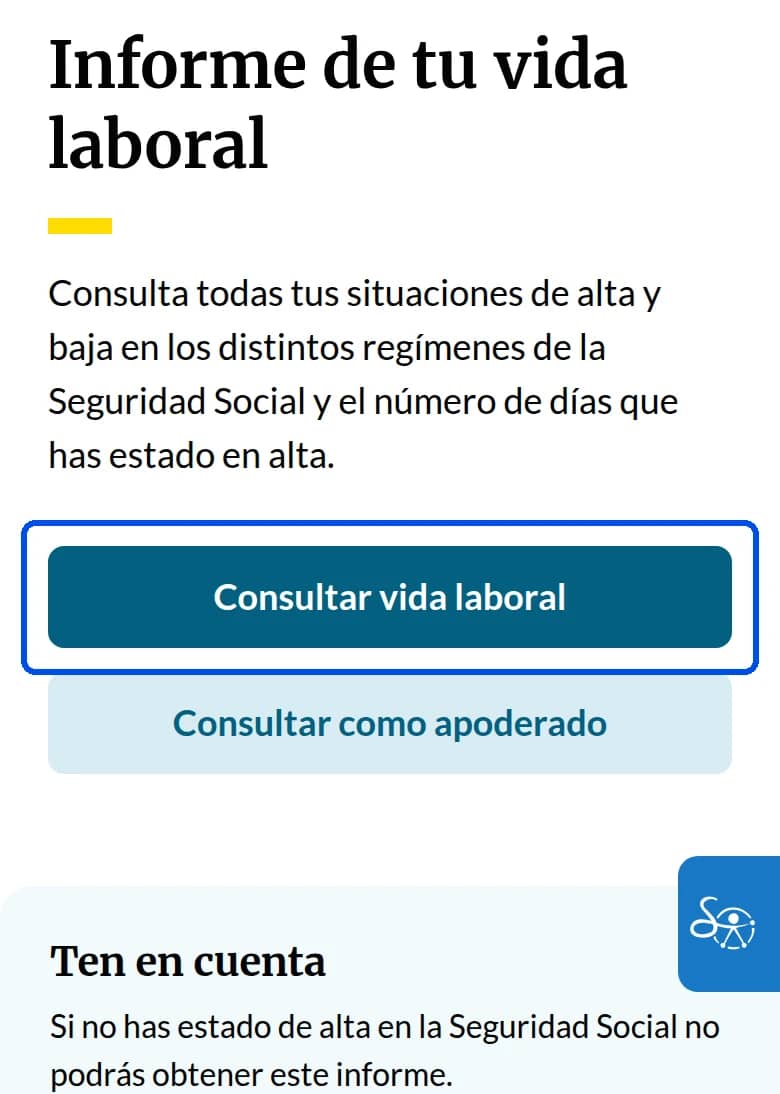
How do you check your Social Security record?
Download your 'vida laboral' from Import@ss.
It's your work history report.
Can you do it without Cl@ve or a digital certificate?
Often, yes.
Import@ss offers a route without Cl@ve or a certificate: you identify with a selfie.
You can also book an INSS appointment without one.
How do you get Social Security in Spain?
You register for Social Security when you start working, as an employee or as a self-employed worker.
Otherwise, you can be covered for healthcare through a family member, or with an S1 from another European country.
As an employee (employed worker)
Your employer registers you ('alta').
It also pays most of your contributions.
It deducts your share from your pay and pays both to Social Security.
Who registers you, and when?
Your employer does, before your first day.
It can't register you more than 60 days ahead.
If your employer doesn't do it, you can register yourself.
The TGSS then informs the Labor Inspectorate.
As a self-employed worker (autónomo)
As a self-employed worker, you register yourself with the TGSS, in the special regime for the self-employed.
You then pay your own contributions every month.
When do you register?
Before you start your activity.
You can do it online on Import@ss.
How do you choose your contribution base?
From the net income you expect.
When you register, you estimate your average monthly net income for the year.
That puts you in an income band, and you choose your base inside it.
Your base is provisional: it's checked once the year's tax data is in.
Can you get the €80 flat rate?
Yes, as a new autónomo, if you ask for it when you register.
Social Security's current guide gives €80 a month for your first 12 months, plus a 0.9% intergenerational contribution (MEI).
You can keep a reduced fee for 12 more months if your net income stays under the minimum wage.
You ask for it before the second year starts, with a statement of your expected income.
Who can't get it?
Anyone registered as an autónomo in the two years before.
If you've had the flat rate already, it's three years.
What is the yearly regularización?
Social Security checks your base against your real income.
The tax office sends the TGSS your income for the year, and the TGSS compares it with your base.
If you earned less than you planned, it refunds the difference.
If you earned more, you pay it.
If you hold an S1 (EU, EEA, Switzerland, UK)
The S1 form certifies your right to healthcare in an EU or EEA country, Switzerland or the UK.
Registering it in Spain gives you access to the public health system here.
How do you register your S1?
Online, with the INSS.
The required documents: your ID (passport, DNI, NIE or TIE) and the S1 your country issued.
You also need a Spanish address.
A Spanish phone number and an email make it faster.
Family members can go on the same request.

What happens next?
The decision is sent to your Spanish address.
If it's favorable, you receive a certificate with your Spanish Social Security number.
Take it to your health center, the one for your address, to register for healthcare.
If you don't work
You can still be covered for healthcare through a family member who is insured.
Can family members be covered?
Yes, as beneficiaries of a person with public healthcare.
That covers:
- a spouse or registered partner;
- descendants (children, grandchildren) under 26, or older with a disability of 65% or more.
They must live legally and effectively in Spain and have no compulsory cover of their own.
The insured person adds them online, on Tu Seguridad Social with Cl@ve or a certificate, or on the INSS portal without one.
What if nobody in your family works?
Our guide to healthcare in Spain covers the other routes to healthcare.
How much is Social Security in Spain in 2026?
Social security contributions in Spain are a percentage of your contribution base.
For an employee, it's your total monthly pay, in money or in kind.
Bonuses paid less often than monthly are spread over the year.
An autónomo chooses their base.
On a permanent contract, employees pay 6.5% of that base, up to a cap.
That 6.5% is the employee's rates in the table below, added together.
Self-employed workers pay about 31.5% of the base they choose.
How much do employees pay?
Your employer deducts your share from your pay and pays it to Social Security with its own.
How much does your employer pay?
About 30.65% of your base, plus a premium for work accidents that depends on the job.
That's the employer's 2026 rates above, added together.
Does a fixed-term contract change it?
Slightly.
Your unemployment contribution is 1.60% instead of 1.55%, so you pay 6.55% in all.
Your employer's goes from 5.50% to 6.70%.
Training, relief ('relevo'), substitution ('sustitución') and vacancy cover ('interinidad') contracts keep the permanent rate, and so do workers with a recognized disability of 33% or more.
Is there a cap?
Yes: a base of €5,101.20 a month.
Above it, you don't pay the normal rates.
A small solidarity contribution applies to the part of a salary above that cap: from 1.15% to 1.46%, mostly paid by the employer.
Is there a minimum base?
Yes, it depends on your professional group.
The lowest base is €1,424.40 a month for professional groups 4 to 7 (€47.48 a day for groups 8 to 11).
It's €1,435.20 for group 3, €1,649.70 for group 2 and €1,989.30 for group 1.
How much do autónomos pay?
About 31.5% of the base you choose.
That's five contributions added up:
- 28.30% for common contingencies;
- 1.30% for work accidents;
- 0.90% for the end of your activity;
- 0.10% for training;
- 0.90% for the MEI.
Your base depends on your expected net income a month.
Find your band and its lowest and highest base:
Social Security's simulator calculates your monthly fee.
What is the lowest monthly fee?
Without the flat rate, the lowest fee is about €206 a month: €653.59, the lowest base, × 31.5%.
It applies to net income up to €670 a month.
From €1,166.70 of net income a month, the lowest base is €950.98, so the lowest fee is about €300 a month (€950.98 × 31.5%).
Does the US have a Social Security agreement with Spain?
Yes: signed in 1986, in force since 1988.
Among other things, the agreement:
- keeps you from paying into both systems for the same work;
- lets your years in each country count toward benefits when you need them to.
Do you pay into both systems?
Usually not.
Which system you pay into depends on how you work.
If a US employer sends you to Spain
You stay under US Social Security only if your assignment isn't expected to last more than five years.
If it runs longer for reasons nobody planned, it can be extended by up to one year, with Spain's consent.
The extension must be requested before the five years end.
Workers exempted this way pay no Spanish social security taxes.
So they generally can't get Spanish benefits such as short-term sickness benefits, health insurance or unemployment benefits.
You and your employer may want to arrange other cover.
Who issues the certificate?
The US Social Security Administration (SSA), at your request or your employer's.
It's your proof that you're exempt in Spain.
If you're self-employed
You're covered where you live: in Spain if you live in Spain.
If you're normally self-employed in the US and move your business to Spain for five years or less, you stay in the US system.
The digital nomad route has a different rule, in Social Security's FAQ for international teleworkers.
A self-employed teleworker must register as an autónomo in Spain, and a bilateral agreement can't replace that.
Can US and Spanish work years be combined?
Yes, when you need them to qualify.
For a US benefit, you need at least 6 US credits (usually about a year and a half of work) to have your Spanish years counted.
For a Spanish benefit, you need at least one year of coverage in Spain to have your US years counted.
Can you collect US Social Security benefits in Spain?
Yes, as a US citizen, as long as you're eligible.
SSA pays US citizens abroad.
Spain isn't on SSA's list of countries where it restricts payments.
Frequently asked questions
Do you need private health insurance in Spain if you don't work?
It depends on your nationality and your residence route.
To get a non-lucrative residence permit, non-EU citizens need public or private health insurance with an insurer authorized to operate in Spain.
They also need enough money to live without working: 400% of the IPREM (Spain's reference income index) a month, and 100% for each family member.
EU and EEA citizens who live in Spain for more than three months without working need enough money to live on and health insurance that covers all risks in Spain.
For pensioners, a certificate showing that the country paying their pension covers their healthcare counts as that insurance.
Do your years in other EU countries count toward a Spanish pension?
Yes.
For a retirement pension in the general regime, Spain asks for at least 15 years of contributions.
Under EU rules, Spain counts your insurance, work or residence periods in other EU countries toward those 15 years, when you need them.
You apply to the pension authority of the country where you live or last worked, and it gathers your records from every country.
Each country then pays its own part of your pension, at its own retirement age.
If you worked less than a year in one country, those months aren't lost: the countries where you worked longer take them into account.
Do digital nomads pay Social Security in Spain?
Usually yes.
If you work from Spain as an international teleworker (the digital nomad route), registering with Spanish Social Security is compulsory.
As an employee, you can replace it only with cover from your home country.
That country needs a social security agreement with Spain, and its administration must issue a certificate saying it covers you in Spain.
As a self-employed teleworker, you must register as an autónomo: Social Security's FAQ for international teleworkers says a bilateral agreement can't replace that.
According to the US Social Security Administration (SSA), a self-employed American who moves their business to Spain for five years or less stays in the US system.
For Americans, the US–Spain agreement's certificate exempts workers sent to Spain by their employer.
Working remotely for a US company doesn't by itself get you that certificate.
Check your case with the US Social Security Administration.
Can foreigners get unemployment benefits in Spain?
Yes, if you live in Spain legally and meet the requirements, as long as you register as a job seeker.
For the contributory unemployment benefit ('prestación contributiva'), the requirements are:
- being registered with Social Security ('alta' or equivalent) in a scheme that covers unemployment;
- at least 360 days of unemployment contributions in the six years before;
- being unemployed in a way the law recognizes ('situación legal de desempleo');
- being available to work (you sign an activity agreement when you apply);
- not having reached the ordinary retirement age.
You apply to SEPE, Spain's public employment service.
Share this article