
What is AIMA's role in immigration?
AIMA is the Portuguese government body responsible for the legal residency of non-EU, EEA, and Swiss nationals, and for EU citizens once they pass five years of legal residence.
If you fall into that group, AIMA is the agency for integration, migration and asylum that controls whether, and how, you can stay in Portugal long-term.
The AIMA role in immigration is administrative, not police work. AIMA's responsibilities are issuing residence permits, deciding renewals, and processing family reunification so a legal resident can bring a spouse, children, or dependent parents.
The throughline: if you are not an EU, EEA, or Swiss citizen and intend to live in Portugal, you need a visa to enter, then a residence permit once you arrive, and your path runs through AIMA.
What services does AIMA provide?
The services AIMA provides fall into three areas: immigration administration, asylum and international protection, and migrant integration: the administrative work SEF used to do, plus the integration role from the old High Commission for Migration.
On the immigration side, AIMA handles residence permits and the renewal of residence titles. It also issues residence cards, extensions of stay, permanent residence certificates for EU citizens, residence cards for non-EU family members of EU citizens, and permits for UK nationals covered by the Brexit arrangements.
On the protection side, AIMA is the competent body for asylum applications and international protection. And on the integration side, it runs reception and inclusion programs, anti-discrimination work, and public services such as Portuguese-language resources and the migrant support centers we describe further below.
What does AIMA no longer do?
When SEF was dismantled its work split up, so you do not turn up at the wrong place.
Border control went to the GNR and PSP (land and sea to the GNR, airports to the PSP), immigration crime and trafficking to the Polícia Judiciária, and passport issuance to the IRN.
AIMA kept the administrative and asylum work, not the policing.
When was AIMA created, and what happened to SEF?
AIMA was created by Decree-Law 41/2023 and began operating on 29 October 2023, replacing SEF ('Serviço de Estrangeiros e Fronteiras'), which had combined border enforcement with immigration administration.
You will still see AIMA services described in old SEF terms, so treat the two as the same lineage.
What are the recent AIMA updates in 2026?
The latest AIMA news in 2026 is dominated by recent changes to the backlog, renewals, and how the NISS is issued.
But, the most important AIMA update is that the inherited backlog has been largely cleared.
At its mid-2025 milestone, AIMA's recovery task force ('Estrutura de Missão') reported more than 525,000 cases decided and around 458,000 residence cards issued, out of roughly one million inherited, with a small residual of complex files needing extra checks. That task force wound down at the end of 2025, so treat these as a dated snapshot rather than a live counter; a separate judicial task force has since been clearing a distinct backlog of court cases through 2026.
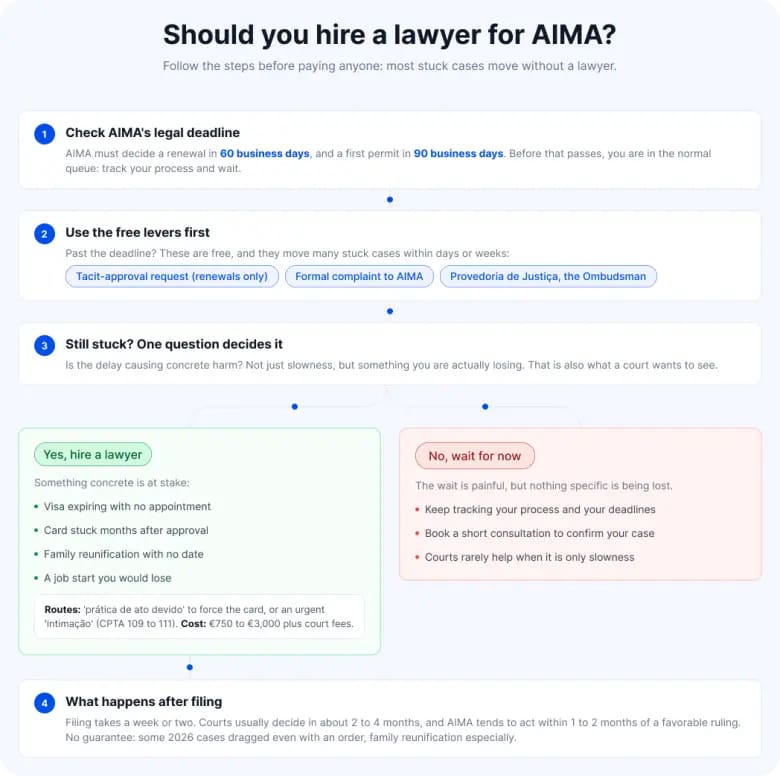
Read 'backlog cleared' precisely: it means the historical queue of 'manifestações de interesse' and legacy files, not that AIMA has no backlog. Legacy renewals and older cases can still be stuck, as the reports here show.
Golden Visa and ARI investment cases continue to be worked through during 2026. AIMA also stresses that having a pending application does not put you in an irregular situation.
Two cautions, so you plan realistically:
- First, some immigration lawyers dispute these figures, noting a decided case is not a card in hand and that physical delivery is still slow.
- Second, the two remaining pain points, getting an appointment and receiving the card, have not gone away. In August 2026 one applicant reported an AIMA appointment set for June 2027 while their D visa expires that November; another travelled from Lisbon to Espinho only to find AIMA had rescheduled without a notice they saw. The backlog may be cleared on AIMA's accounting, but that is not the backlog a migrant actually feels.
Other recent AIMA news, and official AIMA announcements worth knowing:
- Renewals. The Renewals Portal opens month by month; as of August 2026 it accepts titles expiring in November and December 2026. Residents whose permits only expire in November are already submitting in August, well before expiry, a clear shift from the old wait-until-expiry pattern. The open question is how fast an early submission becomes a physical card.
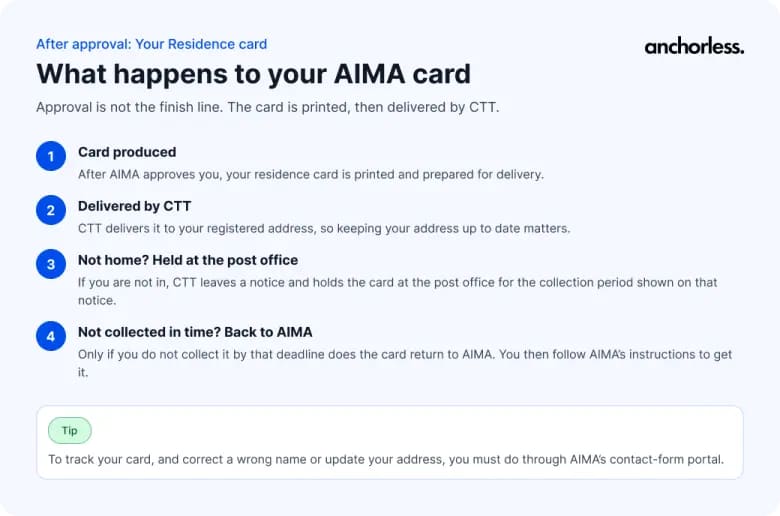
- Card tracking. AIMA launched a tool, still in testing, that lets you follow your process from submission to card delivery, with a tracking code for the card itself.
- Family reunification. Law 61/2025 tightened the rules from October 2025, and AIMA has been sending scheduling emails and promising contact within set deadlines. In practice it stays one of AIMA's least predictable areas: into August 2026, applicants still reported ordinary channels producing no appointment, and even court-backed cases taking months to turn into a date.
- NISS. Since late 2025 the NISS has been a practical requirement to move a residence file forward. From late July 2026, AIMA and Segurança Social added a direct digital link so that, when someone attends AIMA in the context of regularization, a NISS can be assigned in real time. This targets regularization cases, not every AIMA appointment, and it is still new: reports have not established how consistently it works, or whether it reaches renewals as well as first-time cases. For now, treat automatic NISS issuance as procedure-dependent, not a given at any AIMA appointment.