Can a foreigner or a non-resident buy a car in Spain?
Yes. Spain’s vehicle regulation provides for foreign owners, with or without a residence card. What Tráfico needs from the buyer is an identity and an address in Spain:
- Identity: a resident shows their residence card (the TIE); anyone else a passport, or an EU identity card, plus the NIE. The regulation itself names only the passport, but Tráfico’s procedure pages, its application form and its authorisation form all ask for the NIE.
- A Spanish address: the regulation accepts any document that proves one, “such as owning or renting a home, or being on a town’s register”. Tráfico’s transfer form, though, asks for your padrón address as the car’s address, and Tráfico checks it against the padrón records. A foreign address won’t do: no page, form or instruction of Tráfico accepts one.
For a holiday-home owner, that means the deed of your Spanish home or a lease, and often the padrón in practice. Owners on expat forums report provincial offices of Tráfico (the Jefaturas) that asked for the padrón and others that took the deed: before you sign, ask the Jefatura of your province, or the gestoría that files for you.
A car registered at your Spanish home doesn’t make you a Spanish tax resident: the tests are the days you spend in Spain (more than 183 a year) and where the centre of your economic interests lies (what makes you tax resident in Spain).
Why you need a NIE to buy a car in Spain
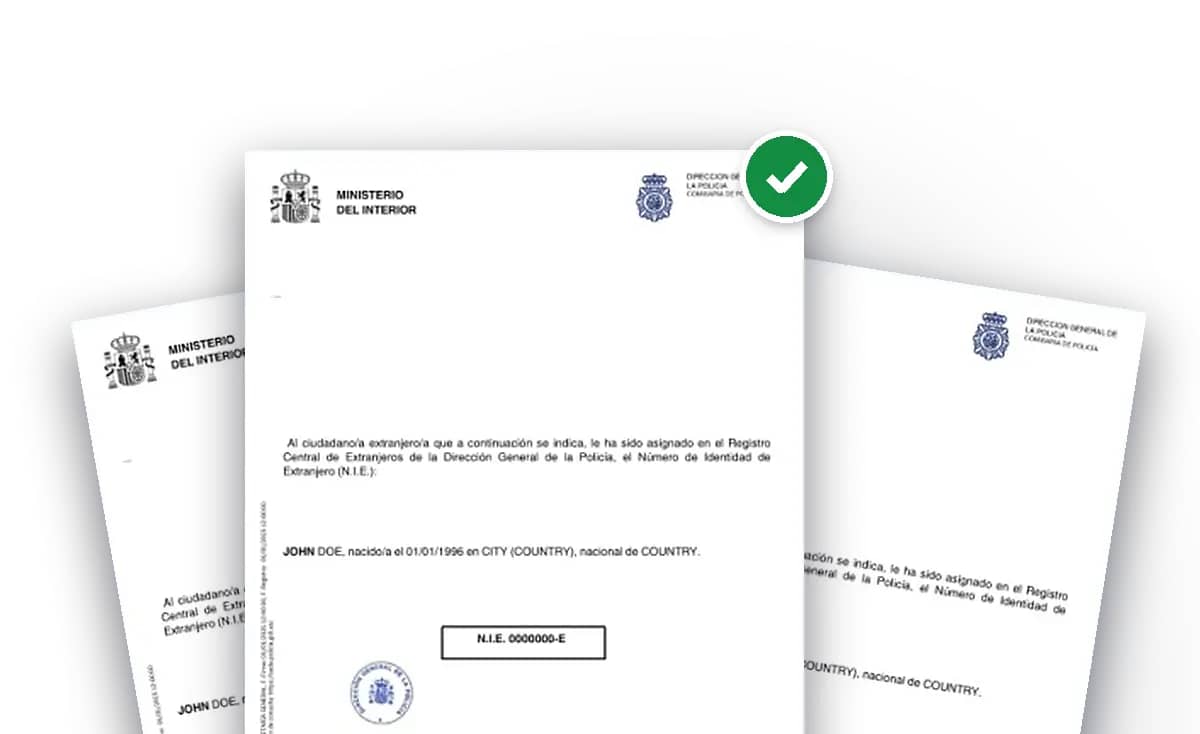
Your NIE (número de identidad de extranjero) comes up at every step of a car purchase:
- The contract: Tráfico’s model contract, and its list of what a contract must state, give each party’s DNI, NIE or CIF.
- The transfer tax: form 620 asks for the buyer’s tax number, and a foreigner’s tax number is the NIE.
- Tráfico: a foreign buyer shows a passport plus NIE, at the counter and online. Even to send someone in your place, Tráfico’s authorisation form asks for your NIE.
- A new or imported car: the registration tax forms (576 and 06) need a tax number and an entry in the tax agency’s census.
How to get one: in Spain, at a police station that handles foreigners, with form EX-15 and the fee of €9.84 (form 790, code 012); the regulation gives the police 5 days to decide. From abroad, at a Spanish consulate, where London and New York quote three and five weeks. Or let us get your NIE: you apply online in 5 minutes, and we book and attend the appointment for you, without you travelling.
How to buy a used car in Spain from a private seller, in 7 steps
From the NIE to the new registration certificate: what to do at each step, and who does it.
1
Get your NIE
The contract, the transfer tax and Tráfico all need it, and from abroad it is what takes longest: start it before you look at cars.
With us: from €199Apply online in 5 minutes
Get my NIE2
Check the car on Tráfico’s report
With the plate, ask Tráfico for the car’s report: the short one is free and shows a green signal when nothing blocks the transfer; the full one (€8.67) adds the ITV history, the mileage, the number of owners and any charges. Last year’s road tax unpaid, a finance company’s retention of title or an embargo can block the transfer.
Short report: freeFull report: €8.67
3
Sign the contract
Write down both parties’ names and DNI or NIE, the make, model, plate, chassis number and mileage, the price, and the date and hour of the sale, and both sign every page: Tráfico’s model contract has it all. Between private individuals, the seller answers for hidden defects for 6 months after delivery.
Hidden defects: 6 months
4
Pay the transfer tax
The buyer pays the transfer tax on the higher of the price and the car’s value in the tax agency’s tables. If you live abroad: form 620 to the State, at 4%, within 30 working days. If you live in Spain: your region’s form and rate (below).
Living abroad: 4%, form 62030 working days
5
Transfer the car at Tráfico
File the change of ownership (cambio de titularidad) with the tax form, your passport and NIE, and your Spanish address: online with a digital certificate, at a Jefatura with an appointment, or through someone you authorise on Tráfico’s free form, or a gestoría. In person, you leave with the new registration certificate; until you have it, the law says the car may not be driven.
Fee: €55.7030 days from the sale
File online: get my digital certificate6
Insure it before you drive
Every car on Spanish plates must be insured, driven or not. Without insurance, the fine is €601 to €3,005, and the car is impounded for a month.
No insurance: €601 to €3,005
7
Then, every year: road tax and ITV
The town hall of the car’s address collects the road tax (IVTM) each year from whoever owns it on 1 January. The roadworthiness test (ITV) is due every 2 years once the car is 4 years old, every year after 10. If your address changes, tell Tráfico within 15 days.
ITV: every 2 years after 4
Selling? Notify Tráfico within 10 days (€8.67), with the hour you handed over the car: until the buyer is registered or you have notified, fines from fixed cameras keep reaching you. Tráfico’s own page notes that a gestoría can handle the whole purchase, the taxes included, with you signing only the authorisations.
- Beforeyour NIE, and the car’s report
- Day 0the contract, signed and dated to the hour
- By day 10the seller notifies Tráfico of the sale
- Before day 30the transfer tax paid, then the transfer at Tráfico
- Every 1 Januarythe road tax falls on the owner
Transfer tax on a used car in Spain, region by region
Between private individuals, a used car carries the transfer tax (impuesto sobre transmisiones patrimoniales, ITP), paid by the buyer whatever the contract says. Its base is the higher of the price you pay and the car’s value in the tax agency’s 2026 tables: the new price of the model, reduced with age (84% after one year, 47% after four, 10% after twelve).
If you live abroad (you are not tax resident in Spain), you pay the State, not a region: 4%, on form 620, within 30 working days of the contract. You file it in person at the tax agency’s national office in Madrid, with an appointment, or post it through any tax office, in which case you get no stamped copy unless someone with your power of attorney goes to the Madrid office.
If you live in Spain, you pay your region:
| Region | Rate | Older or cheaper cars | Deadline |
|---|
| Andalusia | 4% (8% above 15 fiscal horsepower) | No special rule | 2 months |
| Valencia region | 6% (8% from €20,000, or up to 5 years old above 2,000 cc) | Worth under €20,000: €120 to €280 at 5 to 12 years, €40 to €140 over 12, by engine size | 1 month |
| Catalonia | 5% | No return to file at 10 years or more (unless historic, or €40,000 or more new) | 1 month |
| Madrid | 4% | No special rule | 30 working days |
| Balearic Islands | 4% (8% above 15 fiscal horsepower) | No special rule | 1 month |
| Canary Islands | 5.5% | Over 10 years, up to 2,000 cc: €40, €70 or €115 | 1 month |
| Murcia | 4% | Over 12 years: €0 to €75, by engine size | 30 working days |
An example: a car whose new price in the tables is €20,000, bought five to six years after its first registration, is valued at 39%, €7,800. Living abroad, you pay €312 (4%), unless the price you paid is higher. Living in the Valencia region, a fixed €120 to €280 by engine size; in Catalonia, €390 (5%); in the Canary Islands, €429 (5.5%).
A car bought from a dealer carries VAT instead (below), and an inherited car the inheritance tax.
Buying from a dealer, or a new car
From a dealer, there is no transfer tax: the price includes VAT at 21%. On a used car the dealer bought from a private owner, the VAT is often charged on the dealer’s margin only, and the invoice doesn’t show it. Tráfico takes the invoice instead of form 620. The dealer answers for faults that appear within 3 years of delivery, or at least 1 year if you agree a shorter period for a second-hand car. Buyers who live abroad pay the VAT like anyone else, whatever some pages say.
A new car is usually registered by the dealer (Tráfico’s fee is €99.77), with the same passport plus NIE and Spanish address. You also pay the registration tax (impuesto de matriculación), on the price before VAT, by the car’s official CO₂ emissions:
| CO₂ emissions | Rate |
|---|
| Up to 120 g/km, and electric cars | 0% |
| Over 120, under 160 g/km | 4.75% |
| 160, under 200 g/km | 9.75% |
| 200 g/km or more | 14.75% |
On the top band, the Balearic Islands, Catalonia and the Valencia region charge 16%, and Murcia 15.9%; the Canary Islands have their own, lower rates (0%, 3.75%, 8.75% and 13.75%). The form needs your tax number, so your NIE comes first here too, and the year’s road tax is paid to the town hall of your address before the car is registered.
How long can you drive a foreign-registered car in Spain?
If you live abroad, you can drive your own car in Spain on its plates:
- A car registered in another EU country is exempt from Spanish taxes for up to six months in any twelve, under EU law, if your normal residence is elsewhere (at least 185 days a year) and you don’t lend or hire it to someone who lives in Spain.
- A car from outside the EU (the UK, the US) comes in under customs temporary admission, for six months. Cars on UK plates brought in since 2021 count as non-EU.
The “183 days” you may read is the income-tax test, not a car rule. And the tourist plate (matrícula turística), which let non-residents drive a Spanish car tax-free six months a year, was abolished in 2018.
Once you live in Spain, the car must be registered there. The registration tax falls due if you haven’t asked for Spanish registration within 30 days of the car entering Spain, or 60 days when you claim the moving exemption below. If the authorities find the car, you get 5 days to register it or guarantee the tax before the car is immobilised, and the fine starts at 50% of the unpaid tax.
How to register a foreign car in Spain when you move
- Your NIE and your residence papers. The tax forms and Tráfico ask for the NIE; customs relief asks for your EU registration certificate or your TIE, or proof you applied.
- The ITV inspection. An ITV station checks the car with its foreign registration certificate and its Certificate of Conformity (CoC), and issues the Spanish technical card. No CoC? A “reduced sheet” signed by an engineer. A car from outside the EU without European approval needs an individual approval first, with dipped headlights adapted to driving on the right.
- The registration tax, or the moving exemption. Form 576 at the rates above, on the car’s value in the tax agency’s tables. Moving to Spain? Form 06 exempts the car if you lived abroad for the 12 months before, bought it with that country’s normal taxes, used it there for at least 6 months, and don’t sell it for 12 months. You need a consular certificate of residence abroad, and you lose the exemption if you file after the 60 days.
- From the UK or the US: customs first. A car brought from outside the EU pays import duty and 21% import VAT, unless you claim the relief for a transfer of residence on the customs declaration (H1) within 12 months of moving, with the same 12 months abroad and 6 months of use. Since 1 July 2026, cars made in the US pay no EU duty, until the end of 2029 unless the EU suspends it; the import VAT remains.
- Road tax, Tráfico, plates. Pay the year’s road tax to your town hall, then register the car at Tráfico (€99.77) with your passport and NIE or your residence card, the ITV card, the foreign papers and the tax form. Buy the plates and insure the car. Green temporary plates (€20.61, 60 days, renewable) let you drive it meanwhile.
Tráfico’s page also asks you to deregister the car for export in its home country before you move it: check what that country’s authority needs.
An inherited car in Spain
Whoever keeps the car after the owner’s death tells Tráfico within 90 days of the death (€8.67) and gets a provisional permit. The heir who receives the car then transfers it within 90 days of the document that allocates it, with proof of the inheritance tax, a passport and NIE, and the transfer fee of €55.70. Several heirs agree in writing which one will be the registered owner. Heirs who live abroad file the inheritance tax with the State’s tax agency: see inheritance tax in Spain for non-residents.
Owning a Spanish car while you live abroad
- Insurance, all year: every car on Spanish plates must be insured, even parked for months. Insurers may not set your premium by your nationality, nor only by the EU country you lived in before.
- Fines: Tráfico writes to the address on the registration. Living abroad, sign up for its electronic road address (Dirección Electrónica Vial) to read your notices online wherever you are; it needs a digital certificate, and a notice left unopened 10 days counts as rejected.
- Road tax and ITV run while the car is registered: the road tax every year, and the ITV must be valid for the car to be driven.
- Ibiza and Formentera limit the cars that may enter or stay on the island for part of the year. A non-resident who owns a home there is exempt for one car per owner (in Ibiza, if the car’s tax address is that home). Mallorca has no such law: its island council approved a bill on 5 June 2026 and sent it to the Balearic Parliament.
- Your licence: an EU licence stays valid in Spain. One from outside the EU is valid for six months after you become resident, or after you enter Spain as a visitor; then exchange it, if Spain has an agreement with the issuing country, or pass the Spanish tests. Residents exchange a UK licence without a test since the 2023 agreement; a US licence can’t be exchanged.
Buying a home too? See buying a house in Spain as a foreigner. In Portugal instead? See how to buy a car in Portugal.












 MOVING IN EUROPE