What is Modelo 210, and who must file it?
Modelo 210 is the return of Spain’s non-residents’ income tax, the impuesto sobre la renta de no residentes (IRNR). It is for people who are not tax residents of Spain and have income there, without a business: for most readers, a home. There is no single yearly return for everything, as residents have: one Modelo 210 per owner, per home and per kind of income, and a loss on one never reduces another.
| Your Spanish home | What is taxed | Filed |
|---|
| You use it, lend it or leave it empty | A notional income: 1.1% or 2% of the cadastral value | Once a year |
| You rent it out | The rent, minus expenses if you live in the EU or the EEA | Once a year |
| You sell it | The gain, at 19% | After the sale |
- Owning with your spouse or partner? Each of you files for your own share: two owners, two returns. A married couple who both live abroad may file one return together only for a sale.
- Two homes? A return for each.
- Rented out part of the year? The rent for the days it was let, and the notional income for the other days.
Moved to Spain? Once you are a tax resident, Modelo 210 stops: the home goes on your Spanish income tax return, the Renta. See when you become a Spanish tax resident.
How much is Modelo 210 on a home you don’t rent out?
Spain taxes a home that brings you no rent as if it did, on a renta imputada, a notional income. For 2025:
- 1.1% of the cadastral value if your town’s cadastral values were revised in 2012 or later;
- 2% if they were last revised before;
- with no cadastral value, 1.1% of 50% of what you paid for it.
Then times your share of the home and the days of the year you owned it, and taxed at 19% if you live in the EU or the EEA, 24% elsewhere. No expenses are deducted. The cadastral value is on the town hall’s IBI receipt, the local property tax, and is usually far below what the home would sell for; the Catastro tells you the year your town’s values were last revised.
Three worked examples, for 2025
The euro amounts are cadastral values.
| Owner | Notional income | Tax |
|---|
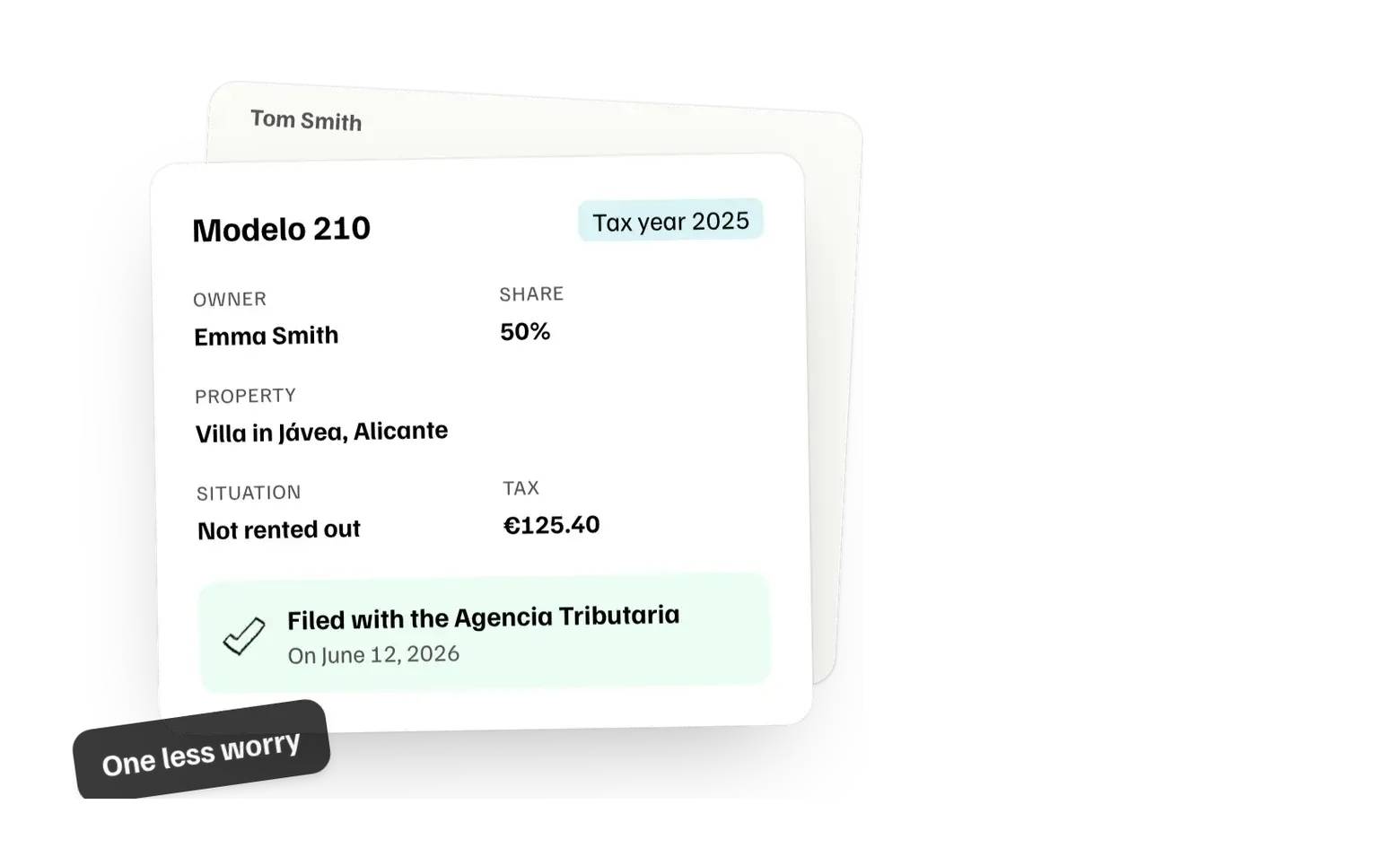
| A couple in Germany, half each: a flat in Torrevieja, €120,000, values revised in 2019 (1.1%) | €660 each | €125.40 each |
| A retiree in the UK, sole owner: a villa near Marbella, €150,000, values revised in 2008 (2%) | €3,000 | €720 |
| The couple, had they bought on 1 July 2025 (184 days) | €332.71 each | €63.21 each |
For your own figures, CasitaTax’s simulator works it out for each owner, free, in your browser.
2026 and 2027: what may change
The 2012 cut-off is renewed one year at a time. For 2026 it comes from a decree-law of October 2026 that Congress had not yet voted on 30 October; without it, only values revised in the 10 years before get 1.1%. The same decree-law would replace both rates from 2027 with a scale from 1.1% to 3% of the cadastral value. We will update this guide when Congress votes and the tax agency says how the scale applies to non-residents.
Modelo 210 when you rent out your Spanish home
Rent from a Spanish home is taxed in Spain, wherever you live. Where you live decides how:
- In the EU, Iceland, Norway or Liechtenstein: 19% on the rent minus the expenses of the days it was let: interest on a loan for the home and repairs (together up to the rent), the IBI and other local taxes and fees, services you pay others (an agency, cleaning), and the building’s wear, up to 3% a year of what it cost, the land left out.
- Anywhere else, the UK, the US and Switzerland included: 24% on the gross rent, with no expenses at all.
The reduction Spanish residents get on long-term lets never applies to non-residents. Example: you let your flat for 8 weeks in summer for €6,000, with €1,500 of expenses for those weeks. Living in the Netherlands, you pay €855; living in the UK, €1,440. For the other 309 days, the notional income is due as well: €212.32 for a sole owner of the Torrevieja flat above.
Since June 2026 the rent is declared once a year, from 1 to 20 April of the following year: see the deadlines. Let it for 30 nights or less? Short lets have rules of their own (a registration number, and VAT from December 2026 if Congress confirms an October decree): our Spain tax calendar tracks them.
Selling your Spanish home as a non-resident
When you sell, the buyer keeps 3% of the price and pays it to the tax agency within a month, with Modelo 211, as an advance on your tax. You then file a Modelo 210 on your gain, taxed at 19% wherever you live, and deduct the 3%: if it is more than your tax, the tax agency refunds the difference, to an account in Spain or abroad.
- Your gain is the sale price minus your selling costs, minus what you paid, your improvements and your purchase costs and taxes (not the mortgage interest). There is no adjustment for inflation any more.
- The deadline: the three months after the buyer’s month. Sold on 15 March? You file between 16 April and 15 July.
- A loss? File all the same: it is the only way to get the 3% back.
- Bought between 12 May and 31 December 2012? Half of the gain is exempt.
- The town hall charges its own tax on the land’s gain, the plusvalía municipal, apart from Modelo 210.
Selling a home you inherited? The gain is counted from the value declared for the inheritance tax in Spain. And if you are on the other side, our guide to buying a house in Spain covers the buyer’s 3%.
How to file Modelo 210 yourself, in 6 steps
Filing is free on the tax agency’s website. From the documents to the receipt:
1
Have a Spanish tax number
Filing online needs your NIE, the foreigner’s number you most likely got to buy the home. On the printable form, an owner without one can ask for a non-resident code instead, and keeps it for the next years.
NIE with us: from €199
Get my NIE2
Find the cadastral value
It is on the IBI receipt, for the whole home, and in the Catastro’s online office, which also gives the year your town’s values were last revised.
IBI receiptCatastro
3
Work out your tax
Cadastral value × 1.1% or 2% × your share × the days you owned it, at the rate of the country where you live. Rented out? The rent, and, in the EU or the EEA, the expenses of those days.
Try the free simulator4
Fill in the form
On the tax agency’s Modelo 210 page. With a digital certificate or Cl@ve, you file and pay online. Without, you fill in the same form online and print it: there is no blank PDF to fill in by hand.
Help pages in English
Get my digital certificate5
Pay the tax
Online: by direct debit from an account in the SEPA area, the UK and Switzerland included (not for a sale), or by card. On paper: at a Spanish bank, or by a transfer in euros from a bank abroad, with the payment code the form gives you, valid 30 days.
Direct debit: by 23 DecemberTransfer: the return counts when the money arrives
6
Keep the proof
Keep the return and the payment receipt, for each owner and each year: the tax agency has 4 years from each deadline to check them.
4 years
Box by box, CasitaTax’s guide to the form in English shows what goes where. Whichever way you file, it is the same return and the same tax: what you pay CasitaTax is the service of preparing and filing it for you.
Modelo 210 deadlines: what changed in June 2026
An order of June 2026 (Orden HAC/623/2026) moved the windows. Rent with tax to pay used to be declared every quarter, and the notional income from 1 January. Most pages, and some of the tax agency’s own, still say so.
| What | Income of 2025 | Income of 2026 |
|---|
| A home you don’t rent out | By 31 December 2026 | 1 April to 31 December 2027 |
| Rent, with tax to pay | Each quarter, as before | Rent from October on, or the whole year grouped: 1 to 20 April 2027 |
| Rent, with no tax to pay | 1 to 20 January 2026 | 1 to 20 January 2027 |
| A refund | From 1 February of the following year, within 4 years |
| A sale | The three months after the buyer’s month |
Paying by direct debit? It closes earlier: on 23 December for a home you don’t rent out, on 15 April for rent. Rent of April to September 2026 declared on its own keeps the July and October windows. From 1 January 2027, every return is filed on a new version of the form, which asks for your days and your share. Our Spain tax calendar lists every date and puts them in your phone’s calendar, with a reminder.
Missed a year? Filing Modelo 210 late
Many owners learn about Modelo 210 years after they bought. File late of your own accord, before the tax agency writes to you, and you pay a surcharge, not a fine:
- 1% of the tax, plus 1% for each full month late, for the first year;
- 15% after 12 months, plus late-payment interest from then on;
- a quarter less if you pay the whole amount when you file.
On the €125.40 of the first example, a year late costs €18.81 more. Wait for the tax agency to find it, and the fine starts at 50% of the tax. A late return with nothing to pay costs a fixed €100 (€200 after a letter). The tax agency can claim a year for 4 years after its deadline: catch up the years still open, the oldest first. CasitaTax files past years too.
Filing Modelo 210 from abroad: what owners ask
Is Modelo 210 in English?
The tax agency’s Modelo 210 pages and their help are in English. The law and the detailed instructions, box by box, are in Spanish: CasitaTax’s guide to the form in English explains each box.
Do I need a digital certificate?
Only to file and pay online: a Spanish digital certificate or Cl@ve. Without one, you print the completed form and pay at a Spanish bank or by transfer from abroad, or have someone file it for you. We get your digital certificate once you have your NIE.
Do I need a tax representative in Spain?
Usually not. If you live in the EU, never; elsewhere, only when the tax agency asks you to name one, because of your income or your property in Spain, or if you live in a country that does not exchange tax information with Spain. Not naming one when you must costs €2,000. Anyone else can file for you with your authorisation, registered with the tax agency.
Will I be taxed twice?
Spain taxes income from a home in Spain. Whether your own country taxes it too, and gives credit for the Spanish tax, depends on its rules and its tax treaty with Spain: many countries don’t tax a notional income at all. Keep your Modelo 210 receipts, and ask your tax office or adviser at home.
File it yourself or with CasitaTax?
| Yourself | CasitaTax |
|---|
| Price | Free | €122 a year, €374 with rent, €299 for a sale |
| Co-owners | Each files their own | 2 included, €54 per extra owner |
| Language | Instructions in Spanish | 9 languages |
| Reminder | Our tax calendar | Every year |
CasitaTax is our sister service, in the same group as AnchorLess, made for owners who live abroad. It works out the tax for each owner, sends you the figures to approve before anything is filed, files the returns with the tax agency, and sends you each filed return and payment receipt. The tax itself is paid to the tax agency, apart from its price, VAT included. It is a private service, not the tax agency. A local gestor, a Spanish tax agent, can file it too.













 MOVING IN EUROPE