What documents are needed for EX18?
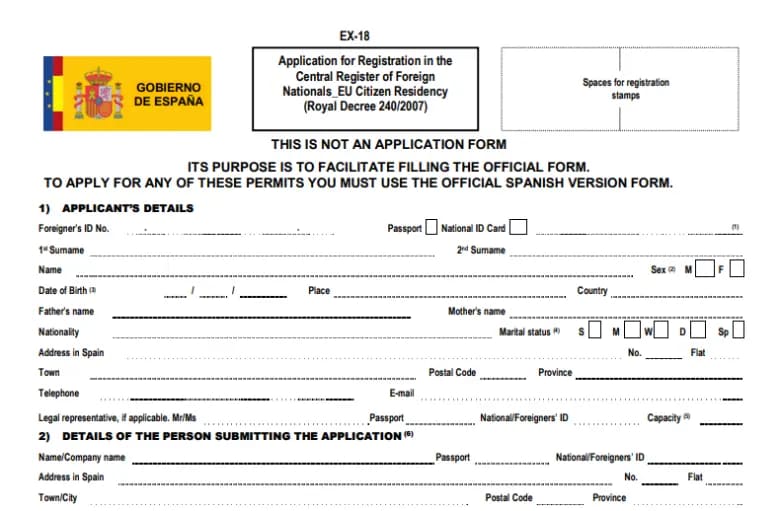
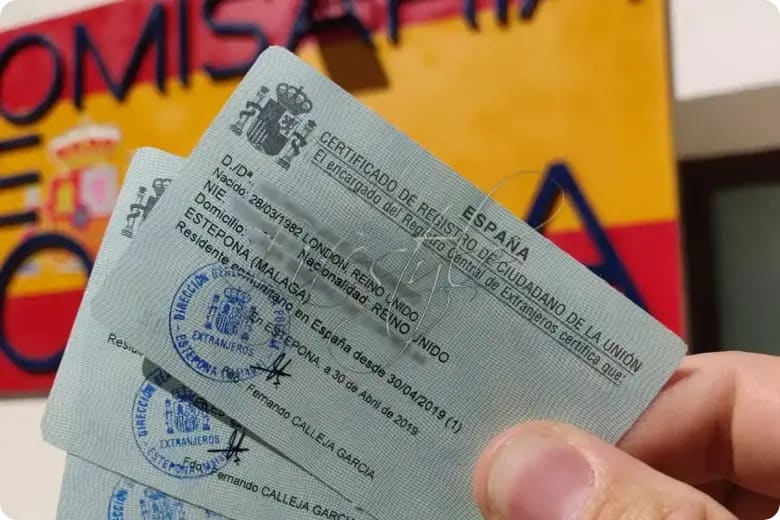
The documents needed for the EX18 application are the completed form, a valid passport or national identity card, proof of payment of the Modelo 790 Código 012 fee, and evidence that you fall into one of the situations in article 7 of Real Decreto 240/2007.
That last item changes from person to person, and it is where most files come apart.
What every applicant brings
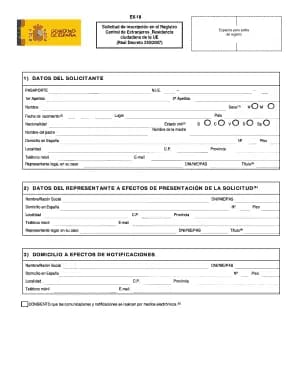
The EX-18 itself, completed and signed. The printed instruction says original and copy ('SE PRESENTARÁ ORIGINAL Y COPIA DE ESTE IMPRESO'), and Barcelona's international welcome desk describes it as the form in duplicate. Bring two, signed identically.
A valid passport or national identity card, original plus photocopy. Expired? Bring a copy with a copy of the renewal application.
The stamped proof of payment of the Modelo 790 Código 012, plus your profile evidence, below.
Evidence for your article 7 situation
This is the part that changes per person. You prove one of four situations in article 7, and you only need the one that matches you.
Employed workers (trabajador por cuenta ajena)
An employed worker proves the situation with a hiring declaration from the employer or an employment certificate carrying the company name and address, its tax identification and the código cuenta de cotización.
A registered work contract or the Social Security 'alta' document also works.
Orden PRE/1490/2012 hides a shortcut almost nobody mentions: consent to the office checking your details directly in the Social Security (TGSS) files and you skip the document entirely.
Self-employed workers (trabajador por cuenta propia)
A self-employed applicant proves the situation with registration in the 'Censo de Actividades Económicas', an entry in the Registro Mercantil, or the Social Security alta under the corresponding regime.
The same consent shortcut applies, and the realistic sequence is alta with Hacienda through Modelo 036 or 037, alta in RETA, then the EX-18.
Non-working residents with sufficient means
Someone who does not work in Spain proves two things at once: health insurance and sufficient resources.
Missing either is fatal, and this is the profile refused most often. It covers retirees, financially independent applicants and the accompanying spouse.
How much money counts as sufficient resources in 2026?
The law publishes no fixed table.
Orden PRE/1490/2012 says resources are deemed sufficient when they exceed the annual amount set for entitlement to a non-contributory benefit, assessed against your personal and family situation.
For 2026 that reference figure is 8.803,20 euros a year, the non-contributory retirement and disability pension amount after this year's revaluation.
Treat it as a floor for a single applicant rather than a guarantee, since the Orden requires individual assessment and offices expect more when a spouse or children rely on the same income.
Proof takes almost any form admitted in law: property deeds, certified checks, investment income documentation, bank statements, or a credit card with a bank certificate.
What health insurance is accepted
The cover has to be equivalent to what the Spanish national health system provides, public or private, taken out in Spain or abroad.
Pensioners meet this condition automatically if they certify entitlement to healthcare charged to the state paying their pension, which is what the S1 does.
Two warnings, repeated by applicants and by the offices themselves. Travel insurance is not health insurance here. And policies with copayments are commonly rejected, since a copayment breaks equivalence with the public system.
Students
Students prove enrollment at a recognized or publicly funded institution, health insurance, and sign a declaración responsable stating they have sufficient resources.
A signed declaration instead of a bank balance makes this the lightest route of the four.
The European Health Insurance Card counts as the insurance if it covers the whole period of residence, and an EU educational exchange program is treated as proof of the whole set.
Do you need an empadronamiento certificate?
No, not as a matter of national law.
The empadronamiento certificate is absent from the official documentation list, yet many provincial offices ask for it anyway, so bring one.
This is where the aggregator guides go wrong, presenting the padrón certificate as a hard requirement. The National Police e-office lists four items: the EX-18, the 790-012 receipt, the passport or national ID, and the article 7 evidence. The padrón is not among them.
What is true is that offices want the address on your form to match a state record. The 'Subdelegación del Gobierno' in Valencia states publicly that the family padrón certificate is not preceptive, since the office verifies it internally, and still recommends presenting it to avoid a requerimiento. Barcelona's international welcome service says padrón evidence is generally not required, becoming necessary only when your address has changed since a previous procedure.
Get empadronado anyway. You need it for healthcare, schools and a bank account regardless.
Profile to tick box, at a glance
| Profile |
Section 4 box to tick |
| Employed |
Trabajador por cuenta ajena |
| Self-employed |
Trabajador por cuenta propia |
| Not working |
No activo con recursos suficientes y seguro de enfermedad |
| Student |
Estudiante con recursos suficientes y seguro de enfermedad |
| EU family member of an EU citizen |
Nacional UE/EEE/Suiza, familiar de otro nacional |
| Five years in Spain |
Residencia permanente, residencia continuada durante 5 años |
One rule in the footnotes of the form saves people trips: you are not obliged to provide documents produced by any Spanish administration, or documents you already submitted in an earlier procedure.